Question
Explain Lorentz force and state its characteristics.

Answer

Suppose a point charge $q$ moving with a velocity $\vec{v}$ in presence of the electric field $\overrightarrow{ E }(\vec{r})$ and the magnetic field $\overrightarrow{ B }(\vec{r})$.
Force on charge $q$ due to the electric and magnetic field.
$\begin{aligned}
\overrightarrow{ F } & =q[\overrightarrow{ E }(r)+(\vec{v} \times \overrightarrow{ B }(\vec{r}))] \\
\therefore \quad \overrightarrow{ F } & =q \overrightarrow{ E }(\vec{r})+q \times \times \overrightarrow{ B })
\end{aligned}$
[Here $\overrightarrow{ B }(r)=\overrightarrow{ B }$ ]
Electric force $\overrightarrow{ F }_{\text {electric }}=q \cdot \overrightarrow{ E }(\vec{r})$
Magnetic force $\overrightarrow{ F }$. magnetic $=q(\overrightarrow{ v } \times \overrightarrow{ B })$
$\therefore \overrightarrow{ F }=\overrightarrow{ F }_{\text {electric }}+\overrightarrow{ F }_{\text {magnetic }}$
The combination of electric and magnetic force here is known as Lorentz force.
• Characteristics :
(1) The Lorentz force depends on charge ( $q$ ), velocity ( $\vec{v}$ ) and the magnetic field $(\vec{B})$. Force on negative charge is opposite to that on a positive charge.
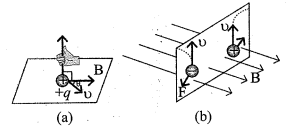
(2) The direction of magnetic force $\vec{F}_m=q(\vec{v} \times$ $\vec{B}$ ) can be found using right hand screw rule.
Image
(3) If velocity $\vec{v}$ and the magnetic field $\vec{B}$ are parallel $(\theta=0)$ anti parallel $\left(\theta=180^{\circ}, \pi\right)$ to each other, the force becomes zero.
The magnetic force is maximum when the velocity $\vec{v}$ and the magnetic field $\vec{B}$ are perpendicular to each other.
(4) If charge is not moving i.e. the charge is stationary. then $\vec{v}=0$ hence the magnetic force is zero.

Need a full question paper?

Generate a complete, print-ready paper with questions like this in minutes — across 16+ boards, with answer keys.
Start Generating Free

Similar questions

Explain what would happen if in the capacitor given in Exercise 2.8, a 3 mm thick mica sheet (of dielectric constant = 6) were inserted between the plates,
  1. While the voltage supply remained connected.
  2. After the supply was disconnected.
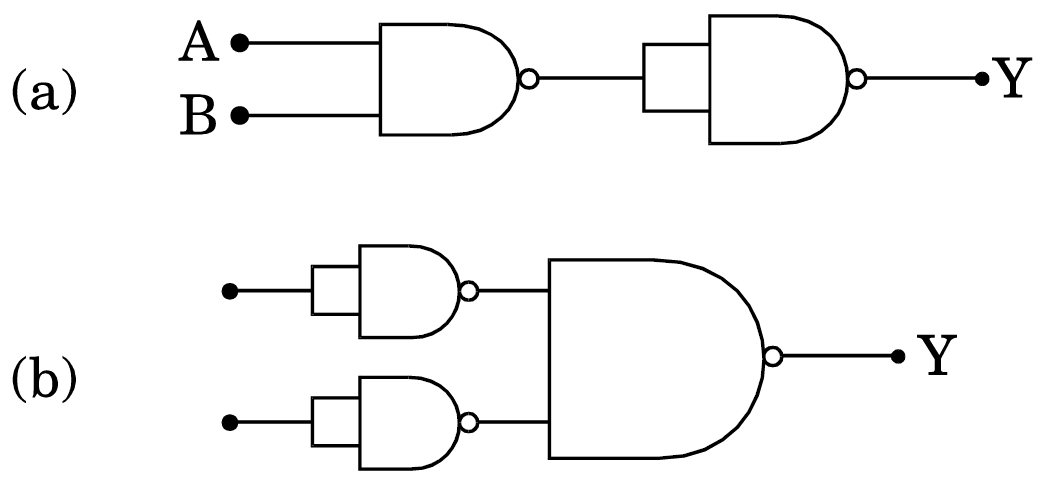
You are given two circuits (a) and (b) as shown in the figures, which consist of NAND gates. Identify the logic operation carried out by the two. Write the truth tables for each. Identify the gates equivalent to the two circuits.
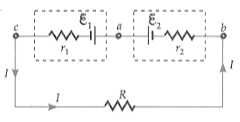
In Figure, $\varepsilon_1$ and $\varepsilon_2$ are respectively 2.0 V and 4.0 V and the resistances $r _1, r _2$ and R are respectively $1.0 \Omega$ $2.0 \Omega$ and $5.0 \Omega$. Calculate the current in the circuit. Also, calculate:
i. potential difference between the points b and a,
ii. potential difference between a and c.
Image
State the law of radioactive decay.
Plot a graph showing the number (N) of undecayed nuclei as a function of time (t) for a given radioactive sample having half life $T_½.$
Depict in the plot the number of undecayed nuclei at (i) $t = 3 T_½$ and (ii) $t = 5 T_½.$
In a photodiode, the conductivity increases when the material is exposed to light. It is found that the conductivity changes only if the wavelength is less than 620nm. What is the band gap?

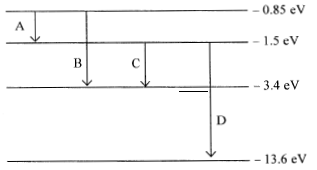
The energy level diagram of an element is given below. Identify, by doing necessary calculations, which transition corresponds to the emission of a spectral line of wavelength 102.7 nm.
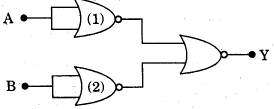
The inputs A and B are inverted by using two NOT gates and their outputs are fed to the NOR gate as shown below.

Analyse the action of the gates (1) and (2) and identify the logic gate of the complete circuit so obtained. Give its symbol and the truth table.
An inductor 200 mH, capacitor 500 µF, resistor 10Ω are connected in series with a100 V, variable frequency a.c. source. Calculate the
  1. Frequency at which the power factor of the circuit is unity.
  2. Current amplitude at this frequency.
  3. Q-factor.
When a photon is emitted from an atom, the atom recoils. The kinetic energy of recoil and the energy of the photon come from the difference in energies between the states involved in the transition. Suppose, a hydrogen atom changes its state from n = 3 to n = 2. Calculate the fractional change in the wavelength of light emitted, due to the recoil.
The electrostatic force on a small sphere of charge 0.4 μC due to another small sphere of charge –0.8 μC in air is 0.2 N.
  1. What is the distance between the two spheres?
  2. What is the force on the second sphere due to the first?