Question
A charged metallic sphere A is suspended by a nylon thread. Another charged metallic sphere B held by an insulating
Image
handle is brought close to A such that the distance between their centres is 10 cm, as shown in Fig. 1.4(a). The resulting repulsion of A is noted (for example, by shining a beam of light and measuring the deflection of its shadow on a screen). Spheres A and B are touched by uncharged spheres C and D respectively, as shown in Fig. 1.4(b). C and D are then removed and B is brought closer to A to a distance of 5.0 cm between their centres, as shown in Fig. 1.4(c). What is the expected repulsion of A on the basis of Coulomb’s law? Spheres A and C and spheres B and D have identical sizes. Ignore the sizes of A and B in comparison to the separation between their centres.

Answer

Let the original charge on sphere A be $q$ and that on B be $q^{\prime}$. At a distance $r$ between their centres, the magnitude of the electrostatic force on each is given by
$
F=\frac{1}{4 \pi \varepsilon_0} \frac{q q^{\prime}}{r^2}
$
neglecting the sizes of spheres A and B in comparison to $r$. When an identical but uncharged sphere $C$ touches $A$, the charges redistribute on A and $C$ and, by symmetry, each sphere carries a charge q/2. Similarly, after D touches B, the redistributed charge on each is $q^{\prime} / 2$. Now, if the separation between A and B is halved, the magnitude of the electrostatic force on each is
$
F^{\prime}=\frac{1}{4 \pi \varepsilon_0} \frac{(q / 2)\left(q^{\prime} / 2\right)}{(r / 2)^2}=\frac{1}{4 \pi \varepsilon_0} \frac{\left(q q^{\prime}\right)}{r^2}=F
$
Thus the electrostatic force on A, due to B, remains unaltered.

Need a full question paper?

Generate a complete, print-ready paper with questions like this in minutes — across 16+ boards, with answer keys.

Start Generating Free

Similar questions

A 3cm tall object is placed at a distance of 7.5cm from a convex mirror of focal length 6cm. Find the location, size and nature of the image.
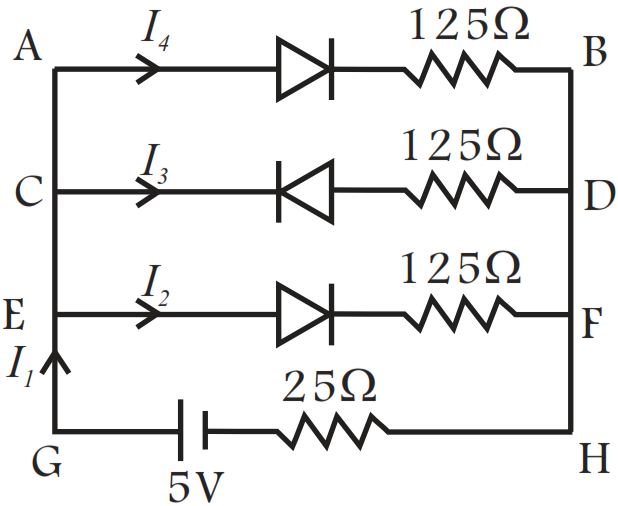
If each diode in Fig. has a forward bias resistance of 25Ω and infinite resistance in reverse bias, what will be the values of the current I1, I2, I3 and I4?

Define half-life of a radioactive sample. Which of the following radiations: $\alpha-$rays, $\beta-$rays and $\gamma-$rays.
  1. Are similar to X-rays.
  2. Are easily absorbed by matter.
  3. Travel with the greatest speed.
  4. Are similar in nature to cathode rays?
Suppose A and B in the previous problem change their positions in such a way that the line joining them becomes perpendicular to the direction of wind while maintaining the separation x. What will be the time lag B finds between seeing and hearing the drum beating by A?
A heating element using nichrome connected to a 230 V supply draws an initial current of 3.2 A which settles after a few seconds to a steady value of 2.8 A. What is the steady temperature of the heating element if the room temperature is 27${ }^{\circ} C$ ? Temperature coefficient of resistance of nichrome averaged over the temperature range involved is $1.70 \times 10^{-4}{ }^{\circ} C ^{-1}$.
Calculate the number of states per cubic metre of sodium in 3s band. The density of sodium is 1013kg/ m3. How many of them are empty?
Three circuits, each consisting of a switch ‘S’ and two capacitors, are initially charged, as shown in the figure. After the switch has been closed, in which circuit will the charge on the left-hand capacitor (i) increase, (ii) decrease and (iii) remain same? Give reasons.

A free atom of iron emits $\text{K}_\alpha$ X-rays of energy 6.4keV. Calculate the recoil kinetic energy of the atom. Mass of an iron atom = 9.3 × 10⁻²⁶kg.
Define ionisation energy.
When in a hydrogen atom an electron is replaced by such a particle whose mass is 200 times the mass of the electron and its charge is the same as that of electron, then how will its ionisation energy be changed ?
The numerical value of ionization energy in eV equals the ionization potential in volts. Does the equality hold if these quantities are measured in some other units?