Question 13 Marks
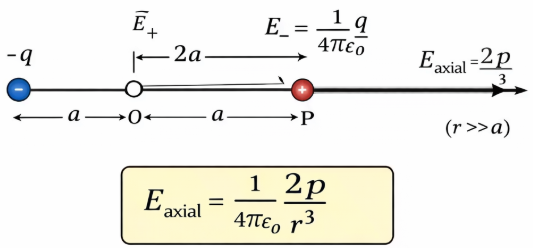
- Drive the expression for electric field at a point on the equatorial line of an electric dipole.
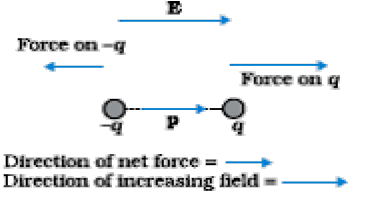
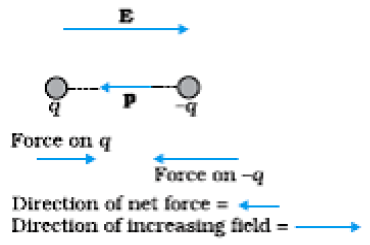
- Depict the orientation of the dipole in (i) stable, (ii) unstable equilibrium in a uniform electric field.
50 questions · timed · auto-graded
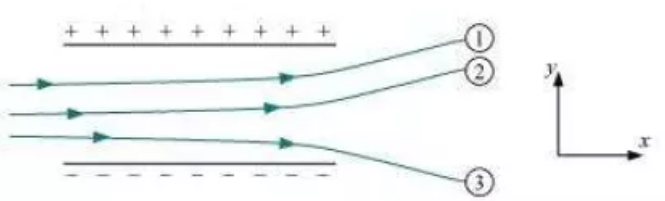
and for both plate E $=\frac{\sigma}{2\in_0}+\frac{\sigma}{2\in_0}$
$\text{E}=\frac{\sigma}{\in_0}=\sigma\times4\pi\times9\times10^9$
E = 17.0 × 10-22 × 4 × 3.14 × 9 × 109
E = 1921.7 × 10-13
= 1.92 × 10⁻¹⁰ N/C.
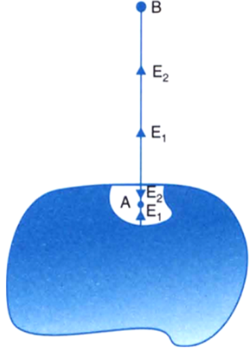
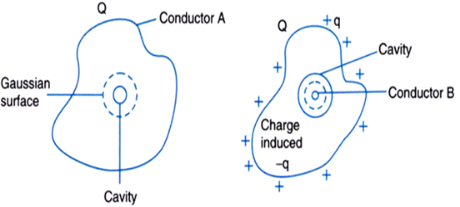
$\phi_\text{E}=\int\text{E.ds}=\frac{\text{total charge}}{\in_0}$
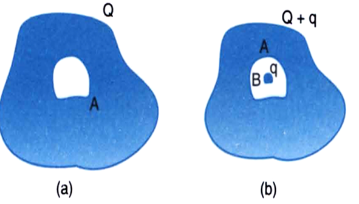
As the electric field inside the conductor is zero, the total charge which is enclosed by the gaussian surface must be zero. This requires, a charge of -q units to be induced on the inner surface of the hollow conductor A. But an equal and opposite charge +q units must appear on the outer surface of conductor A, so that the total charge on the outer surface of A is Q + q.
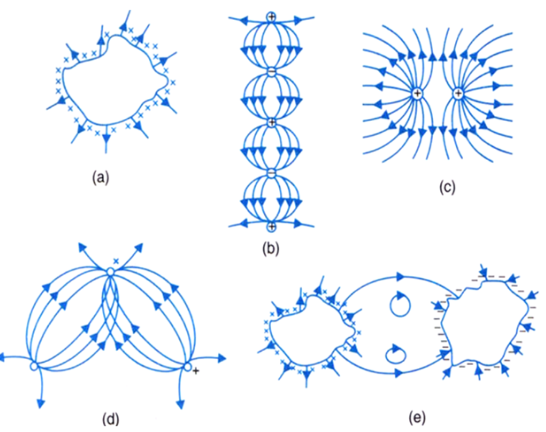
For a body containing net charge a, flux is given by the relation,
$\phi = \frac{\text{q}}{\in_0}$
$\in_0$ = Permittivity of free space
= 8.854 × 10-12 × 8.0 × 103
q = $\in_0\phi$
= 8.854 × 10-12 × 8.0 × 103
= 7.08 × 10-8
= 0.07 µC
Therefore, the net charge inside the box is 0.07 µC.
Net flux piercing out through a body depends on the net charge contained in the body. If net flux is zero, then it can be inferred that net charge inside the body is zero. The body may have equal amount of positive and negative charges.
Charge on this sphere, q1 = 0.4 µC = 0.4 × 10⁻⁶ C
Charge on the second sphere, q2 = -0.8 µC = 0.8 × 10⁻⁶ C
Electrostatic force between the spheres is given by the relation,
$\text{F}=\frac{\text{q}_1\text{q}_2}{4\pi\in_0\text{r}^2}$ And $\frac{1}{4\pi\in_0}=9\times10^{9}\text{Nm}^2\text{C}^{-2}$
Where, $\in_0\ =$ Permittivity of free space
And, $\frac{1}{4\pi\in_0} = 9\times10^9\text{Nm}^{-2}\text{C}^{-2}$
$\text{r}^2=\frac{\text{q}_1\text{q}_2}{4\pi\in_0\text{F}}$
= 144 × 10-4
r = $\sqrt{144\times10^{-4}}=0.12\text{m}$
The distance between the two spheres is 0.12m.



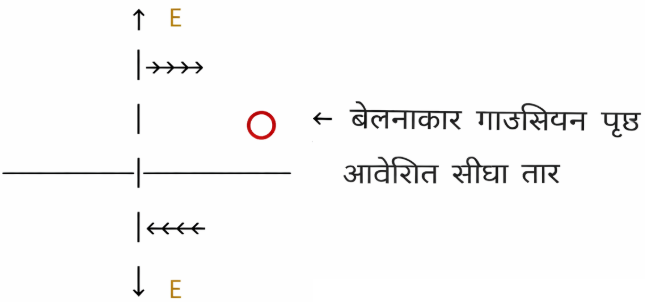
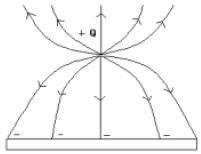 Field at the surface of a charged conductor
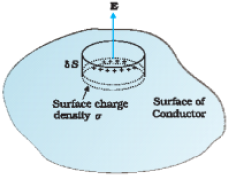 We have, by Gauss’s law,
 $\text{E }\delta\text{ S} =\frac{|\sigma| \delta\text{ S}}{\varepsilon_{0}}$
$\therefore\text{E} = \frac{|\sigma|}{\varepsilon_{0}}.$
(If the student just writes $\oint\text{E}.\text{ds} =\frac{\text{q}}{\in_\circ}$, award )

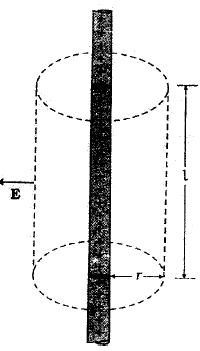
$\oint\text{E}.\text{ds} \int\limits_{s_1}\overline{E}.\text{d}\overline{s}_{1} + \int\limits_{s_2}\overline{E}.\text{ds}_{2} + \int\limits_{s_3}\overline{E}.\text{ds}_{3}$
$ = 0 + 0 + 2\pi\text{r}\ell$
Also, $\text{q} = \lambda$ $\ell$ (where $\lambda$ is charge per unit length)
$(\text{E}).(2\pi\text{r}\ell) = \frac{1}{\varepsilon_\circ}\lambda\ell $ OR $\text{E}2\pi\text{r}\ell\frac{\text{q}}{\varepsilon_\circ}$
$\text{E} = \frac{\lambda}{2\pi\varepsilon_\circ\text{r}}$ OR $\text{E} = \frac{\text{q}}{2\pi\varepsilon_\circ\text{r}\ell}$.
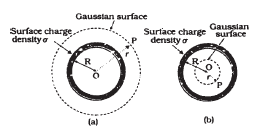
Derivation: $\text{E}\times4\pi\text{r}^{2} =\frac{\sigma}{\varepsilon_{\circ}}4\pi\text{R}^{2}$
$\therefore \text{E} = \frac{\sigma\text{R}^{2}}{\varepsilon_{\circ}\text{r}^{2}}$
where $\text{q} = 4\pi\text{R}^{2}\sigma$ is the total charge on the spherical shell. Electrostatic field is zero, since total charge inside the shell is zero or charge reside on the surface of the shell.
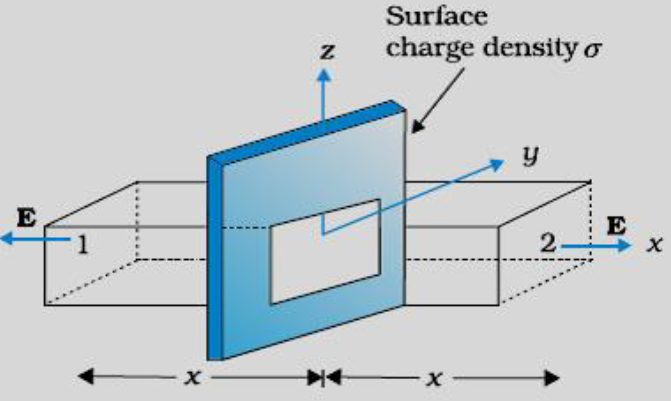
By Gauss’s law
$ \oint \overrightarrow{E}.\overrightarrow{ds}=\frac{q}{\in_0}$$\therefore{2{\text{EA}}}=\frac{\sigma{\text{A}}}{{\in_0}}$
$\therefore\text{E}=\frac{\sigma}{2\in_0}\text{ }\text{or}\frac{\sigma}{2\in_0}\text{A}$
Electric field between two identical charged sheets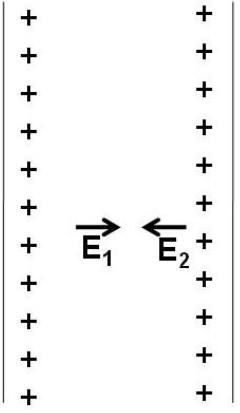
$\because$ Both the sheets have same charge density, their electric fields will be equal and opposite in the region between the two sheets.
Hence the net field is zero.Alternate Answer
$\text{E}_1=\frac{\sigma}{2\in_0}$
$\text{E}_2=-\frac{\sigma}{2\in_0}$
Resultant electric field between the plates = E1 + E2$\frac{\sigma}{2\in_0}-\frac{\sigma}{2\in_0}=0$]
$\phi_E=\overrightarrow{E}.\overrightarrow{A}={EA}\cos\theta$
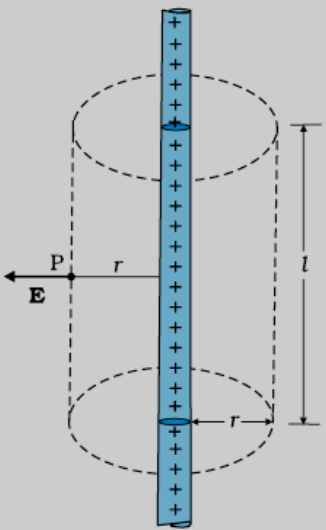
Its S.I unit is $(Nm^{2}C^{-1})$ The Gaussian surface is cylindrical and field is radial. At the cylindrical part of the surface, cylindrical part of the surface, $ \overrightarrow{E}$ is normal to the surface at every point and its magnitude is constant (since it depends only on r). By Gauss’s theorem : $ \oint \overrightarrow{E}.{d}\overrightarrow{S}=\frac{q}{\in_0}$$\therefore(2\pi{rl})=\frac{\lambda{l}}{\in_0}$
$\text{or}\text{ }\text{ } E=\frac{\lambda}{2\pi\in_0r}$
$\tau=\overrightarrow{p}\times\overrightarrow{\text{E}}$
Direction of torque is perpendicular to the plane containing and given by right-hand screw rule.
Alternate Answer
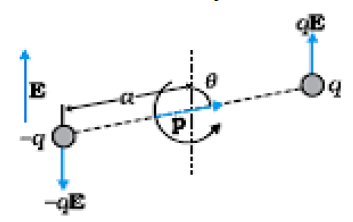
Direction of torque is out of the plane of the paper.
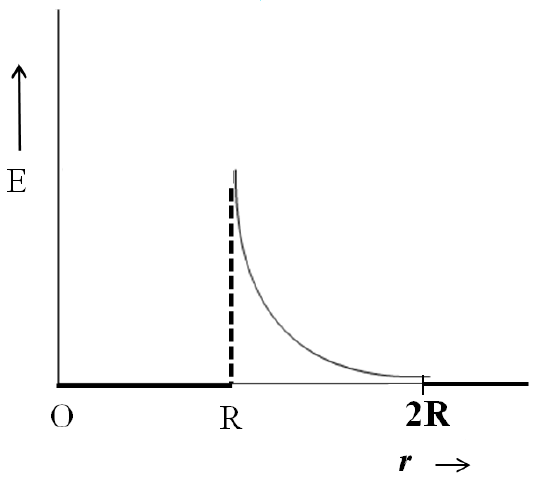
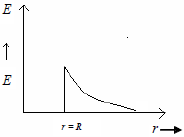
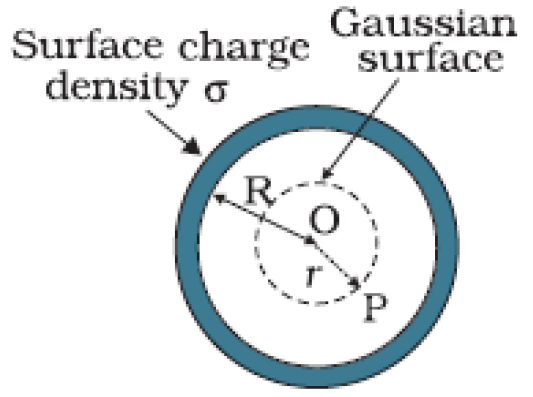 By Gauss theorem $\oint \overrightarrow{E}.d\vec{s}=\frac{q}{E_0}$ q = 0 in interval 0 < x < R
 $\Rightarrow E=0$
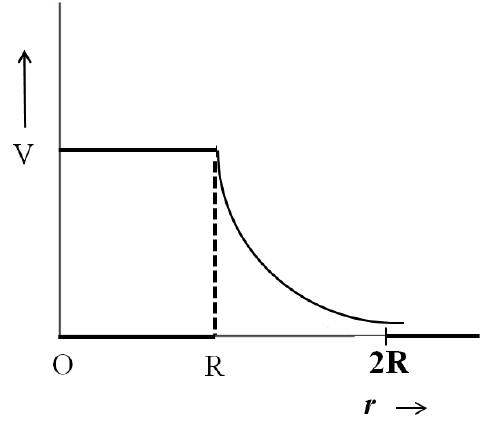
$E=-\frac{dv}{dr}$
$\Rightarrow V= constant=\frac{1}{4\pi E_0}\frac{Q}{R}$
$\oint\overrightarrow{E}.\vec{ds}=\frac{q}{\in_0}$
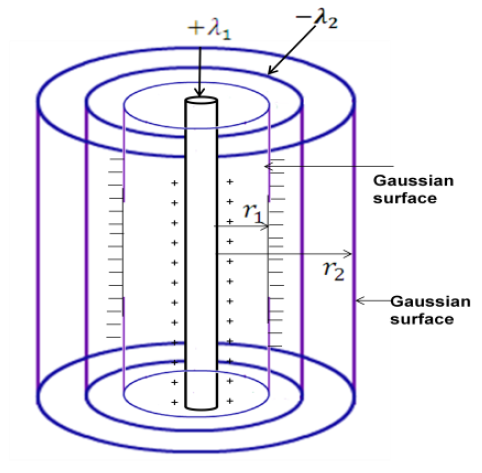
$\Longrightarrow\overrightarrow{E_1}=\frac{\lambda_1}{2\pi\in_0r_1}\hat{r_1}$
$\Longrightarrow\overrightarrow{E_2}=\frac{(\lambda_1-\lambda_2)}{2\pi\in_0r_2}\hat{r_2}$
$\tau=\overrightarrow{p}\times\overrightarrow{\text{E}}$
Direction of torque is perpendicular to the plane containing and given by right-hand screw rule.
Alternate Answer
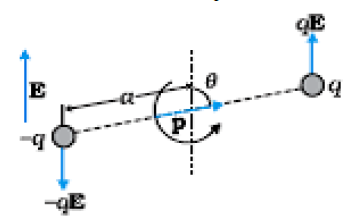
Direction of torque is out of the plane of the paper.
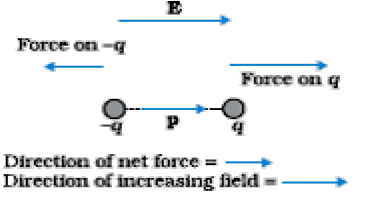
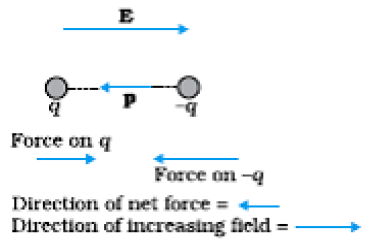
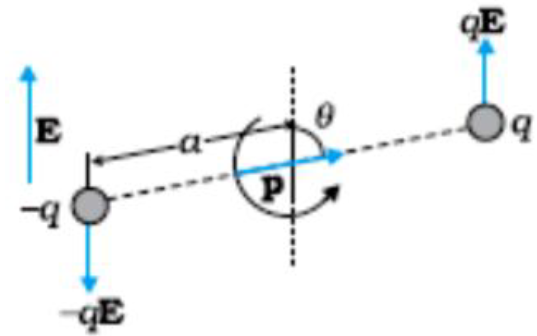
Force on + q, $\overrightarrow{\text{F}}=q\overrightarrow{\text{E}}$
Force on - q, $\overrightarrow{\text{F}}=-q\overrightarrow{\text{E}}$
Magnitude of torque
$\tau=q\text{E}\times2a \text{ sin}\theta$
$\tau=2q\text{a}\times{\text{E}} \text{ sin}\theta$
$\overrightarrow\tau=\overrightarrow{\text{P}}\times\overrightarrow{\text{E}}$
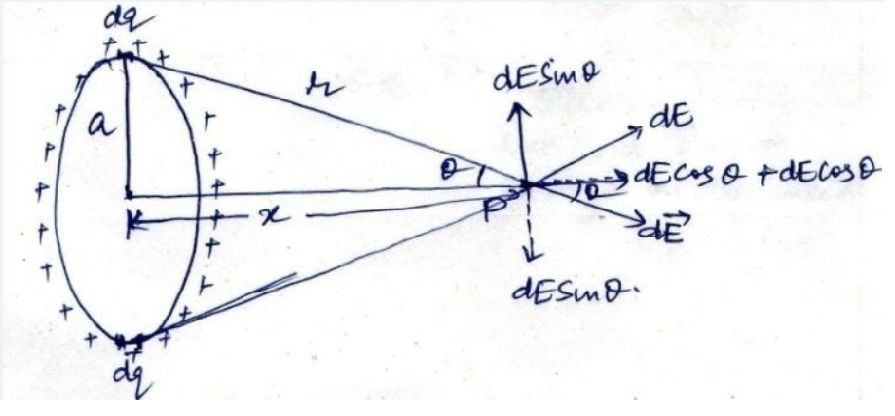
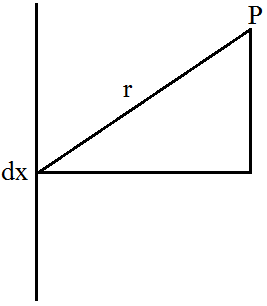
Net Electric Field at point $\text{P} =\int^{2\pi\text{a}}_{\circ}\text{dE}\cos\theta$
dE = Electric field due to a small element having charge dq
$ = \frac{1}{4\pi\varepsilon_\circ}\frac{\text{dq}}{\text{r}^{2}}$
Let $\lambda$ = Linear charge density
$ = \frac{\text{dq}}{\text{dl}}$
$\text{dq} = \lambda\text{dl}$
Hence $\text{E} = \int^{2\pi\text{a}}_{\circ}\frac{1}{4\pi\varepsilon_\circ}.\frac{\lambda\text{dl}}{\text{r}^{2}}\times\frac{x}{r} , $
where $\cos\theta =\frac{\text{x}}{\text{r}}$
$ = \frac{\lambda\text{x}}{4\pi\varepsilon_\circ\text{r}^{3}}(2\pi\text{a})$
$ =\frac{1}{4\pi\varepsilon_\circ}\frac{\text{Qx}}{(\text{x}^{2} + \text{a}^{2})^{\frac{3}{2}}}$
where total charge $\text{Q} = \lambda\times2\pi\text{a}$
At large distance i.e. x >> a
$\text{E}\simeq\frac{1}{4\pi\varepsilon_\circ}.\frac{\text{Q}}{\text{x}^{2}}$
This is the Electric field due to a point charge at distance x.
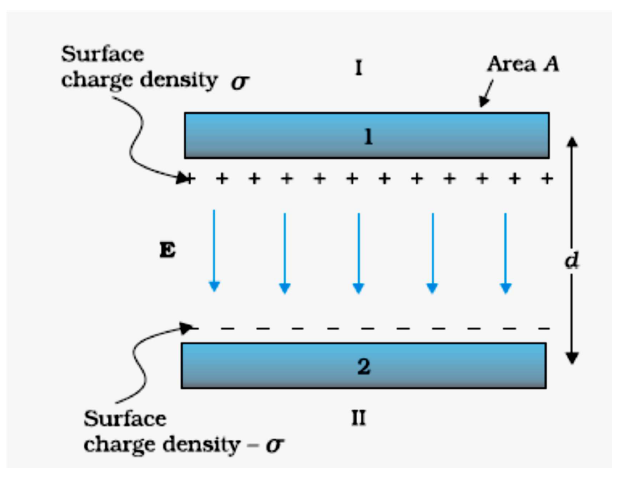
Electric field between the plates of capacitor E = $\frac{\sigma}{\varepsilon_{0}} =\frac{\text{Q}}{\text{A}\varepsilon_{0}}$
$\therefore$ potential difference
$\text{V} = \text{Ed} = \frac{\text{Qd}}{\text{A}\varepsilon_{0}}$
Capacitance
$\text{C} = \frac{\text{Q}}{\text{V}} = \frac{\varepsilon_{0}\text{A}}{\text{d}}$
i.e $\frac{\text{Kq}_{1}}{\text{R}_{1}} = \frac{\text{Kq}_{2}}{\text{R}_{2}}\Rightarrow\frac{\text{q}_{1}}{\text{q}_{2}} = \frac{\text{R}_{1}}{\text{R}_{2}}$
Hence, ratio of surface charge densities
$\frac{\sigma_{1}}{\sigma_{2}} = \frac{\text{q}_{1}/4\pi\text{R}_{1}^{2}}{\text{q}_{2}/4\pi\text{R}_{2}^{2}}$
$ = \frac{\text{q}_{1}\text{R}_{2}^{2}}{\text{q}_{2}\text{R}_{1}^{2}}$
$ = \frac{\text{R}_{1}}{\text{R}_{2}}\times\frac{\text{R}_{2}^{2}}{\text{R}_{1}^{2}} = \frac{\text{R}_{2}}{\text{R}_{1}}.$
Initial voltage, V1 = V volts and charge stored, Q1 = 360 µC.
Q1 = CV1 …(1)
Changed potential, V2 = V − 120
Q2 = 120 µC
Q2 = CV2 ...(2)
By dividing (2) from (1), we get
$\therefore {\text{C}}=\frac{\text{Q}_{1}}{\text{V}_{1}}=\frac{{360}\times{10}{^-}{^6}}{180}={2}\times{10}{^-}{^6} \text{F}={2}\mu{\text{F}}$
Hence, charge stored in the capacitor, $\text{Q}_{3}=\text{C}\text{V}_{3}={2}\times{10}{^-}{^6}\times{300}={600}\mu\text{C}.$
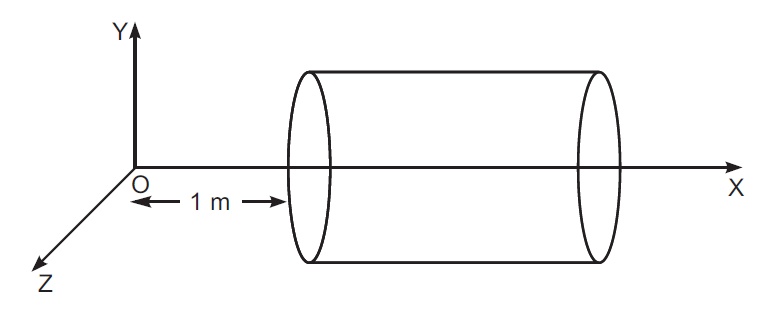
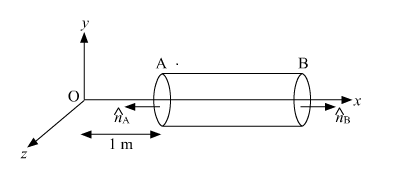
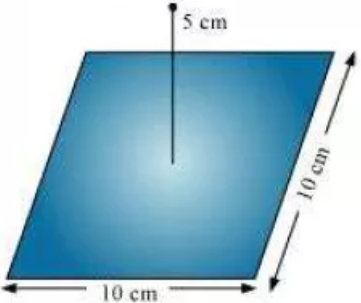
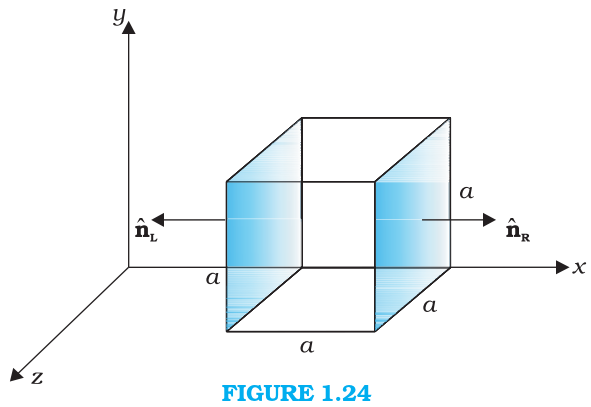
Given, $\vec{E}={50}{x}\vec{i} \text{and}\bigtriangleup{s}={25}\text{C}\text{m}{^2}={25}\times{10}{^-}{^4}\text{m}{^2}$
As the electric field is only along the x-axis, so, flux will pass only through the cross-section of cylinder.
Magnitude of Electric Field at cross - section A, $\text{E}_\text{A}={50}\times{1}={50}\text{N}\text{C}{^-}{^1}$
Magnitude of Electric Field at cross - Section B, $\text{E}_\text{B}={50}\times{2}={100}\text{N}\text{C}{^-}{^1}$
The Corresponding Electric Fluxes are:
$\phi_\text{A}=\vec{\text{E}}.\bigtriangleup\vec{s}={50}\times{25}\times{10}{^-}{^4}\times\cos{180}{^0}=-{0.125}\text{N}\text{m}{^2}\text{C}{^-}{^1}$
$\phi_\text{B}=\vec{\text{E}}.\bigtriangleup\vec{s}={100}\times{25}\times{10}{^-}{^4}\times\cos{0}{^0}=-{0.25}\text{N}\text{m}{^2}\text{C}{^-}{^1}$
So, the net flux through the cylinder,
$\phi=\phi_\text{A}+\phi_\text{B}= -{0.125} + {0.25}={0.125}\text{N}\text{m}{^2}\text{C}{^-}{^1}$$\oint\vec{\text{E}}{d}\vec{\text{s}}=\frac{\text{q}}{\in_{0}}\Rightarrow{0.125}=\frac{\text{q}}{{8.85}\times{10}{^-}{^1}{^2}}$
$\Rightarrow\text{q}={8.85}\times{0.125}\times{10}{^-}{^1}{^2}={1.1}\times{10}{^-}{^1}{^2}\text{C}$
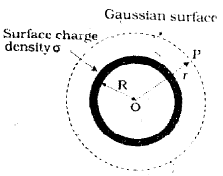
From Gauss's theorem, ${\phi = \oint\overrightarrow{\text{E}}}.\text{d}\overrightarrow{\text{S}} = \frac{\text{q}_{m}}{\varepsilon_{0}}$
Flux $\phi$through S'.
$\phi = \oint\limits_{s'}\overrightarrow{\text{E}}.\text{d}\overrightarrow{\text{S}} = \oint\limits_{s'}\text{EdS} = \text{E}.4\pi\text{r}^{2}$
$\Rightarrow\text{E}.4\pi\text{r}^{2} = \frac{\text{q}_{m}}{\varepsilon_{0}}\Rightarrow\text{E} = \frac{1}{4\pi\varepsilon_{0}}\frac{\text{q}_{m}}{\text{r}^{2}}$
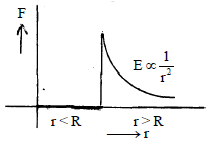
Draw a graph of electric field E(r) with distance r from the centre of the shell for $0\underline{<}\text{r}\underline{<}\infty.$
$\text{E}\times4\pi\text{r}^{2} =\frac{\text{Q}}{\varepsilon_\circ}$
$\text{E} = \frac{1}{4\pi\varepsilon_\circ}\frac{\text{Q}}{\text{r}^{3}}$
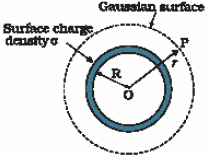
Using Gauss’s theorem, deduce an expression for the electric field at a point due to a uniformly charged infinite plane sheet.
Alternate Answer
The surface integral of electric field over a closed surface.
Alternate Answer
$\phi = \oint\overrightarrow{\text{E}}.\text{d}\overrightarrow{\text{s}}$
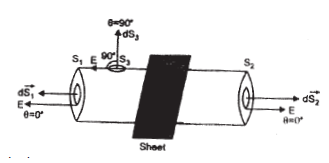
Derivation: $\phi= \oint_{s}\overrightarrow{\text{E}}.\overrightarrow{\text{ds}}= \frac{\text{q}}{\varepsilon_\circ}$
$2\text{EA} =\frac{\sigma\text{A}}{\varepsilon_\circ}$
$\therefore \text{E} =\frac{\sigma}{2\varepsilon_{\circ}}$
$=3.34\times10^{25}$
$\therefore$ Total charge $=3.34\times10^{25}\times1.6\times10^{-19}$
$=5.34\times10^6\text{C}$
$\Rightarrow10\text{J}=(200-100)\text{v}\times\text{q}_0$
$\Rightarrow100\text{q}_0=10\text{v}$
$\Rightarrow\text{q}_0=\frac{10}{100}$
$=0.1\text{C}$
$\text{U}=\frac{1}{2}\in_0\text{E}^2$
But, $\text{E}=\frac{\sigma}{\in_0}=\frac{\text{Q}}{\text{A}\in_0}$$\therefore\ \text{U}=\frac{1}{2}\frac{\in_0\text{Q}^2}{\text{A}^2\in_0}\ \Rightarrow\ \text{U}=\frac{\text{Q}^2}{2\text{A}^2}$
$\Rightarrow\ \text{U}\propto\frac{1}{\text{A}^2}\ \Rightarrow\ \text{U}_\text{A}>\text{U}_\text{B}$
$\text{F}=\frac{1}{4\pi\in_0}\frac{\text{q}_1\text{q}_2}{\text{r}^2}$
$\Rightarrow490=9\times10^9\times\frac{\text{q}^2}{1^2}$
$\Rightarrow\text{q}^2=54.4\times10^{-9}$
$\Rightarrow\text{q}=\sqrt{54.4\times10^{-9}}$
$=23.323\times10^{-5}\text{C}$
$\text{q}=2.3\times10^{-4}\text{C}$
$\phi=\Big(\frac{\text{Q}_{\text{in}}}{\in_0}\Big),$ where Qin = charge enclosed inside the cube
Here, charge per unit length of the rod $=\frac{\text{Q}}{\text{l}}$ Charge enclosed, $\text{Q}_{\text{in}}=\frac{\text{Q}}{\text{l}}\times\frac{\text{l}}{2}=\frac{\text{Q}}{2}$ Therefore,$\phi=\frac{\frac{\text{Q}}{2}}{\in_0}=\frac{\text{Q}}{2\in_0}$