MCQ
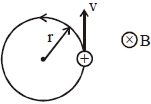
A charged particle going around in a circle can be considered to be a current loop. A particle of mass $m$ carrying charge $q$ is moving in a plane with speed $v$ under the influence of magnetic field $\overrightarrow{ B }$. The magnetic moment of this moving particle
  • A
    $-\frac{ mv ^{2} \overrightarrow{ B }}{ B ^{2}}$
  • B
    $-\frac{m v^{2} \vec{B}}{2 \pi B^{2}}$
  • C
    $\frac{m v^{2} \vec{B}}{2 B^{2}}$
  • $-\frac{m v^{2} \vec{B}}{2 B^{2}}$

Answer

Correct option: D.
$-\frac{m v^{2} \vec{B}}{2 B^{2}}$
d
Magnetic moment

$M=i A$

$M=\left(\frac{q}{T}\right) \times \pi r^{2}=\frac{q \pi r^{2}}{\left(\frac{2 \pi r}{v}\right)}=\frac{q v r}{2}$

$M=\frac{q v}{2} \times \frac{v m}{q B}$

$M =\frac{ mv ^{2}}{2 B }$

As we can see from the figure, direction of magnetic moment $(M)$ is opposite to magnetic field.

$\overrightarrow{ M }=-\frac{ mv ^{2}}{2 B } \hat{ B }$

$=-\frac{m v^{2}}{2 B^{2}} \vec{B}$

Need a full question paper?

Generate a complete, print-ready paper with questions like this in minutes — across 16+ boards, with answer keys.

Start Generating Free

Similar questions

A gaseous mixture contains equal number of hydrogen and nitrogen molecules. Specific heat measurements on this mixture at temperatures below $100\, K$ would indicate that the value of $\gamma $ (ratio of specific heats) for this mixture is
Which of the following statements concerning the depletion zone of an unbiased $PN $ junction is (are) true
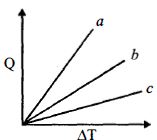
Figure shows the variation in temperature $\left( {\Delta T} \right)$ with the amount of heat supplied $(Q)$ in an isobaric process corresponding to a monoatomic $(M)$, diatomic $(D)$ and a polyatomic $(P)$ gas. The initial state of all the gases are the same and the scales for the two axes coincide. Ignoring vibrational degrees of freedom, the lines $a, b$ and $c$ respectively correspond to
$20\, gm$ of boiling water is poured into an ice-cold brass vessel (specific heat $0.1\, cal/gm-\,^oC$) of mass $100\, gm$. The resulting temperature is ........ $^oC$
A ball of mass $2 \,m$ and a system of two balls with equal masses $m$ connected by a massless spring, are placed on a smooth horizontal surface (see figure below). Initially, the ball of mass $2 \,m$ moves along the line passing through the centres of all the balls and the spring, whereas the system of two balls is at rest. Assuming that the collision between the individual balls is perfectly elastic, the ratio of vibrational energy stored in the system of two connected balls to the initial kinetic energy of the ball of mass $2 \,m$ is
Which one of the following phenomena is not explained by Huygen's construction of wavefront
A particle executing simple harmonic motion has an amplitude of $6\, cm$. Its acceleration at a distance of $2 \,cm$ from the mean position is $8\,cm/{s^2}$. The maximum speed of the particle is ... $ cm/s$
A body of mass $50\, kg$ is projected vertically upwards with velocity of $100 \,m/sec$. $5 \,seconds$ after this body breaks into $20\, kg$ and $30 \,kg$. If $20\, kg $ piece travels upwards with $150 \,m/sec$, then the velocity of other block will be
On adjusting the $P-N $junction diode in forward biased
If two light waves having same frequency have intensity ratio $4 : 1$ and they interfere, the ratio of maximum to minimum intensity in the pattern will be