Question
A charged particle is accelerated through a potential difference of 12kV and acquires a speed of 1.0 × 10⁶m s−1. It is then injected perpendicularly into a magnetic field of strength 0.2T. Find the radius of the circle described by it.

Answer

$\text{V}=12\text{KV}$
$\text{E}=\frac{\text{qV}}{\text{ml}}$
Now, $\text{F}=\text{qE}=\frac{\text{qV}}{\text{l}}$
$\text{a}=\frac{\text{F}}{\text{m}}=\frac{\text{qv}}{\text{ml}}$
$\text{v}=1\times10^6\text{m/s}$
$\text{v}=\sqrt{2\times\frac{\text{qV}}{\text{ml}}\times\text{l}}=\sqrt{2\times\frac{\text{q}}{\text{m}}\times12\times10^3}$
$1\times10^6=\sqrt{2\times\frac{\text{q}}{\text{m}}\times12\times10^3}$
$\Rightarrow10^{12}=24\times10^3\times\frac{\text{q}}{\text{m}}$
$\Rightarrow\frac{\text{m}}{\text{q}}=\frac{24\times10^3}{10^{12}}=24\times10^{-9}$
$\Rightarrow\frac{\text{mV}}{\text{qB}}=\frac{24\times10^{-9}\times1\times10^6}{2\times10^{-1}}=12\times10^{-2}\text{m}=12\text{cm}$

Need a full question paper?

Generate a complete, print-ready paper with questions like this in minutes — across 16+ boards, with answer keys.
Start Generating Free

Similar questions

  1. State Kirchhoff’s rules for an electric network. Using Kirchhoff’s rules, obtain the balance condition in terms of the resistances of four arms of Wheat sone bridge.
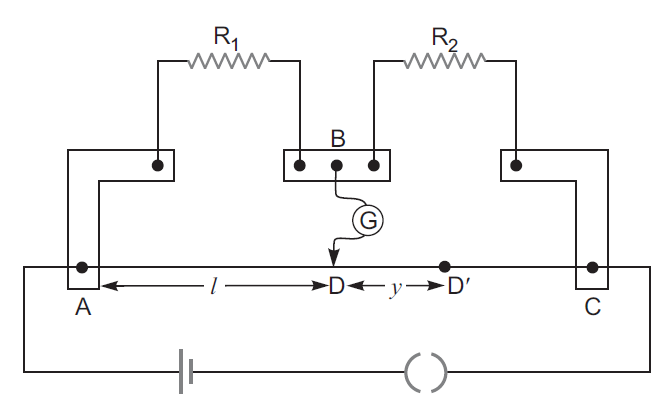
  2. In the meter bridge experimental set up, shown in the figure, the null point ‘D’ is obtained at a distance of 40 cm from end A ofthe meter bridge wire. If a resistance of 10 Ω is connected in series with R1, null point is obtained at AD = 60 cm. Calculate the value of R1 and R2.

A person is standing on a truck moving with a constant velocity of 14.7m/s on a horizontal road. The man throws a ball in such a way that it returns to the truck after the truck has moved 58.8m. Find the speed and the angle of projection:
  1. As seen from the truck.
  2. As seen from the road.
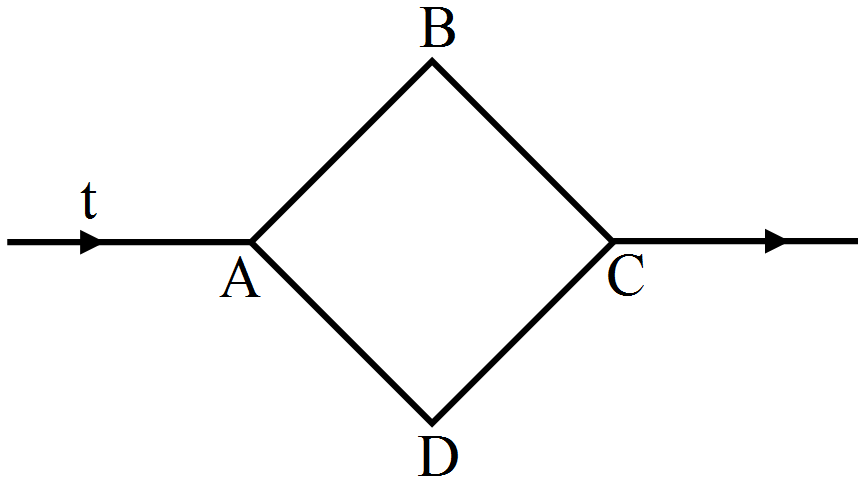
Figure shows a square loop ABCD with edgelength a. The resistance of the wire ABC is r and that of ADC is 2r. Find the magnetic field B at the centre of the loop assuming uniform wires.

A conducting loop of area 5.0cm2 is placed in a magnetic field which varies sinusoidally with time as $\text{B}=\text{B}_0\sin\omega\text{t}$ wherer $\text{B}_0=0.20\text{T}$ and $\omega=300\text{s}^{-1}.$ The normal to the coil makes an angle of 60° with the field. Find
  1. The maximum emf induced in the coil.
  2. The emf induced at $\text{t}=\Big(\frac{\pi}{900}\Big)\text{s}$
  3. $\text{t}=\Big(\frac{\pi}{600}\Big)\text{s}.$
  4. The emf induced at $\text{t}=\Big(\frac{\pi}{600}\Big)\text{s}.$
What is the focal length of a convex lens of focal length 30cm in contact with a concave lens of focal length 20 cm? Is the system a converging or a diverging lens? Ignore thickness of the lenses.
A wire of length l is bent in the form of an equilateral triangle and carries an electric currrent i.
  1. Find the magnetic field B at the centre.
  2. If the wire is bent in the form of a square, what would be the value of B at the centre?
Derive an expression for magnetic field intensity due to a magnetic dipole at a point lies on its equatorial line.
An electron of kinetic energy 100eV circulates in a path of radius 10cm in a magnetic field. Find the magnetic field and the number of revolutions per second made by the electron.
Sea water at frequency ν = 4 × 108Hz has permittivity $\in\approx80\in_0$, permeability $\mu \approx\mu_0$ and resistivity $\rho=0.25\Omega-\text{m}$. Imagine a parallel plate capacitor immersed in sea water and driven by an alternating voltage source $\text{V(t)}=\text{V}_0\sin(2\pi\text{vt})$. What fraction of the conduction current density is the displacement current density?
Find the wavelength of the radiation emitted by hydrogen in the transitions (a) n = 3 to n= 2, (b) n = 5 to n = 4 and (c) n = 10 to n = 9.