Question
  1. State Kirchhoff’s rules for an electric network. Using Kirchhoff’s rules, obtain the balance condition in terms of the resistances of four arms of Wheat sone bridge.
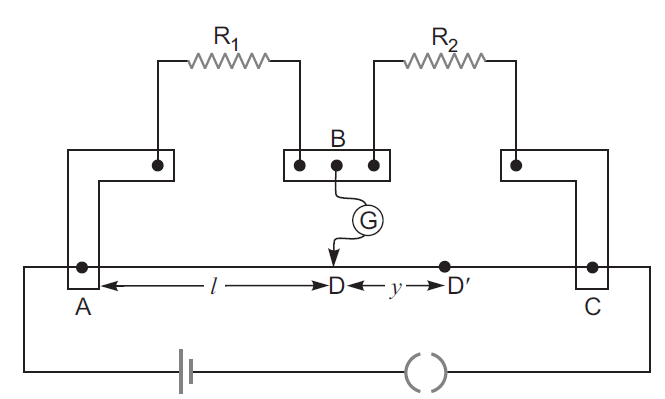
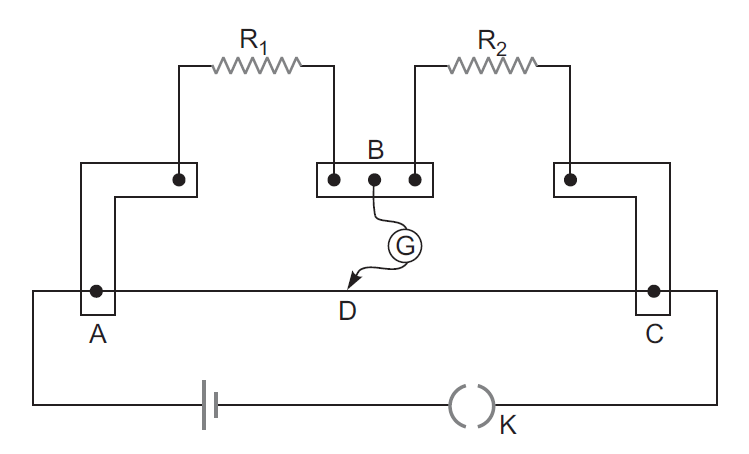
  2. In the meter bridge experimental set up, shown in the figure, the null point ‘D’ is obtained at a distance of 40 cm from end A ofthe meter bridge wire. If a resistance of 10 Ω is connected in series with R1, null point is obtained at AD = 60 cm. Calculate the value of R1 and R2.

Answer

  1. Kirchhoff’s Rule
    1. At any junction, the sum of the currents entering the junction is equal to the sum of the currents leaving the junction.
    2. The algebraic sum of the charges in potential around any closed loop involving resistors and cells in the loop is zero.

Condition of balance of a Wheatstone bridge: The circuit diagram of Wheatstone bridge is shown in fig.

P, Q, R and S are four resistance forming a closed bridge, called Wheatstone bridge. A battery is connected across A and C, while a galvanometer is connected between B and D. At  balance, there is no current in galvanometer.

Derivation of Formula: Let the current given by battery in the balanced position be I. This current on reaching point A is divided into two parts I1 and I2 . As there is no current in galvanometer in balanced state, current in resistances P and Q is I1 and in resistances R and S it is I2 .
Applying Kirchhoff’s I law at point A

I - I1 - I2 = 0 or I = I1 + I2 - - - - - - - - (i)

Applying Kirchhoff’s II law to closed mesh ABDA

- I1P + I2R = 0 or I1P = I2 R -  - - - - - - (ii)

Applying Kirchhoff’s II law to mesh BCDB

- I1Q + I2S = 0 or I1Q = I2S - - - - -- - (iii)

Dividing equation (ii) by (iii), we get

$\frac{\text{I}_{1}\text{P}}{\text{I}_{1}\text{Q}} = \frac{\text{I}_{2}\text{R}}{\text{I}_{2}\text{S}}\text{ or }\frac{\text{P}}{\text{Q}} = \frac{\text{R}}{\text{S}}$ - - - - - - -(iv)

This is the condition of balance of Wheatstone bridge.

  1.  

For null point at D, balance length $\ell_{1}$ = 40 cm

So,  $\frac{\text{R}_{1}}{\text{R}_{2}} = \frac{\text{AD}}{\text{DC}} =\frac{40}{(100- 40)} = \frac{2}{3}$ - - - -- - (i)

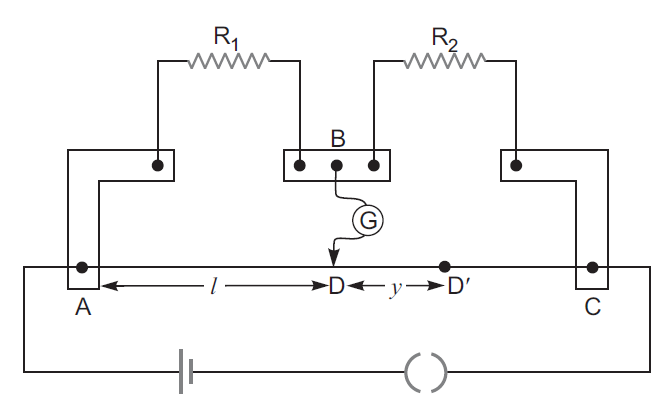
If resistance 10 $\Omega$ is connected in series of R1, then balance length AD' > AD i.e. balance point shifts by length ‘y’ towards C i.e., AD = 60 cm.

$\frac{\text{R}_{1} + 10}{\text{R}_{2}} = \frac{\text{AD}"}{\text{D}'\text{C}} = \frac{60}{100-60} = \frac{3}{2}$

$\frac{\text{R}_{1}}{\text{R}_{2}} + \frac{10}{\text{R}_{2}} =\frac{3}{2}$-  - - - - -- -- - -(ii)

From equations (1) and (2), we have

$\frac{2}{3} +\frac{10}{\text{R}_{2}} =\frac{3}{2}$

$\frac{10}{\text{R}_{2}} = \frac{3}{2} - \frac{2}{3} =\frac{9-4}{6} = \frac{5}{6}$

$\Rightarrow\text{R}_{2} = \frac{ 10\times6}{5} = 12\text{ ohm}$

From equation (1), we have

$\frac{\text{R}_{1}}{12} = \frac{2}{3}\Rightarrow\text{R}_{1} = \frac{12\times2}{3} =8\text{ ohm}.$
Need a full question paper?

Generate a complete, print-ready paper with questions like this in minutes — across 16+ boards, with answer keys.

Start Generating Free

Similar questions

The magnitude F of the force between two straight parallel current carrying conductors kept at a distance d apart in air is given by:
$\text{F}=\frac{\mu_0\text{I}_1\text{I}_2}{2\pi\text{d}}$
Where I1 and I2 are the currents flowing through the two wires.
Use this expression, and the sign convention that the:
“Force of attraction is assigned a negative sign and Force of repulsion is assigned a positive sign”.
Draw graphs showing dependence of F on:
  1. I1 I2 when d is kept constant.
  2. d when the product I1 I2 is maintained at a constant positive value.
  3. d when the product I1 I2 is maintained at a constant negative value.
If a LC circuit is considered analogous to a harmonically oscillating spring block system, which energy of the LC circuit would be analogous to potential energy and which one analogous to kinetic energy?
State the Biot-Savart law for the magnetic field due to a current carrying element. Use this law to obtain a formula for magnetic field at the centre of a circular loop of radius R carrying a steady current I. Sketch the magnetic field lines for a current loop clearly indicating the direction of the field.
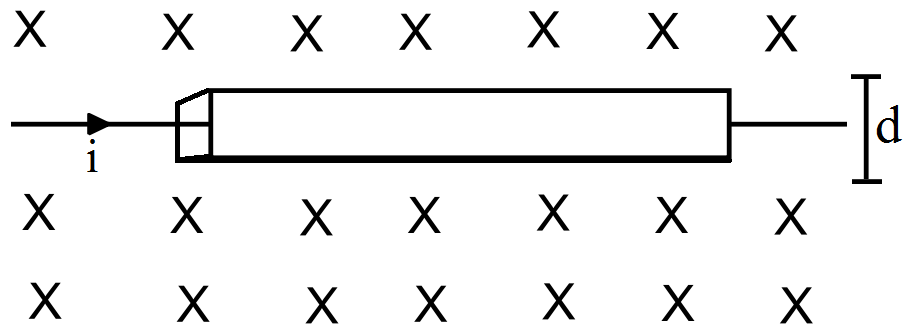
A current i is passed through a silver strip of width d and area of cross-section A. The number of free electrons per unit volume is n.
  1. Find the drift velocity v of the electrons.
  2. If a magnetic field B exists in the region, as shown in the figure, what is the average magnetic force on the free electrons?
  3. Due to the magnetic force, the free electrons get accumulated on one side of the conductor along its length. This produces a transverse electric field in the conductor, which opposes the magnetic force on the electrons. Find the magnitude of the electric field which will stop further accumulation of electrons.
  4. What will be the potential difference developed across the width of the conductor due to the electron-accumulation? The appearance of a transverse emf, when a current-carrying wire is placed in a magnetic field, is called Hall effect.

Calculate the electric field in a copper wire of cross-sectional area 2.0mm2 carrying a current of 1A.
The resistivity of copper $=1.7\times10^{-8}\Omega\text{-m}.$
A hollow sphere of radius 2cm is attached to an 18cm long thread to make a pendulum. Find the time period of oscillation of this pendulum. How does it differ from the time period calculated using the formula for a simple pendulum?
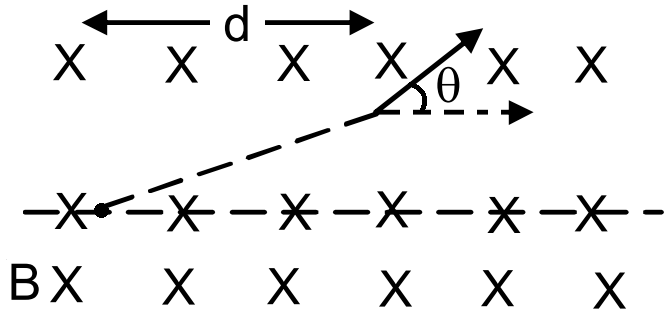
A particle of mass m and charge q is projected into a region that has a perpendicular magnetic field B. Find the angle of deviation of the particle as it comes out of the magnetic field if the width d of the region is very slightly smaller than

  1. $\frac{\text{mv}}{\text{qB}}$

  2. $\frac{\text{mv}}{2\text{qB}}$

  3. $\frac{2\text{mv}}{\text{qB}}.$

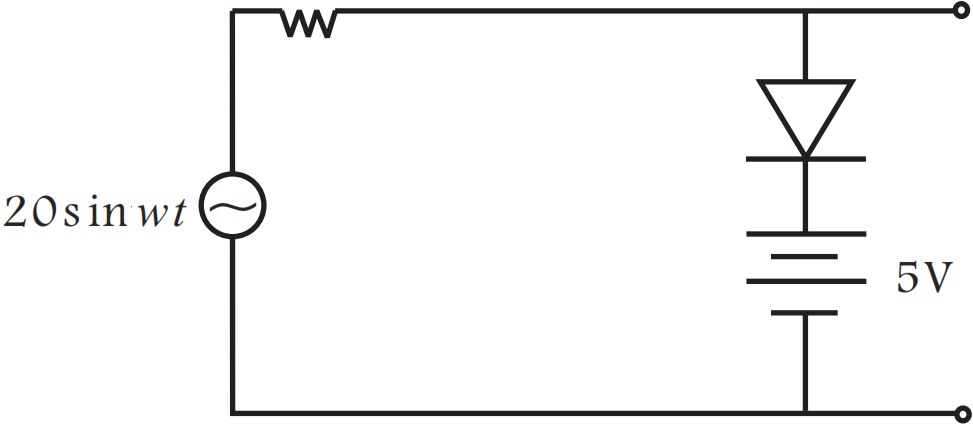
Assuming the ideal diode, draw the output waveform for the circuit given in Fig. Explain the waveform.

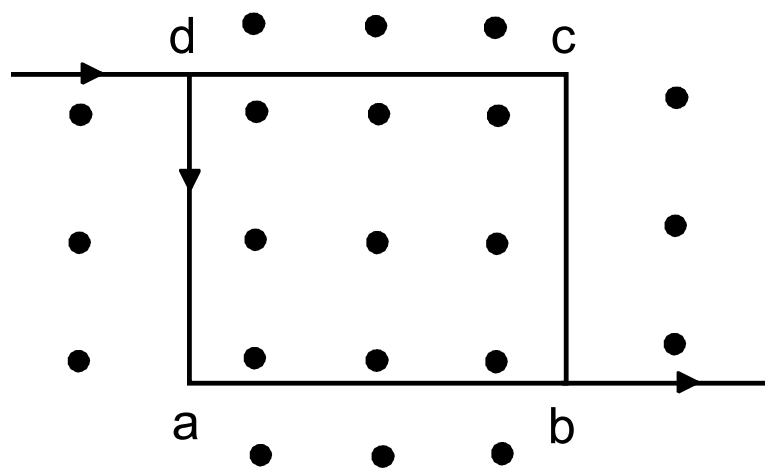
A current of 2A enters at the corner d of a square frame abcd of side 20cm and leaves at the opposite corner b. A magnetic field B = 0.1 T exists in the space in a direction perpendicular to the plane of the frame, as shown in the figure. Find the magnitude and direction of the magnetic forces on the four sides of the frame.

Seema's uncle was advised by his doctor to have an MRI (Magnetic Resonance Imaging) scan of his brain. Her uncle felt it to be expensive and wanted to postpone it. When Seema learnt about this, she took the help of her family and also approached the doctor, who also offered a substantial discount. She then convinced her uncle to undergo the test to enable the doctor to know the condition of his brain. The information thus obtained greatly helped the doctor to treat him properly.
Based on the above paragraph, answer the following questions:
  1. What according to you are the values displayed by Seema, her family and the doctor?
  2. What could be the possible reason for MRI test to be so expensive?
  3. Assuming that MRI test was performed using a magnetic field of 0.1 T., find the minimum and maximum values of the force that the magnetic field could exert on a proton (charge = 1.6 x 10⁻¹⁹ C) moving with a speed of 104 m/s.