Question
A charged particle is accelerated through a potential difference of 12kV and acquires a speed of 1.0 × 10⁶m s−1. It is then injected perpendicularly into a magnetic field of strength 0.2T. Find the radius of the circle described by it.

Answer

$\text{V}=12\text{KV}$
$\text{E}=\frac{\text{qV}}{\text{ml}}$
Now, $\text{F}=\text{qE}=\frac{\text{qV}}{\text{l}}$
$\text{a}=\frac{\text{F}}{\text{m}}=\frac{\text{qv}}{\text{ml}}$
$\text{v}=1\times10^6\text{m/s}$
$\text{v}=\sqrt{2\times\frac{\text{qV}}{\text{ml}}\times\text{l}}=\sqrt{2\times\frac{\text{q}}{\text{m}}\times12\times10^3}$
$1\times10^6=\sqrt{2\times\frac{\text{q}}{\text{m}}\times12\times10^3}$
$\Rightarrow10^{12}=24\times10^3\times\frac{\text{q}}{\text{m}}$
$\Rightarrow\frac{\text{m}}{\text{q}}=\frac{24\times10^3}{10^{12}}=24\times10^{-9}$
$\Rightarrow\frac{\text{mV}}{\text{qB}}=\frac{24\times10^{-9}\times1\times10^6}{2\times10^{-1}}=12\times10^{-2}\text{m}=12\text{cm}$

Need a full question paper?

Generate a complete, print-ready paper with questions like this in minutes — across 16+ boards, with answer keys.
Start Generating Free

Similar questions

What is transformer ? Describe its construction and working principle.
The difference in the frequencies of series limit of Lyman series and Balmer series is equal to the frequency of the first line of the Lyman series. Explain.
A particle of mass m is kept on a fixed, smooth sphere of radius R at a position, where the radius through the particle makes an angle of 30° with the vertical. The particle is released from this position.
  1. What is the force exerted by the sphere on the particle just after the release?
  2. Find the distance travelled by the particle before it leaves contact with the sphere.
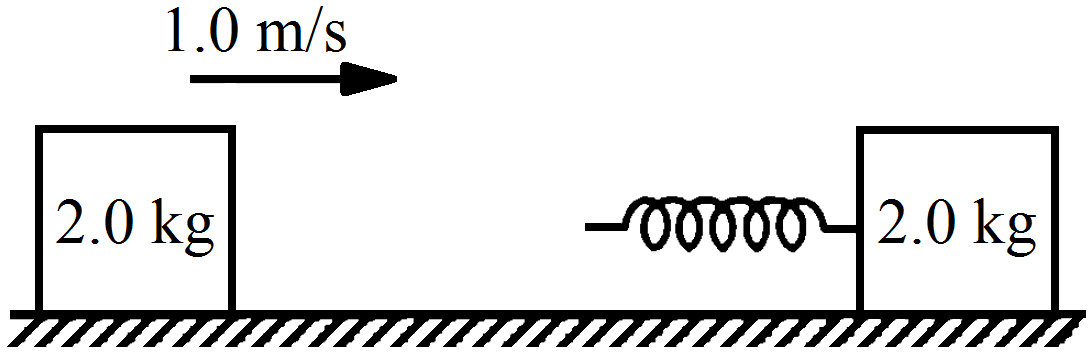
A block of mass 2.0kg is moving on a frictionless horizontal surface with a velocity of 1.0m/s towards another block of equal mass kept at rest. The spring constant of the spring fixed at one end is 100N/m. Find the maximum compression of the spring.

What are coherent sources of light? Why are coherent sources required to produce interference of light? Give an example of interference in everyday life.
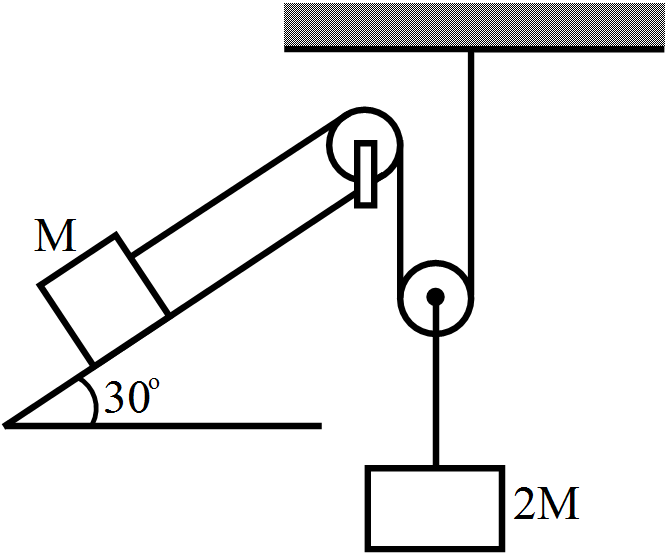
Find the acceleration of the block of mass M in the situation shown in figure. All the surfaces are frictionless and the pulleys and the string are light.

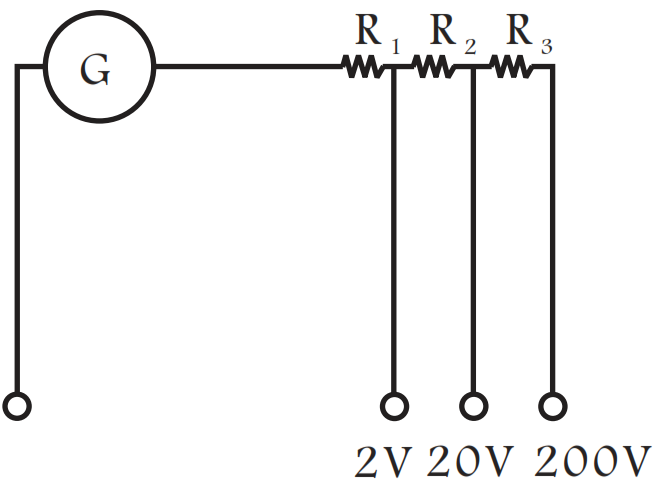
A multirange voltmeter can be constructed by using a galvanometer circuit as shown in Fig. We want to construct a voltmeter that can measure 2V, 20V and 200V using a galvanometer of resistance 10Ω and that produces maximum deflection for current of 1mA. Find R1, R2 and R3 that have to be used.

A parallel-plate capacitor of plate area 40cm2 and separation between the plates 0.10mm, is connected to a battery of emf 2.0V through a $16\Omega$ resistor. Find the electric field in the capacitor 10ns after the connections are made.
Let us list some of the factors, which could possibly influence the speed of wave propagation:
  1. Nature of the source.
  2. Direction of propagation.
  3. Motion of the source and/or observer.
  4. Wavelength.
  5. Intensity of the wave.
On which of these factors, if any, does
  1. The speed of light in vacuum,
  2. The speed of light in a medium (say, glass or water), depend?
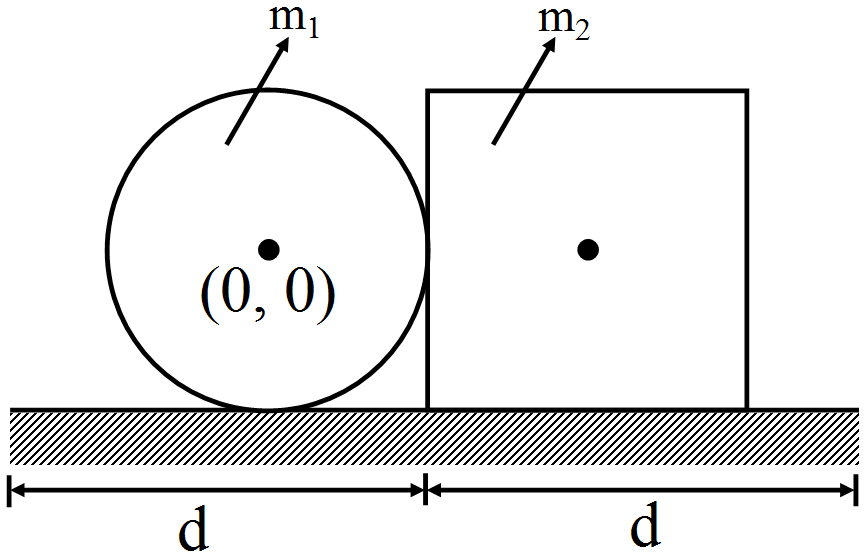
A square plate of edge d and a circular disc of diameter d are placed touching each other at the midpoint of an edge of the plate as shown in figure. Locate the centre of mass of the combination, assuming same mass per unit area for the two plates.