Question
A charged particle is accelerated through a potential difference of 12kV and acquires a speed of $1.0 \times 10^6m s^{−1}$. It is then injected perpendicularly into a magnetic field of strength 0.2T. Find the radius of the circle described by it.
Answer

$\text{V}=12\text{KV}$
$\text{E}=\frac{\text{qV}}{\text{ml}}$
Now, $\text{F}=\text{qE}=\frac{\text{qV}}{\text{l}}$
$\text{a}=\frac{\text{F}}{\text{m}}=\frac{\text{qv}}{\text{ml}}$
$\text{v}=1\times10^6\text{m/s}$
$\text{v}=\sqrt{2\times\frac{\text{qV}}{\text{ml}}\times\text{l}}=\sqrt{2\times\frac{\text{q}}{\text{m}}\times12\times10^3}$
$1\times10^6=\sqrt{2\times\frac{\text{q}}{\text{m}}\times12\times10^3}$
$\Rightarrow10^{12}=24\times10^3\times\frac{\text{q}}{\text{m}}$
$\Rightarrow\frac{\text{m}}{\text{q}}=\frac{24\times10^3}{10^{12}}=24\times10^{-9}$
$\Rightarrow\frac{\text{mV}}{\text{qB}}=\frac{24\times10^{-9}\times1\times10^6}{2\times10^{-1}}=12\times10^{-2}\text{m}=12\text{cm}$

Need a full question paper?

Generate a complete, print-ready paper with questions like this in minutes — across 16+ boards, with answer keys.

Start Generating Free

Similar questions

Doubly-ionised helium ions are projected with a speed of $10km/s^{-1}$ in a direction perpendicular to a uniform magnetic field of magnitude 1.0T. Find
  1. The force acting on an ion.
  2. The radius of the circle in which it circulates.
  3. The time taken by an ion to complete the circle.
A plane electromagnetic wave is passing through a region. Consider (a) electric field (b) magnetic field (c) electrical energy in a small volume and (d) magnetic energy in a small volume. Construct the pairs of the quantities that oscillate with equal frequencies.
When a proton is released from rest in a room, it starts with an initial acceleration $a_0$ towards west. When it is projected towards north with a speed $v_0$, it moves with an initial acceleration $3a_0$ towards west. Find the electric field and the maximum possible magnetic field in the room.
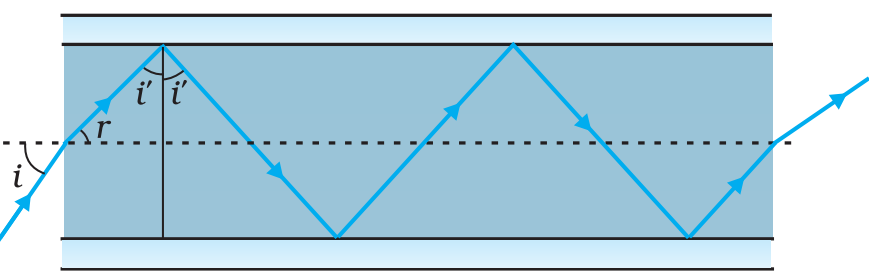
  1. a cross - section of a ‘light pipe’ made of a glass fibre of refractive. The outer covering of the pipe is made of a material of refractive. What is the range of the angles of the incident rays with the axis of the pipe for which total reflections inside the pipe take place, as shown in the figure.
  2. What is the answer if there is no outer covering of the pipe?
A pendulum bob of mass 50g is suspended from the ceiling of an elevator. Find the tension in the string if the elevator:
  1. Goes up with acceleration $1.2m/s^2.$
  2. Goes up with deceleration $1.2m/s^2.$
  3. Goes up with uniform velocity.
  4. Goes down with acceleration $1.2m/s^2.$
  5. Goes down with deceleration $1.2m/s^2.$
  6. Goes down with uniform velocity.
The earth revolves round the sun due to gravitational attraction. Suppose that the sun and the earth are point particles with their existing masses and that Bohr's quantization rule for angular momentum is valid in the case of gravitation. (a) Calculate the minimum radius the earth can have for its orbit. (b) What is the value of the principal quantum number n for the present radius? Mass of the earth $= 6.0 \times 10^{-24}kg$. Mass of the sun $= 2.0 \times 10^{30}kg, $ earth-sun distance $= 1.5 \times 10^{11}m.$
A capacitor of capacitance $C_1$ is charged to a potential $V_1$ while another capacitor of capacitance $C_2$ is charged to a potential difference $V_2$. The capacitors are now disconnected from their respective charging batteries and connected in parallel to each other.
$i.$ Find the total energy stored in the two capacitors before they are connected.
$ii.$ Find the total energy stored in the parallel combination of two capacitors.
$iii.$ Explain the reason for the difference of energy in parallel combination in comparison to the total energy before they are connected
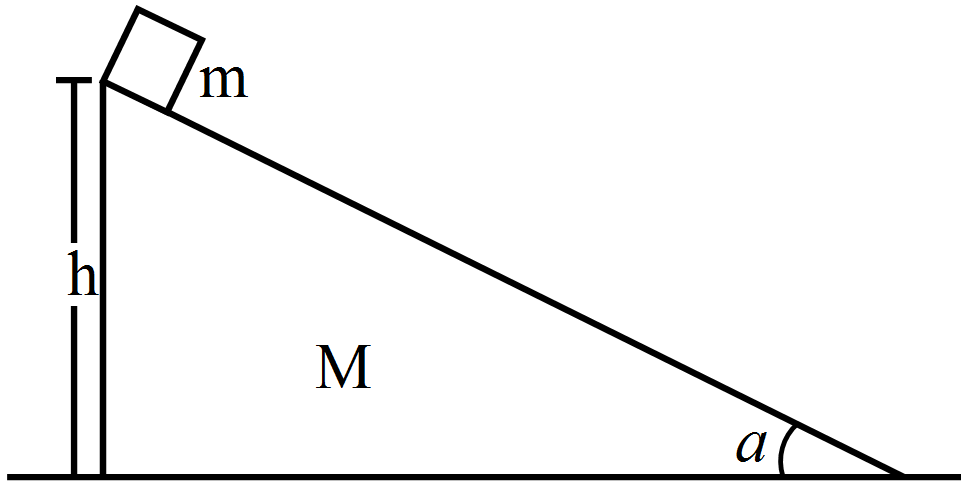
A block of mass m is placed on a triangular block of mass M, which in turn is placed on a horizontal surface as shown in figure. Assuming frictionless surfaces find the velocity of the triangular block when the smaller block reaches the bottom end.
Consider an electron in front of metallic surface at a distance d (treated as an infinite plane surface). Assume the force of attraction by the plate is given as $\frac{1}{2}\frac{\text{q}^2}{4\pi\in_0\text{d}^2}$
Calculate work in taking the charge to an infinite distance from the plate. Taking d = 0.1nm, find the work done in electron volts. [Such a force law is not valid for d < 0.1nm].
A circular disc made of iron is rotated about its axis at a constant velocity to $\omega$. Calculate the percentage change in the linear speed of a particle of the rim as the disc is slowly heated from $20^{\circ} \mathrm{C}$ to $50^{\circ} \mathrm{C}$ keeping the angular velocity constant. Coefficient of linear expansion of iron $=1.2 \times 10^{-5}{ }^{\circ} \mathrm{C}^{-1}$.