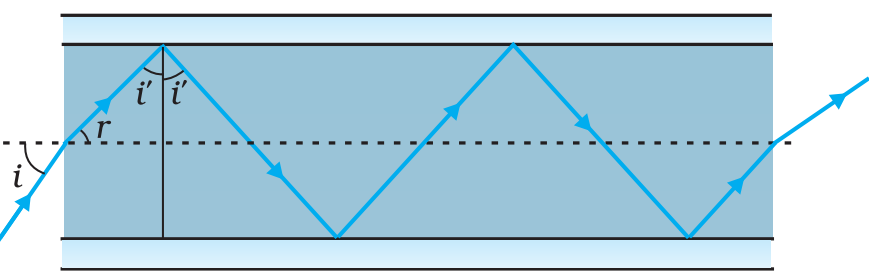
- a cross - section of a ‘light pipe’ made of a glass fibre of refractive. The outer covering of the pipe is made of a material of refractive. What is the range of the angles of the incident rays with the axis of the pipe for which total reflections inside the pipe take place, as shown in the figure.
- What is the answer if there is no outer covering of the pipe?
Exercise
Download our app for free and get started
- Refractive index of the glass fibre, $µ_1 = 1.68$
Angle of incidence = i
Angle of refraction = r
Angle of incidence at the interface = i'
The refractive index (µ) of the inner core - outer core interface is given as:
$\mu=\frac{\mu_2}{\mu_1}=\frac{1}{\sin\text{i}'}$
$\sin\text{i}'=\frac{\mu_1}{\mu_2}$
$=\frac{1.44}{1.68}=0.8571$
$\therefore \ \text{i}'=59^\circ$
For the critical angle, total internal reflection (TIR) takes place only when i > i, i. e., i > 59°
Maximum angle of reflection, $r_{max} = 90^\circ - i' = 90^\circ - 59^\circ = 31^\circ$
Let, $i_{max}$ be the maximum angle of incidence.
The refractive index at the air - glass interface, $µ_1 = 1.68$
We have the relation for the maximum angles of incidence and reflection as:
$\mu_1=\frac{\sin\text{i}_\text{max}}{\sin\text{r}_\text{max}}$
$=\sin\text{i}_\text{max}=\mu_1\sin\text{r}_\text{max}$
$= 1.68 sin 31°$
$= 1.68 × 0.5150$
$= 0.8652$
$\text{i}_\text{max}=\sin^{-1}0.8652\approx60^\circ$
Thus, all the rays incident at angles lying in the range 0 < i< 60° will suffer total internal reflection.
- If the outer covering of the pipe is not present, then:
For the angle of incidence i = 90°, we can write Snell's law at the air - pipe interface as:
$\frac{\sin\text{i}}{\sin\text{r}}=\mu_2=1.68$
$\sin\text{r}=\frac{\sin90^\circ}{1.68}=\frac{1}{1.68}$
$\text{r}=\sin^{-1}(0.5952)$
= 36.5°
$\therefore \ \text{i}'=90^\circ-36.5^\circ=53.5^\circ$
Since i' > r, All incident rays will suffer total internal reflection.

Download our appand get started for free
Experience the future of education. Simply download our apps or reach out to us for more information. Let's shape the future of learning together!No signup needed.*
Similar Questions
- 1View SolutionA paperweight in the form of a hemisphere of radius 3.0cm is used to hold down a printed page. An observer looks at the page vertically through the paperweight. At what height above the page will the printed letters near the centre appear to the observer?
- 2View SolutionA point object is placed at a distance of 15cm from a convex lens. The image is formed on the other side at a distance of 30cm from the lens. When a concave lens is placed in contact with the convex lens, the image shifts away further by 30cm. Calculate the focal lengths of the two lenses.
- 3View SolutionAn angular magnification (magnifying power) of 30X is desired using an objective of focal length 1.25 cm and an eyepiece of focal length 5 cm. How will you set up the compound microscope?
- 4View SolutionConsider the situation in figure. The bottom of the pot is a reflecting plane mirror, S is a small fish and T is a human eye. Refractive index of water is.
- At what distance(s) from itself will the fish see the image(s) of the eye?
- At what distance(s) from itself will the eye see the image(s) of the fish.
- 5View Solution
- Draw a labelled ray diagram to obtain the real image formed by an astronomical telescope in normal adjustment position. Define its magnifying power.
- You are given three lenses of power 0.5 D, 4 D and 10 D to design a telescope:
- Which lenses should he used as objective and eyepiece? Justify your answer.
- Why is the aperture of the objective preferred to be large?
- 6View Solution
- Draw a ray diagram to show image formation when the concave mirror produces a real, inverted and magnified image of the object.
- Obtain the mirror formula and write the expression for the linear magnification.
- Explain two advantages of a reflecting telescope over a refracting telescope.
- 7View SolutionA gun of mass M fires a bullet of mass m with a horizontal speed V. The gun is fitted with a concave mirror of focal length f facing tpwards the receding bullet. Find the speed of separation of the bullet and the image just after the gun was fired.
- 8View SolutionA Cassegrain telescope uses two mirrors. Such a telescope is built with the mirrors 20 mm apart. If the radius of curvature of the large mirror is 220 mm and the small mirror is 140 mm, where will the final image of an object at infinity be?
- 9View Solutionequiconvex lens (of refractive index 1.50) in contact with a liquid layer on top of a plane mirror. A small needle with its tip on the principal axis is moved along the axis until its inverted image is found at the position of the needle. The distance of the needle from the lens is measured to be 45.0 cm. The liquid is removed and the experiment is repeated. The new distance is measured to be 30.0 cm. What is the refractive index of the liquid?
- 10A card sheet divided into squares each of size $1\ mm^2$ is being viewed at a distance of 9 cm through a magnifying glass (a converging lens of focal length 9 cm) held close to the eye.View Solution
- What is the magnification produced by the lens? How much is the area of each square in the virtual image?
- What is the angular magnification (magnifying power) of the lens?
- Is the magnification in (a) equal to the magnifying power in (b)? Explain.