A charged particle moves along circular path in a uniform magnetic field in a cyclotron. The kinetic energy of the charged particle increases to $4$ times its initial value. What will be the ratio of new radius to the original radius of circular path of the charged particle
JEE MAIN 2022, Medium
Download our app for free and get started
radius of paerticle in cyclotron
$r =\frac{\sqrt{2 mK . E .}}{ qB }$
So ratio of new radius to original
$\frac{ r _{ n }}{ r _{0}}=\sqrt{\frac{( K \cdot E .)_{ n }}{( K \cdot E )_{0}}}=\sqrt{4} \Rightarrow 2: 1$

Download our appand get started for free
Experience the future of education. Simply download our apps or reach out to us for more information. Let's shape the future of learning together!No signup needed.*
Similar Questions
- 1View SolutionCurrent flows through uniform, square frames as shown. In which case is the magnetic field at the centre of the frame not zero?
- 2A metallic rod of mass per unit length $0.5\; kg\; m^{-1}$ is lying horizontally on a smooth inclined plane which makes an angle of $30^o$ with the horizontal. The rod is not allowed to slide down by flowing a current through it when a magnetic field of induction $0.25\; T$ is acting on it in the vertical direction. The current flowing in the rod to keep it stationary is.....$A$View Solution
- 3View SolutionTesla is the unit of
- 4View SolutionA cell is connected between two points of a uniformly thick circular conductor. The magnetic field at the centre of the loop will be
- 5A long solenoid carrying a current produces a magnetic field $B$ along its axis. If the current is doubled and the number of turns per cm is halved, the new value of the magnetic field isView Solution
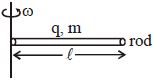
- 6In the given diagram a rod is rotating with angular velocity $\omega $. Mass of this rod is $m$ charge $q$ and length $l$ then find out magnetic moment of this rodView Solution
- 7View SolutionThe following statement is false for Helmholtz coils
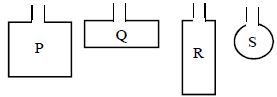
- 8Four wires, each of length $2.0\,m$, are bent into four loops $P,\,Q,\,R$ and $S$ and then suspended in a uniform magnetic field. If the same current is passed in each, then the torque will be maximum on the loopView Solution
- 9A galvanometer, whose resistance is $50\,ohm,$ has $25$ divisions in it. When a current of $4\times 10^{-4}\,A$ passes through it, its needle (pointer) deflects by one division. To use this galvanometer as a voltmeter of range $2.5\,V,$ it should be connected to a resistance of.......$ohm$View Solution
- 10A disc of radius $r$ and carrying positive charge $q$ is rotating with an angular speed $l$ in a uniform magnetic field $B$ about a fixed axis as shown in figure, such that angle made by axis of disc with magnetic field is $\theta $. Torque applied by axis on the disc isView Solution