A charged particle moves along circular path in a uniform magnetic field in a cyclotron. The kinetic energy of the charged particle increases to $4$ times its initial value. What will be the ratio of new radius to the original radius of circular path of the charged particle
JEE MAIN 2022, Medium


Download our appand get started for free
Experience the future of education. Simply download our apps or reach out to us for more information. Let's shape the future of learning together!No signup needed.*
Similar Questions
- 1View SolutionTwo parallel wires are carrying electric currents of equal magnitude and in the same direction. They exert
- 2View SolutionThe ratio of the magnetic field at the cpentre of a current carrying circular wire and the magnetic field at the centre of a square coil made from the same length of wire will be
- 3A proton and a deutron ( $\mathrm{q}=+\mathrm{e}, m=2.0 \mathrm{u})$ having same kinetic energies enter a region of uniform magnetic field $\vec{B}$, moving perpendicular to $\vec{B}$. The ratio of the radius $r_d$ of deutron path to the radius $r_p$ of the proton path is:View Solution
- 4Ionized hydrogen atoms and $\alpha$ -particles with same momenta enters perpendicular to a constant magnetic field $B$. The ratio of their radii of their paths $\mathrm{r}_{\mathrm{H}}: \mathrm{r}_{\alpha}$ will beView Solution
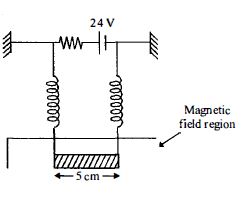
- 5The circuit in figure consists of wires at the top and bottom and identical springs as the left and right sides. The wire at the bottom has a mass of $10\, g$ and is $5\, cm$ long. The wire is hanging as shown in the figure. The springs stretch $0.5\, cm$ under the weight of the wire and the circuit has a total resistance of $12\, \Omega $. When the lower wire is subjected to a static magnetic field, the springs, stretch an additional $0.3\, cm$. The magnetic field isView Solution
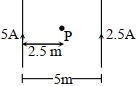
- 6For adjoining fig., The magnetic field at point, $P$ will beView Solution
- 7Two ions having same mass have charges in the ratio $1: 2$. They are projected normally in a uniform magnetic field with their speeds in the ratio $2: 3$. The ratio of the radii of their circular trajectories is -View Solution
- 8View SolutionTesla is the unit of
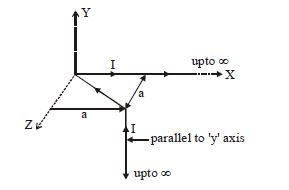
- 9View SolutionThe magnetic field at the origin due to the current flowing in the wire is
- 10Two mutually perpendicular conductors carrying currents $I_1$ and $I_2$ lie in one plane. Locus of the point at which the magnetic induction is zero, is aView Solution