A proton and a deutron ( $\mathrm{q}=+\mathrm{e}, m=2.0 \mathrm{u})$ having same kinetic energies enter a region of uniform magnetic field $\vec{B}$, moving perpendicular to $\vec{B}$. The ratio of the radius $r_d$ of deutron path to the radius $r_p$ of the proton path is:
JEE MAIN 2024, Diffcult
Download our app for free and get started
In uniform magnetic field,
$\mathrm{R}=\frac{\mathrm{m} v}{\mathrm{qB}}=\frac{\sqrt{2 \mathrm{~m}(\mathrm{~K} \cdot \mathrm{E})}}{\mathrm{qB}}$
Since same $K.E$
$\mathrm{R} \propto \frac{\sqrt{\mathrm{m}}}{\mathrm{q}}$
$\therefore \frac{\mathrm{R}_{\text {deutron }}}{\mathrm{R}_{\text {proton }}}=\sqrt{\frac{\mathrm{m}_{\mathrm{d}}}{\mathrm{m}_{\mathrm{p}}}} \times \frac{\mathrm{q}_{\mathrm{p}}}{\mathrm{q}_{\mathrm{d}}}$
$=\sqrt{2} \times 1$
$\therefore \gamma_{\mathrm{d}}: \gamma_{\mathrm{p}}=\sqrt{2}: 1$

Download our appand get started for free
Experience the future of education. Simply download our apps or reach out to us for more information. Let's shape the future of learning together!No signup needed.*
Similar Questions
- 1A charged particle enters a uniform magnetic field with velocity vector making an angle of $30^o$ with the magnetic field. The particle describes a helical trajectory of pitch $x$ . The radius of the helix isView Solution
- 2A long solenoid of radius $2\, cm$ has $100\, turns/cm$ and carries a current of $5\,A$. A coil of radius $1\, cm$ having $100\, turns$ and a total resistance of $20\,\Omega $ is placed inside the solenoid coaxially. The coil is connected to a galvanometer. If the current in the solenoid is reversed in direction, find the charge flown through the galvanometerView Solution
- 3View SolutionTwo long wires are hanging freely. They are joined first in parallel and then in series and then are connected with a battery. In both cases, which type of force acts between the two wires
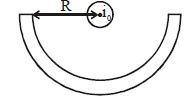
- 4Adjoining figure shows a very long semicylindrical conducting shell of radius $R$ and carrying a current $i$. An infinitely long straight current carrying conductor is lying along the axis of the semi-cylinder. If the current flowing through the straight wire be $i_0$, then the force per unit length on the conducting wire isView Solution
- 5The dipole moment of a circular loop carrying a current $I$, is $m$ and the magnetic field at the centre of the loop is $B_1$ . When the dipole moment is doubled by keeping the current constant, the magnetic field at the centre of the loop is $B_2$ . The ratio $\frac{{{B_1}}}{{{B_2}}}$ isView Solution
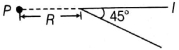
- 6A long straight wire, carrying current $I$ is bent at its mid-point to form an angle of $45^{\circ}$. Induction of magnetic field (in tesla) at point $P$, distant $R$ from point of bending is equal toView Solution
- 7Given below are two statements:View Solution
Statement $(I)$: When an object is placed at the centre of curvature of a concave lens, image is formed at the centre of curvature of the lens on the other side.
Statement $(II)$: Concave lens always forms a virtual and erect image.
In the light of the above statements, choose the correct answer from the options given below:
- 8The deflection in moving coil galvanometer falls from $25$ divisions to $5$ division when a shunt of $24\ \Omega$ is applied. The resistance of galvanometer coil will be :View Solution
- 9View SolutionTesla is the unit of
- 10A current $i$ is flowing in a conductor of length $l$. When it is bent in the form of a circular loop then its magnetic moment will be-View Solution