A charged particle moves in a uniform magnetic field. The velocity of the particle at some instant makes an acute angle with the magnetic field. The path of the particle will be
Easy


Download our appand get started for free
Experience the future of education. Simply download our apps or reach out to us for more information. Let's shape the future of learning together!No signup needed.*
Similar Questions
- 1In the figure, find out the magnetic field at $B$ (Given $I =2.5 \;A,r =5\, cm )$View Solution
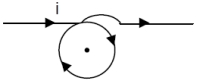
- 2A large current carrying plate is kept along $y-z$ plane with $k$ $amp$ current per unit length in the $+ve$ $y$ direction. Find the net force on the semi cricular current carrying looplying in the $x-y$ plane. Radius of loop is $R$, current is $i$ and centre is at $(d,0, 0)$ where $(d > R)$View Solution
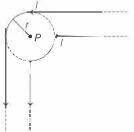
- 3Two infinitely long wires each carrying current $I$ along the same direction are made into the geometry as shown in the figure below. The magnetic field at the point $P$ isView Solution
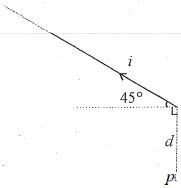
- 4Find the magnitude of magnetic field at point $p$ due to a semi - infinite wire given belowView Solution
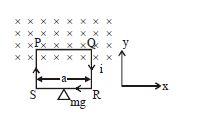
- 5A rectangular loop of wire, supporting a mass $m$, hangs with one end in a uniform magnetic field $\vec B$ pointing into the plane of the paper. $A$ clockwise current is set up such that $i> mg/Ba,$ where $a$ is the width of the loop. ThenView Solution
- 6Two very long, straight and parallel wires carry steady currents $I$ and $I$ respectively. The distance between the wires is $d$. At a certain instant of time, a point charge $q$ is at a point equidistant from the two wires in the plane of the wires. Its instantaneous velocity $v$ is perpendicular to this plane. The magnitude of the force due to the magnetic field acting on the charge at this instant isView Solution
- 7A proton and a deutron ( $\mathrm{q}=+\mathrm{e}, m=2.0 \mathrm{u})$ having same kinetic energies enter a region of uniform magnetic field $\vec{B}$, moving perpendicular to $\vec{B}$. The ratio of the radius $r_d$ of deutron path to the radius $r_p$ of the proton path is:View Solution
- 8A straight wire carrying a current ${i_1}\,amp$ runs along the axis of a circular current ${i_2}\,amp$. Then the force of interaction between the two current carrying conductors isView Solution
- 9An electron, moving in a uniform magnetic field of induction of intensity $\vec B,$ has its radius directly proportional toView Solution
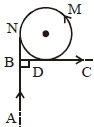
- 10A very long wire $ABDMNDC$ is shown in figure carrying current $I. AB$ and $BC$ parts are straight, long and at right angle. At $D$ wire forms a circular turn $DMND$ of radius $R. AB.$ $\mathrm{BC}$ parts are tangential to circular turn at $\mathrm{N}$ and $D$. Magnetic field at the centre of circle isView Solution