Find the magnitude of magnetic field at point $p$ due to a semi - infinite wire given below
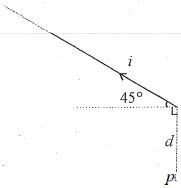
Diffcult
Download our app for free and get started
$B=\frac{\mu_{0} i}{4 \pi d} \times\left[\sin \theta_{1}+\sin \theta_{2}\right]$
Where $d$ is $\perp $ distance iron wire
$B=\frac{\mu_{0} i}{4 \pi d / \sqrt{2}} \times\left[\sin 90-\sin 45^{\circ}\right]$
$ = \frac{{\sqrt 2 {\mu _0}i}}{{4\pi d}}\left[ {1 - \frac{1}{{\sqrt 2 }}} \right]$
$ {B=\frac{\mu_{0} i}{4 \pi d}[\sqrt{2}-1]}$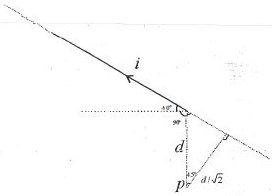

Download our appand get started for free
Experience the future of education. Simply download our apps or reach out to us for more information. Let's shape the future of learning together!No signup needed.*
Similar Questions
- 1A uniform magnetic field $B$ of $0.3\, T$ is along the positive $Z-$ direction . A rectangular loop $(abcd)$ of sides $10\, cm\times5\, cm$ carries a current $I$ of $12\, A$. Out of the following different orientations which one corresponds to stable equilibrium ?View Solution
- 2An ammeter gives full scale deflection when current of $1.0\, A$ is passed in it. To convert it into $10\, A$ range ammeter, the ratio of its resistance and the shunt resistance will beView Solution
- 3A proton of energy $8\, eV$ is moving in a circular path in a uniform magnetic field. The energy of an alpha particle moving in the same magnetic field and along the same path will be.....$eV$View Solution
- 4A galvanometer whose resistance is $120\,\Omega $ gives full scale deflection with a current of $0.05\, A$ so that it can read a maximum current of $10\, A$. A shunt resistance is added in parallel with it. The resistance of the ammeter so formed is .............. $\Omega $View Solution
- 5A square loop of side $l$ is kept in a uniform magnetic field $B$ such that its plane makes an angle $\alpha$ with $\vec{B}$. The loop carries a current $i$. The torque experienced by the loop in this position isView Solution
- 6In an ionised sodium atom, an electron is moving in a circular path of radius $r$ with angular velocity $\omega $. The magnetic induction in $wb/m^2$ produced at the nucleus will beView Solution
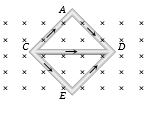
- 7Same current $i = 2A$ is flowing in a wire frame as shown in figure. The frame is a combination of two equilateral triangles $ACD$ and $CDE$ of side $1\,m$. It is placed in uniform magnetic field $B = 4T$ acting perpendicular to the plane of frame. The magnitude of magnetic force acting on the frame is.......$N$View Solution
- 8A moving coil galvanometer is converted into an ammeter reading upto $0.03\,A$ by connecting a shunt of resistance $4r$ across it and into an ammeter reading upto $0.06\,A$ when a shunt of resistance $r$ is connected across it. What is the maximum current which can be sent through this galvanometer if no shunt is used ............... $A$View Solution
- 9A solenoid of $1.5$ $metre$ length and $4.0\, cm$ diameter posses $10$ $turn$ per $cm$. A current of $5$ $ampere$ is flowing through it. The magnetic induction at axis inside the solenoid isView Solution
- 10Two infinitely long straight wires lie in the $\mathrm{xy}$-plane along the lines $\mathrm{x}=+R$. The wire located at $\mathrm{x}=+\mathrm{R}$ carries a constant current $\mathrm{I}_1$ and the wire located at $\mathrm{x}=-R$ carries a constant current $\mathrm{I}_2$. A circular loop of radius $R$ is suspended with its centre at $(0,0, \sqrt{3} R)$ and in a plane parallel to the xy-plane. This loop carries a constant current $/$ in the clockwise direction as seen from above the loop. The current in the wire is taken to be positive if it is in the $+\hat{\mathrm{j}}$ direction. Which of the following statements regarding the magnetic field $\dot{B}$ is (are) true?View Solution
$(A)$ If $I_1=I_2$, then B' cannot be equal to zero at the origin $(0,0,0)$
$(B)$ If $\mathrm{I}_1>0$ and $\mathrm{I}_2<0$, then $\mathrm{B}$ can be equal to zero at the origin $(0,0,0)$
$(C)$ If $\mathrm{I}_1<0$ and $\mathrm{I}_2>0$, then $\mathrm{B}$ can be equal to zero at the origin $(0,0,0)$
$(D)$ If $\mathrm{I}_1=\mathrm{I}_2$, then the $\mathrm{z}$-component of the magnetic field at the centre of the loop is $\left(-\frac{\mu_0 \mathrm{I}}{2 \mathrm{R}}\right)$