A charged particle of charge $Q $ is held fixed and another charged particle of mass $m$ and charge $q$ (of the same sign) is released from a distance $r.$ The impulse of the force exerted by the external agent on the fixed charge by the time distance between $Q$ and $q$ becomes $2r$ is
Advanced


Download our appand get started for free
Experience the future of education. Simply download our apps or reach out to us for more information. Let's shape the future of learning together!No signup needed.*
Similar Questions
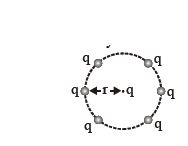
- 1A point charge is surrounded symmetrically by six identical charges at distance $r$ as shown in the figure. How much work is done by the forces of electrostatic repulsion when the point charge $q$ at the centre is removed at infinityView Solution
- 2Point charge ${q_1} = 2\,\mu C$ and ${q_2} = - 1\,\mu C$ are kept at points $x = 0$ and $x = 6$ respectively. Electrical potential will be zero at pointsView Solution
- 3A uniformly charged solid sphere of radius $R$ has potential $V_0$ (measured with respect to $\infty$) on its surface. For this sphere the equipotential surfaces with potentials $\frac{{3{V_0}}}{2},\;\frac{{5{V_0}}}{4},\;\frac{{3{V_0}}}{4}$ and $\frac{{{V_0}}}{4}$ have rasius $R_1,R_2,R_3$ and $R_4$ respectively. ThenView Solution
- 4The distance between the plates of a charged parallel plate capacitor is $5\ cm$ and electric field inside the plates is $200\ Vcm^{-1}$. An uncharged metal bar of width $2\ cm$ is fully immersed into the capacitor. The length of the metal bar is same as that of plate of capacitor. The voltage across capacitor after the immersion of the bar is......$V$View Solution
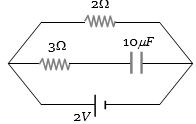
- 5The charge on a capacitor of capacitance $10\,\mu F$ connected as shown in the figure is.......$\mu C$View Solution
- 6The space between the plates of a parallel plate capacitor is filled with a 'dielectric' whose 'dielectric constant' varies with distance as per the relation:View Solution
$K(x) = K_0 + \lambda x$ ( $\lambda =$ constant)
The capacitance $C,$ of the capacitor, would be related to its vacuum capacitance $C_0$ for the relation
- 7A negatively charged plate has charge density of $2 \times {10^{ - 6}}\,C/{m^2}$. The initial distance of an electron which is moving toward plate, cannot strike the plate, if it is having energy of $200\,eV$View Solution
- 8A capacitor is charged with a battery and energy stored is $U$. After disconnecting battery another capacitor of same capacity is connected in parallel to the first capacitor. Then energy stored in each capacitor isView Solution
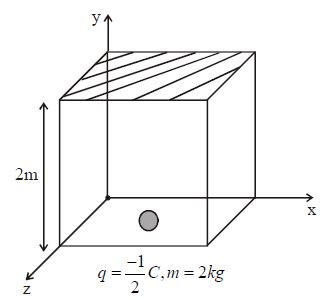
- 9Consider a gravity free container as shown. System is initially at rest and electric potential in the regon is $V = (y^3+2)\ J/C$. A ball of charge $q$ and mass $m$ is released from rest from base starts to move up due to electric field and collides with the shaded face as shown.If its speed just after collision is $1.5\ m/s$ and time for which ball is in contact with shaded face is $0.1\ sec$, find external force required to hold the container fixed in its position during collision assuming ball exerts constant force on wall during entire span of collision.......$N$View Solution
- 10The electric potential at a point $(x,\;y)$ in the $x - y$ plane is given by $V = - kxy$. The field intensity at a distance $r$ from the origin varies asView Solution