The electric potential at a point $(x,\;y)$ in the $x - y$ plane is given by $V = - kxy$. The field intensity at a distance $r$ from the origin varies as
Medium
Download our app for free and get started
(b) ${E_x} = - \frac{{dV}}{{dx}} = - \,ky$; ${E_y} = - \frac{{dV}}{{dy}} = \, - kx$
$E = \sqrt {E_x^2 + E_y^2} = k\sqrt {{x^2} + {y^2}} = kr$=
$E = \sqrt {E_x^2 + E_y^2} = k\sqrt {{x^2} + {y^2}} = kr$=
$E \propto r$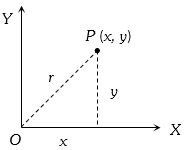

Download our appand get started for free
Experience the future of education. Simply download our apps or reach out to us for more information. Let's shape the future of learning together!No signup needed.*
Similar Questions
- 1A parallel plate capacitor is connected to a battery. The quantities charge, voltage, electric field and energy associated with the capacitor are given by $Q_0, V_0, E_0$ and $U_0$ respectively. A dielectric slab is introduced between plates of capacitor but battery is still in connection. The corresponding quantities now given by $Q, V, E$ and $U$ related to previous ones areView Solution
- 2View SolutionOne plate of parallel plate capacitor is smaller than other, then charge on smaller plate will be
- 3Two identical capacitors have same capacitance $C$. One of them is charged to the potential $\mathrm{V}$ and other to the potential $2 \mathrm{~V}$. The negative ends of both are connected together. When the positive ends are also joined together, the decrease in energy of the combined system is :View Solution
- 4Ten electrons are equally spaced and fixed around a circle of radius $R$. Relative to $V = 0$ at infinity, the electrostatic potential $V$ and the electric field $E$ at the centre $C$ areView Solution
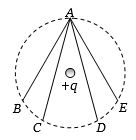
- 5In the electric field of a point charge $q$, a certain charge is carried from point $A$ to $B$, $C$, $D$ and $E$. Then the work doneView Solution
- 6Figure shows a positively charged infinite wire. $A$ particle of charge $2C$ moves from point $A$ to $B$ with constant speed. (Given linear charge density on wire is $\lambda = 4 \pi \varepsilon_0$)View Solution
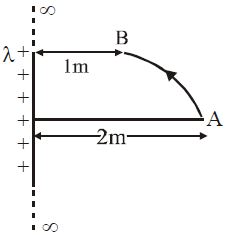
- 7View SolutionWork done in moving a positive charge on an equipotential surface is
- 8A series combination of $n_1$ capacitors, each of value $C_1$ is charged by a source of potential difference $4\, V.$ When another parallel combination of $n_2$ capacitors, each of value $C_2,$ is charged by a source of potential difference $V$, it has the same (total) energy stored in it, as the first combination has. The value of $C_2,$ in terms of $C_1$ is thenView Solution
- 9A fully charged capacitor has a capacitance $‘C’$. It is discharged through a small coil of resistance wire embedded in a thermally insulated block of specific heat capacity $‘s’$ and mass $‘m’$. If the temperature of the block is raised by ‘$\Delta T$’, the potential difference $‘V’$ across the capacitance isView Solution
- 10Two small equal point charges of magnitude $q$ are suspended from a common point on the ceiling by insulating mass less strings of equal lengths. They come to equilibrium with each string making angle $\theta $ from the vertical. If the mass of each charge is $m,$ then the electrostatic potential at the centre of line joining them will be $\left( {\frac{1}{{4\pi { \in _0}}} = k} \right).$View Solution