MCQ
A circular loop is kept in that vertical plane which contains the north-south direction. It carries a current that is towards north at the topmost point. Let A be a point on the axis of the circle to the east of it and B a point on this axis to the west of it. The magnetic field due to the loop
  • A
    Is towards east at A and towards west at B.
  • B
    Is towards west at A and towards east at B.
  • C
    Is towards east at both A and B.
  • Is towards west at both A and B.

Answer

Correct option: D.
Is towards west at both A and B.
Explanation:
According to the right-hand thumb rule, if we curl the fingers of our right hand in the direction of the current flowing, then the stretching of the thumb will show the direction of the magnetic field developed due to it and vice versa.
Let north-south is along x axis and east-west is along y axis. Circular wire is in xz plane. Then point A will lie on positive y axis and B on negative y axis. On looking from point B, current is flowing in anticlockwise direction so the magnetic field will point from right to left. Hence, the magnetic field due to the loop will be towards west at both A and B.

Need a full question paper?

Generate a complete, print-ready paper with questions like this in minutes — across 16+ boards, with answer keys.

Start Generating Free

Similar questions

An athlete is running at a speed of $30 \ kmh ^{-1}$ towards east, holding a $3$ m metallic rod horizontally. The horizontal component of the earth, magnetic field in this region is $3 \times 10^{-4}$ Tesla and the angle of dip is $30^{\circ}$. Then, the emf induced across the ends of the rod is.
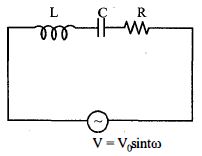
For the $LCR$ circuit, shown here, the current is observed to lead the applied voltage. An additional capacitor $C '$ , when joined with the capacitor $C$ present in the circuit , makes the power factor of the circuit unity. The capacitor $C'$, must have been connected in
A charged $30\,\mu F$ capacitor is connected to a $27\,mH$ inductor. The angular frequency of free oscillations of the circuit is
A coil having an inductance of 0.5 H carries a current which is uniformly varying from zero to 10 ampere in 2 second. The e.m.f. (in volts) generated in the coil is
A fighter plane of length $20\, m$, wing span (distance from tip of one wing to the tip of the other wing) of $15\,m$ and height $5\,m$ is lying towards east over Delhi. Its speed is $240\, ms^{-1}$ . The earth's magnetic field over Delhi is $5 \times 10^{-5}\,T$ with the declination angle $ \sim {0^o}$ and dip of $\theta$ such that $\sin \,\theta  = \frac{2}{3}$. If the voltage developed is $V_B$ between the lower and upper side of the plane and $V_W$ between the tips of the wings then $V_B$ and $V_W$ are close to
In a conductor, if the number of conduction electrons per unit volume is $8.5 \times 10^{28}\, m^{-3}$ and mean free time is $25\,fs$ (femto second), its approximate resistivity is $\left( {{m_e} = 9.1 \times {{10}^{ - 31}}\,kg} \right)$
The thermionic emission of electron is due to
The displacement at point P by two light waves emitted from this light source is $Y _1=5 \sin \omega t$ and $Y _2$ $=3 \cos \omega t$ respectively, then both the waves will be :
The north pole of a magnet is brought near a metallic ring. The direction of the induced current in the ring will be
At a distance $l$ from a uniformly charged long wire, a charged particle is thrown radially outward with a velocity $u$ in the direction perpendicular to the wire. When the particle reaches a distance $2 l$ from the wire, its speed is found to be $\sqrt{2} u$. The magnitude of the velocity, when it is a distance $4 l$ away from the wire is (ignore gravity)