Question
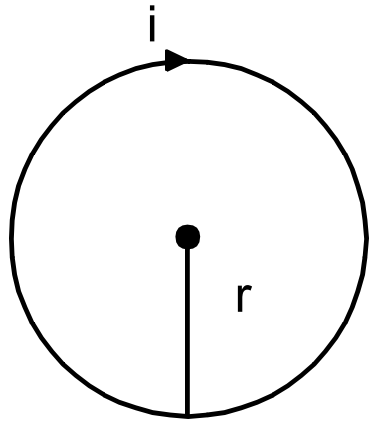
A circular loop of radius r carries a current i. How should a long, straight wire carrying a current 4i be placed in the plane of the circle so that the magnetic field at the centre becomes zero?
Answer


$\overrightarrow{\text{B}}$ due to loop $\frac{\mu_0\text{i}}{2\text{r}}$
Let the straight current carrying wire be kept at a distance R from centre. Given I = 4i
$\overrightarrow{\text{B}}$ due to wire $\frac{\mu_0\text{i}}{2\pi\text{R}}=\frac{\mu_0\times4\text{i}}{2\pi\text{R}}$
Now, the $\overrightarrow{\text{B}}$ due to both will balance each other
Hence $\frac{\mu_0\text{i}}{2\text{r}}=\frac{\mu_04\text{i}}{2\pi\text{R}}\Rightarrow\text{R}=\frac{4\text{r}}{\pi}$
Hence the straight wire should be kept at a distance $\frac{4\pi}{\text{r}}$ from centre in such a way that the direction of current in it is opposite to that in the nearest part of circular wire. As a result the direction will $\overrightarrow{\text{B}}$ will be oppose.

Need a full question paper?

Generate a complete, print-ready paper with questions like this in minutes — across 16+ boards, with answer keys.
Start Generating Free

Similar questions

A human body excretes (removes by waste discharge, sweating, etc.) certain materials by a law similar to radioactivity. If technetium is injected in some form in a human body, the body excretes half the amount in 24 hours. A patient is given an injection containing $^{99}Tc$. This isotope is radioactive with a half-life of 6 hours. The activity from the body just after the injection is $6\mu\text{Ci}.$ How much time will elapse before the activity falls to $3\mu\text{Ci}?$
A myopic person has been using spectacles of power –1.0 dioptre for distant vision. During old age he also needs to use separate reading glass of power + 2.0 dioptres. Explain what may have happened.
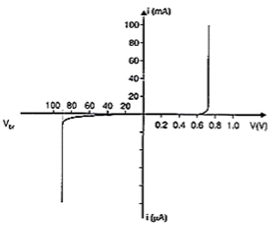
The following figure shows the V-I characteristics of a semiconductor diode.
i. Identify the semiconductor diode used.
ii. Draw the circuit diagram to obtain the given characteristics of this device.
iii. Briefly explain how this diode can be used as a voltage regulator.
Image
The given graph shows the variation of photo-electric currently) with the applied voltage(V) for two different materials and for two different intensities of the incident radiations. Identify and explain using Einstein's photo electric equation the pair of curves that correspond to (i) different materials but same intensity of incident radiation (ii) different intensities but same materials.
$a.$ Differentiate between nuclear fission and nuclear fusion.
$b.$ Deuterium undergoes fusion as per the reaction:
${ }_1^2 H +{ }_1^2 H \longrightarrow{ }_2^3 He +{ }_0^1 n +3.27 MeV$
Find the duration for which an electric bulb of $500 W$ can be kept glowing by the fusion of $100 g$ of deuterium.
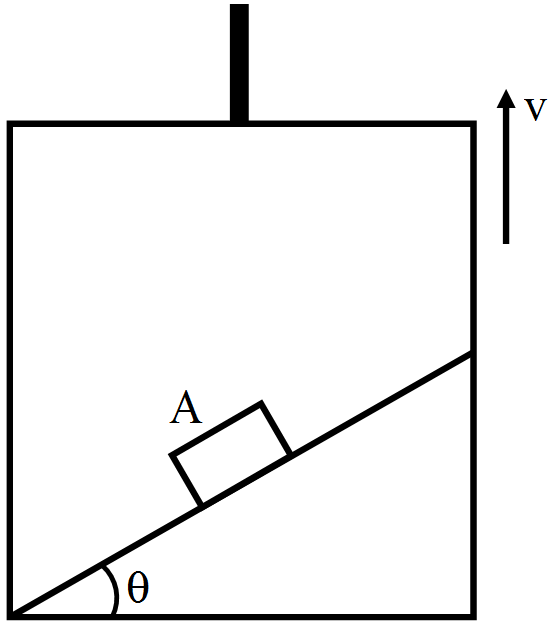
A block A can slide on a frictionless incline of angle $\theta$ and length l, kept inside an elevator going up with uniform velocity v. Find the time taken by the block to slide down the length of the incline if it is released from the top of the incline.

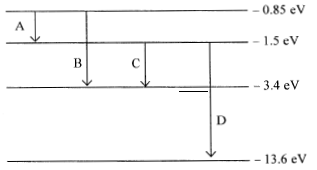
The energy level diagram of an element is given below. Identify, by doing necessary calculations, which transition corresponds to the emission of a spectral line of wavelength 102.7 nm.
A circular loop of radius 20cm carries a current of 10A. An electron crosses the plane of the loop with a speed of $2.0 \times 10^6m/s$. The direction of motion makes an angle of 30° with the axis of the circle and passes through its centre. Find the magnitude of the magnetic force on the electron at the instant it crosses the plane.
Consider the situation of the previous problem. Find the average electric field energy stored in the capacitor and the average magnetic field energy stored in the coil.
A steel wire of original length 1m and cross-sectional area $4.00mm^2$ is clamped at the two ends so that it lies horizontally and without tension. If a load of 2.16kg is suspended from the middle point of the wire, what would be its vertical depression? Y of the steel $= 2.0 \times 10^{11}N/m^2$ Take $g = 10m/s^2.$