Question
A myopic person has been using spectacles of power –1.0 dioptre for distant vision. During old age he also needs to use separate reading glass of power + 2.0 dioptres. Explain what may have happened.

Answer

Power of spectacles, P = -1 D
$\therefore$ Focal length, f = -100 cm
That is, the far point of the person is at 100 cm.
Near point of the eye might have been normal (i.e., 25 cm).
The objects at infinity produce virtual images at 100 cm (using spectacles).
To see objects between 25 cm to 100 cm, the person uses the ability of accommodation of his eye-lens. This ability is partially lost in old age.
The near point of the eye may recede to 50 cm. He has, therefore, to use glasses of suitable power for reading.
Here,
Object distance, u = -25 cm
Image distance, v = -50 cm
Since, $\frac{1}{\text{v}}-\frac{1}{\text{u}}=\frac{1}{\text{f}}=-\frac{1}{50}+\frac{1}{25}$
i.e., focal length, f = 50 cm
power $\text{P}=\frac{100}{\text{f}}=\frac{100}{50}=+2$ dipotre.

Need a full question paper?

Generate a complete, print-ready paper with questions like this in minutes — across 16+ boards, with answer keys.
Start Generating Free

Similar questions

A wire carries an alternating current $\text{i}=\text{i}_0\sin\omega\text{t}.$ Is there an electric field in the vicinity of the wire?
Draw a circuit diagram of a transistor amplifier in CE configuration. Under what condition does the transistor act as an amplifier?
Define the terms:
i. Input resistance and
ii. Current amplification factor. How are these determined using typical input and output characteristics?
The sunlight reaching Earth has maximum electric field of $810Vm^{-1}$. What is the maximum magnetic field in this light?
In Young’s double slit experiment, the two slits are separated by a distance of 1·5 mm and the screen is placed 1 m away from the plane of the slits. A beam of light consisting of two wavelengths 650 nm and 520 nm is used to obtain interference fringes. Find.
  1. The distance of the third bright fringe for$\lambda = 520$ nm on the screen from the central maximum.
  2. The least distance from the central maximum where the bright fringes due to both the wavelengths coincide.
  1. Calculate the distance of an object of height h from a concave mirror of radius of curvature 20 cm, so as to obtain a real image of magnification 2. Find the location of image also.
  2. Using mirror formula, explain why does a convex mirror always produce a virtual image.
Use Biot-Savart law to derive the expression for the magnetic field on the axis of a current carrying circular loop of radius R. Draw the magnetic field lines due to a circular wire carrying current I.
A transverse wave described by$\text{y}=(0.02\text{m})\sin\Big[(1.0\text{m}^{-1})\text{x}+(30\text{s}^{-1})\text{t}\Big]$
propagates on a stretched string having a linear mass density of $1.2 \times 10^{-4}kg/m$. Find the tension in the string.
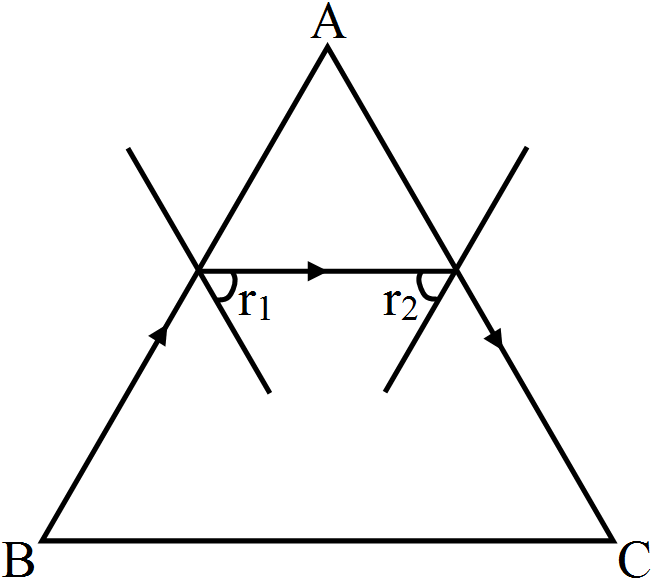
A light ray incident at grazing angle on the face AB of a prism ABC, follows the path shown in the figure. Obtain the relation between the angle of prism A and the refractive index $\mu$ of its material.
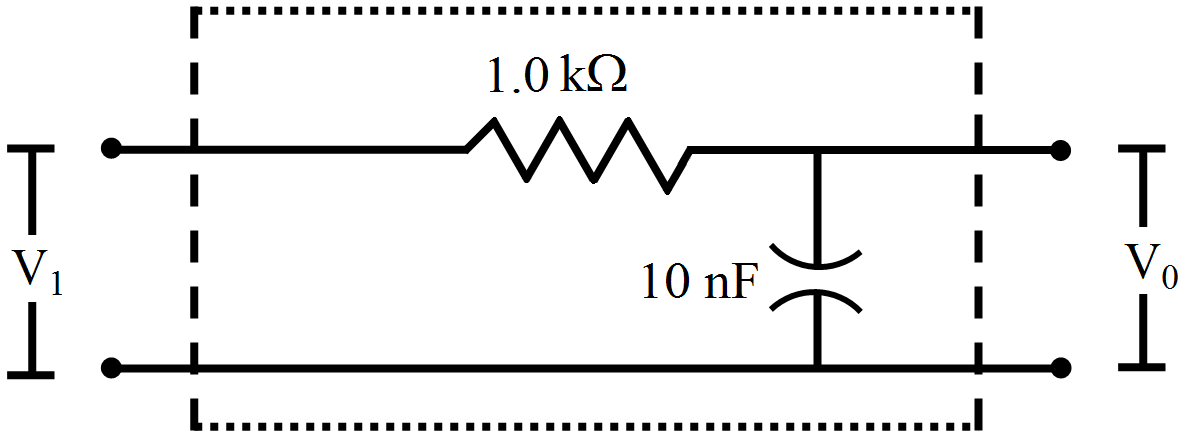
Figure shows a typical circuit for a low-pass filter. An AC input $V_{i }= 10mV$ is applied at the left end and the output $V_0$ is received at the right end. Find the output voltage for ν = 10kHz, 1.0MHz and 10.0MHz. Note that as the frequency is increased the output decreases and, hence, the name low-pass filter.
How much energy is released in the following reaction?
$\text{ }^7\text{Li + p}\rightarrow\alpha+\alpha.$
Atomic mass of $^7Li = 7.0160u$ and that of $^4He = 4.0026u.$