Question
A closed compartment containing gas is moving with some acceleration in horizontal direction. Neglect effect of gravity. Then the pressure in the compartment is

Answer

(b)The pressure on the rear side would be more due to fictitious force (acting in the opposite direction of acceleration) on the rear face. Consequently the pressure in the front side would be lowered.

Need a full question paper?

Generate a complete, print-ready paper with questions like this in minutes — across 16+ boards, with answer keys.
Start Generating Free

Similar questions

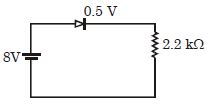
In the circuit, if the forward voltage drop for the diode is $0.5\, V$, the current will be.......$mA$
Which of the following electromagnetic waves have minimum frequency
A body of mass $2 \,kg$ is sliding with a constant velocity of $4 \,m / s$ on a frictionless horizontal table. The force required to keep the body moving with the same velocity is ..........$N$
The exposure time of a camera lens at the $\frac{f}{{2.8}}$ setting is $\frac{1}{{200}}$ second. The correct time of exposure at $\frac{f}{{5.6}}$ is......$sec$
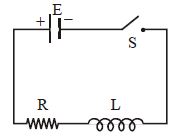
Switch $S$ of the circuit shown in figure is closed at $t = 0$. If $e$ denotes the induced $emf$ in $L$ and $i$ the current flowing through the circuit at time $t$, which of the following graphs is correct
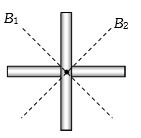
Two identical rods each of mass $M$. and length $l$ are joined in crossed position as shown in figure. The moment of inertia of this system about a bisector would be 
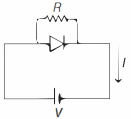
For a diode connected in parallel with a resistor, which is the most likely current $I$-voltage $V$ characteristic?
A closed vessel contains $0.1$ mole of a monoatomic ideal gas at $200\, K$. If $0.05$ mole of the same gas at $400\, K$ is added to it, the final  equilibrium temperature (in $K$ ) of the gas in the vessel will be closed to
A glass flask contains some mercury at room temperature. It is found that at different temperatures the volume of air inside the flask remains the same. If the volume of mercury in the flask is $300 \,\,cm^3$, then volume of the flask is ........ $cm^3$. (given that coefficient of volume expansion of mercury and coefficient of linear expansion of glass are $1.8 × 10^{-4} (^o C)^{-1}$ and $9 × 10^{-6} (^o C)^{-1}$ respectively)
Point charges $ + 4q,\, - q$ and $ + 4q$ are kept on the $x - $axis at points $x = 0,\,x = a$ and $x = 2a$ respectively, then