Question
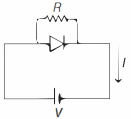
For a diode connected in parallel with a resistor, which is the most likely current $I$-voltage $V$ characteristic?
Answer

(a)

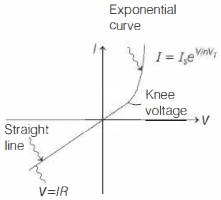
When $V$ is negative, diode is in reverse bias and it does not conducts. So, current-voltage relationship followed from Ohm's law is, $V=I R$

$\therefore V-I$ graph is straight line.

As $V$ grows in positive region, diode becomes conductive after knee voltage and af ter that current is approximately,

$I=I_s e^{V / n V_T}$

where, $I_s=$ saturation current in reverse bias, $V=$ voltage across diode $n$ and $V_T$ are diode constants. So, correct graph is
Need a full question paper?

Generate a complete, print-ready paper with questions like this in minutes — across 16+ boards, with answer keys.

Start Generating Free

Similar questions

A conductor of length $l$ and mass $m$ is placed along the east-west line on a table. Suddenly a certain amount of charge is passed through it and it is found to jump to a height $h$. The earth’s magnetic induction is $B$. The charge passed through the conductor is: 
A solenoid is connected to a battery so that a steady current flows through it. If an iron core is inserted into the solenoid, the current will
An excited $He^+$ ion emits two photons in succession, with wavelengths $108.5\, nm$ and $30.4\, nm$, in making a transition to ground state. The quantum number $n$, corresponding to its initial excited state is $n=........$ (for photon of wavelength $\lambda $, energy $E = \frac{{1240\,eV}}{{\lambda \,(in\,nm)}}$)
The value of gravitational acceleration $C.G.S.$ system is $980 \;cm / sec$ ? .find the value of $g$ in $M.K.S$ system?
If two glass plates are quite nearer to each other in water, then there will be force of
Choose the correct statement
Match the thermodynamic processes taking place in a system with the correct conditions. In the table: $\Delta Q$ is the heat supplied, $\Delta W$ is the work done and $\Delta U$ is change in internal energy of the system
Process Condition
$(I)$ Adiabatic $(A)\; \Delta W =0$
$(II)$ Isothermal $(B)\; \Delta Q=0$
$(III)$ Isochoric $(C)\; \Delta U \neq 0, \Delta W \neq 0 \Delta Q \neq 0$
$(IV)$ Isobaric $(D)\; \Delta U =0$
Consider the situation shown in the figure. The capacitor $A$ has a charge $q$ on it whereas $B$ is uncharged. The charge appearing on the capacitor $B$ a long time after the switch is closed is
A charged particle enters a uniform magnetic field perpendicular to it. The magnetic field
The focal length of a concave mirror is $f$ and the distance from the object to the principle focus is $x$. The ratio of the size of the image to the size of the object is