- Passes through the centre of the top.
- Passes through a point to the right of the centre.
- Passes through a point to the left of the centre.
- Pecomes zeros.
Explanation:
When the box is accelerated towards right, the water in the box experiences a pseudo force (ma) towards left, where m is the mass of water. So, the resultant normal force by the water on the top of the box passes through a point to the left of the centre.
Generate a complete, print-ready paper with questions like this in minutes — across 16+ boards, with answer keys.
The electrochemical equivalent Z of any element can be obtained by multiplying the electrochemical equivalent of hydrogen with
|
(a) Atomic weight |
(b) Molecular weight |
(c) Chemical equivalent |
(d) A constant |
Putting a dielectric substance between two plates of condenser, capacity, potential and potential energy respectively
|
(a) Increase, decrease, decrease |
(b) Decrease, increase, increase |
|
(c) Increase, increase, increase |
(d) Decrease, decrease, decrease |
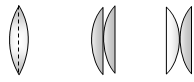
Two similar plano-convex lenses are combined together in three different ways as shown in the adjoining figure. The ratio of the focal lengths in three cases will be

|
(a) 2 : 2 : 1 |
(b) 1 : 1 : 1 |
(c) 1 : 2 : 2 |
(d) 2 : 1 : 1 |
The de-Broglie wavelength of an electron having 80eV of energy is nearly (1eV = 1.6 × 10⁻¹⁹ J, Mass of electron = 9 × 10–31kg Plank’s constant = 6.6 × 10⁻³⁴ J-sec)
|
(a) 140 Å |
(b) 0.14 Å |
(c) 14 Å |
(d) 1.4 Å |
Two cells when connected in series are balanced on 8m on a potentiometer. If the cells are connected with polarities of one of the cell is reversed, they balance on 2m. The ratio of e.m.f.'s of the two cells is
|
(a) 3 : 5 |
(b) 5 : 3 |
(c) 3 : 4 |
(d) 4 : 3 |
Angle of a prism is 30° and its refractive index is
and one of the surface is silvered. At what angle of incidence, a ray should be incident on one surface so that after reflection from the silvered surface, it retraces its path
|
(a) 30° |
(b) 60° |
(c) 45° |
(d) |
A circular current carrying coil has a radius R. The distance from the centre of the coil on the axis where the magnetic induction will be to its value at the centre of the coil, is
|
(a) |
(b) R |
(c) 2 |
(d) |