Question types

Fluid Mechanics question types

81 questions across 6 question groups — pick any mix to generate a Physics paper with step-by-step answer keys.

81
Questions
6
Question groups
5
Question types
Sample Questions

Fluid Mechanics questions

One sample from each question group in this chapter. Select any group above to see the full set with answer keys.

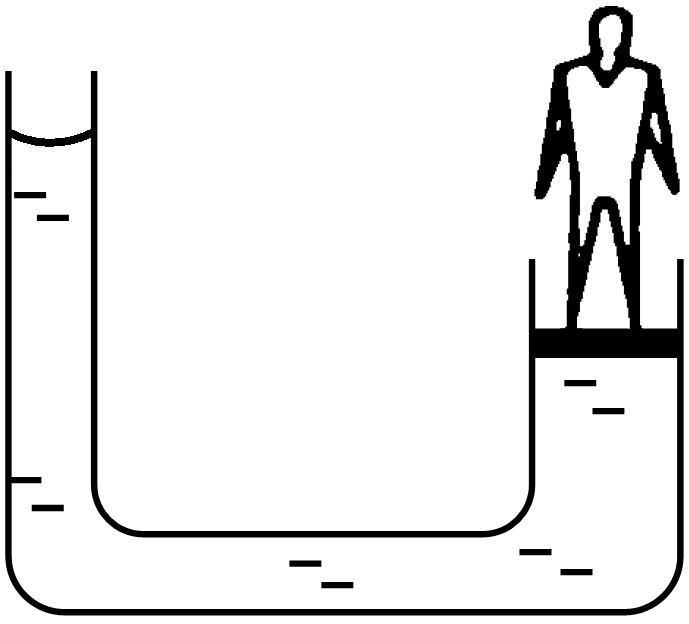
The area of cross-section of the wider tube shown in  is 900cm2. If the boy standing on the. Piston weighs 45kg, find the difference in the levels of water in the two tubes.
View full solution
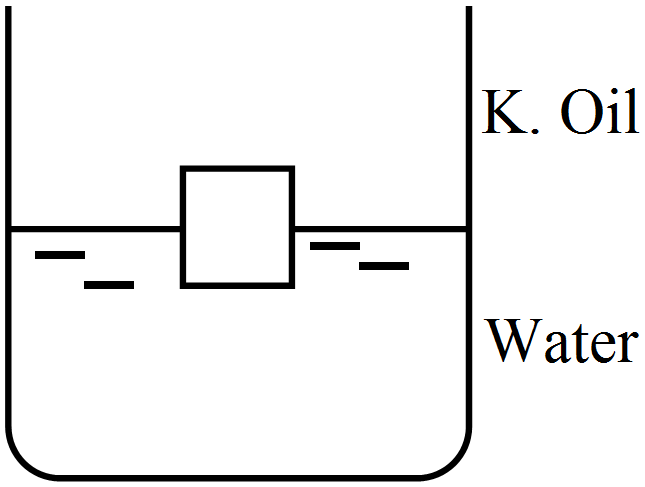
A cube of ice floats partly in water and partly in K. oil  Find the ratio of the volume of ice immersed in water to that in K.oil. Specific gravity of K. oil is 0.8 and that of ice is 0.9.

View full solution
A solid sphere of radius 5cm floats in water. If a maximum load of 0.1kg can be put on it without wetting the load, find the specific gravity of the material of the sphere.
View full solution
A hollow spherical body of inner and outer radii 6cm and 8cm respectively floats half submerged in water. Find the density of the material of the sphere.
View full solution
Suppose the tube in the previous problem is kept vertical with A upward but the other conditions remain the same. The separation between the cross- sections at A and B is $\frac{15}{16}\text{cm}.$ Repeat parts (a), (b) and (c) of the previous problem. Take g = 10m/s2.
View full solution
A cube of ice of edge 4cm is placed in an empty cylindrical glass of inner diameter 6cm. Assume that the ice melts uniformly from each side so that it always retains its cubical shape. Remembering that ice is lighter than water, find the length of the edge of the ice cube at the instant it just leaves contact with the bottom of the glass.
View full solution
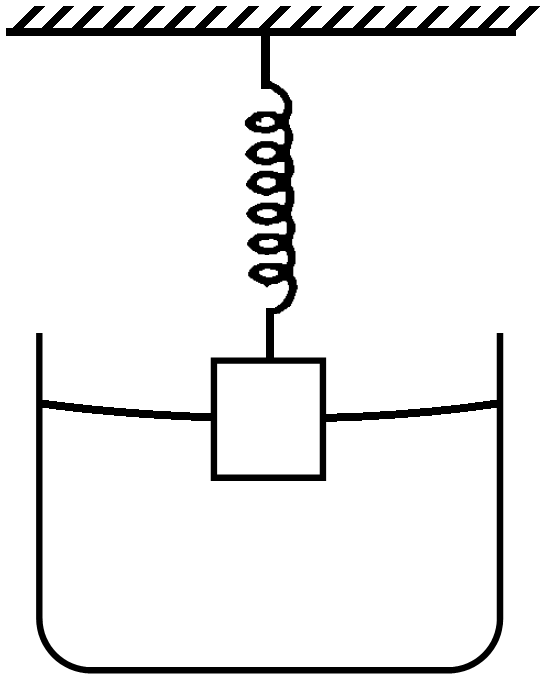
A cylindrical object of outer diameter 10cm, height 20cm and density 8000kg/m3 is supported by a vertical spring and is half dipped in water as shown in.
  1. Find the elongation of the spring in equilibrium condition.
  2. If the object is slightly depressed and released, find the time period of resulting oscillations of the object. The spring constant = 500N/m.

View full solution
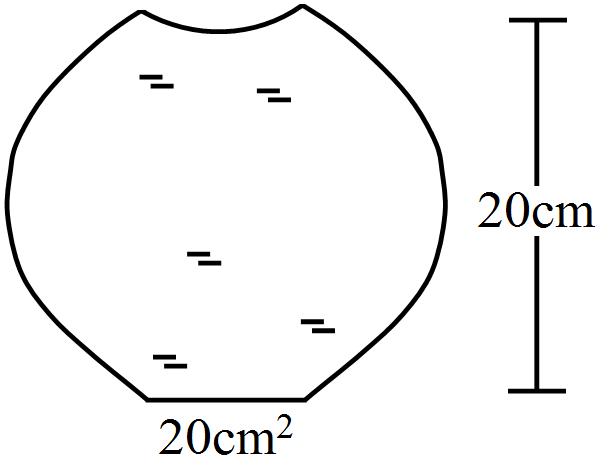
A glass full of water has a bottom of area 20cm2, top of area 20cm2, height 20cm and volume half a litre.
  1. Find the force exerted by the water on the bottom.
  2. Considering the equilibrium of the water, find the.
Resultant force exerted by the sides of the glass on the water. Atmospheric pressure = 1.0 × 105N/m2. Density of water = 1000kg/m3 and g = 10m/s2. Take all numbers to be exact.

View full solution
Water is filled in a rectangular tank of size 3m × 2m × 1m.
  1. Find the total force exerted by the water on the bottom surface of the tank.
  2. Consider a vertical side of area 2m × 1m. Take a horizontal strip of width ox metre in this side, situated at a depth of x metre from the surface of water. Find the force by the water on this strip.
  3. Find the torque of the force calculated in part.(b) about the bottom edge of this side.
  4. Find the total force by the water on this side.
  5. Find the total torque by the water on the side about.
The bottom edge. Neglect the atmospheric pressure and take g = 10m/s2.
View full solution
Q 103 Marks Question3 Marks
Suppose the glass of the previous problem is covered by a jar and the air inside the jar is completely pumped out.
  1. What will be the answers to the problem?
  2. Show that the answers do not change if a glass of different shape is used provided the height, the bottom area and the volume are unchanged.
View full solution
At Deoprayag (Garhwal, UP) river Alaknanda mixes with the river Bhagirathi and becomes river Ganga. Suppose Alaknanda has a width of 12m, Bhagirathi has a width of 8m and Ganga has a width of 16m. Assume that the depth of water is same in the three rivers. Let the average speed of water in Alaknanda be 20km/h and in Bhagirathi be 16km/h. Find the average speed of water in the river Ganga.
View full solution
A cylindrical object of outer diameter 20cm and mass 2kg floats in water with its axis vertical. If it is slightly depressed and then released, find the time period of the resulting simple harmonic motion of the object.
View full solution
Water is slowly coming out from a vertical pipe. As the water descends after coming out, its area of cross-section reduces. Explain this on the basis of the equation of continuity.
View full solution
Suppose the tube in the previous problem is kept vertical with B upward. Water enters through B at the rate of 1cm3/s . Repeat parts (a), (b) and (c). Note that the speed decreases as the water falls down.
View full solution
The free surface of a liquid resting in an inertial frame is horizontal. Does the normal to the free surface pass through the centre of the earth? Think separately if the? The free surface of a liquid resting in an inertial frame is horizontal. Does the normal to the free surface pass through the centre of the earth? Think separately if the liquid is.
  1. At the equator.
  2. At a pole.
  3. Somewhere else.
View full solution
In the derivation of P1 - P2 = Pgz, it was assumed that the liquid is incompressible. Why will this equation not be strictly valid for a compressible liquid?
View full solution
Suppose the density of air at Madras is P0 and atomospheric pressure is P0. If we go up, the density and the pressure both decrease. Suppose we wish to calculate the pressure at a height 10km above Madras. If we use the equation P- P = pogz, will we get a pressure more than the actual or less than the actual? Neglect the variation in g. Does your answer change if you also consider the variation in g?
View full solution
Refer to the previous problem. Suppose, the goldsmith argues that he has not mixed copper or any other material with gold, rather some cavities might have been left inside the ornament. Calculate the volume of the cavities left that will allow the weights given in that problem.
View full solution
While watering a distant plant, a gardener partially water than in fresh closes the exit hole of the pipe by putting his finger on it. Explain why this results in the water stream goirig to a larger distance.
View full solution
Q 20M.C.Q (1 Marks)1 Mark
Equal mass of three liquids are kept in three identical cylindrical vessels A, B and C. The densities are PA, PB, PC with PA < PB < PC  The force on the base will be:
  1. Maximum in vessel A.
  2. Maximum in vessel B.
  3. Maximum in vessel C.
  4. Equal in all the vessels.
View full solution
Q 21M.C.Q (1 Marks)1 Mark
In a streamline flow:
  1. The speed of a particle always remains same.
  2. The velocity of a particle always remains same.
  3. The kinetic energies of all the particles arriving at a given point are the same.
  4. The momenta of all the particles arriving at a given point are the same.
View full solution
Q 22M.C.Q (1 Marks)1 Mark
A barometer kept in an elevator reads 76cm when it is at rest. If the elevator goes up with increasing speed, the reading will be:
  1. zero.
  2. 76cm.
  3. < 76cm.
  4. > 76cm.
View full solution
Q 23M.C.Q (1 Marks)1 Mark
Suppose the pressure at the surface of mercury in a barometer tube is P1 and the pressure at the surface of mercury in the cup is P2,
  1. P1 = 0, P2 = atmospheric pressure.
  2. P1 = atmospheric pressure P2 = 0
  3. P1 = P2 = atmospheric pressure.
  4. P1 = P2 = 0
View full solution
Q 24M.C.Q (1 Marks)1 Mark
Water enters through end A with a speed v1 and leaves through end B with a speed v2 of a cylindrical tube AB. The tube is always completely filled with water. In case I the tube is horizontal, in case II it is vertical with the end A upward and in case III it is vertical with the end B upward. We have v1 = v2 for
  1. Case I.
  2. Case II.
  3. Case III.
  4. Each case.
View full solution
A cubical metal block of edge 12cm floats in mercury with one fifth of the height inside the mercury. Water is poured till the surface of the block is just immersed in it. Find the height of the water column to be poured. Specific gravity of mercury = 13.6.
View full solution
An ornament weighing 36g in air, weighs only 34g in water. Assuming that some copper is mixed with gold to prepare the ornament, find the amount of copper in it. Specific gravity of gold is 19.3 and that of copper is 8.9.
View full solution
Water leaks out from an open tank through a hole of area 2mm2 in the bottom. Suppose water is filled up to a height of 80cm and the area of cross-section of the tank is 0.4m2. The pressure at the open surface and at the hole are equal to the atmospheric pressure. Neglect the small velocity of the water near the open surface in the tank.
  1. Find the initial speed of water coming out of the hole.
  2. Find the speed of water coming out when half of water has leaked out.
  3. Find the volume of water leaked out during a time interval dt after the height remained is h. Thus find the decrease in height dh in terms of h and dt.
  4. From the result of part c find the time required for half of the water to leak out.
View full solution

Generate a Fluid Mechanics paper free

Pick question groups from the list above, set marks and difficulty, and export a branded PDF with step-by-step answer keys. First 3 chapters free — no signup.

Download App