MCQ
A closed pipe and an open pipe have their first overtones identical in frequency. Their lengths are in the ratio
  • A
    $1:2$
  • B
    $2:3$
  • $3:4$
  • D
    $4:5$

Answer

Correct option: C.
$3:4$
c
(c) If is given that First over tone of closed pipe = First over tone of open pipe 

$\Rightarrow$$3\left( {\frac{v}{{4{l_1}}}} \right) = 2\left( {\frac{v}{{2{l_2}}}} \right)$;

where $l_1$ and $l_2$ are the lengths of closed and open organ pipes 

hence $\frac{{{l_1}}}{{{l_2}}} = \frac{3}{4}$

Need a full question paper?

Generate a complete, print-ready paper with questions like this in minutes — across 16+ boards, with answer keys.
Start Generating Free

Similar questions

An ideal gas is subjected to a thermodynamic process $PV^{2.5} = 0.40$ where $P$ is in $Pa$ and $V$ is in $m^3$.What is the slope of the $P-V$ curve with volume plotted against $x-$ axis at $V=1\, m^3$ ?
On applying a stress of $20 \times {10^8}N/{m^2}$ the length of a perfectly elastic wire is doubled. Its Young’s modulus will be
A body of mass $50\, kg$ is projected vertically upwards with velocity of $100 \,m/sec$. $5 \,seconds$ after this body breaks into $20\, kg$ and $30 \,kg$. If $20\, kg $ piece travels upwards with $150 \,m/sec$, then the velocity of other block will be
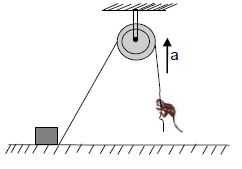
A light string fixed at one end to a clamp on ground passes over a fixed pulley and hangs at the other side. It makes an angle of $30^o$ with the ground. A monkey of mass $5\ kg$ climbs up the rope. The clamp can tolerate a vertical force of $40\ N$ only. The maximum acceleration in upward direction with which the monkey can climb safely is ............ $m/s^2$ (neglect friction and take $g = 10\ m / s^2$ )
The percentage error in measurement of mass and speed are $3\%$ and $2\%$ then error in kinetic energy will be .......... $\%$
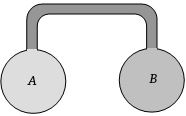
Two spherical vessel of equal volume, are connected by a n arrow tube. The apparatus contains an ideal gas at one atmosphere and $300K$. Now if one vessel is immersed in a bath of constant temperature $600K$ and the other in a bath of constant temperature $300K$. Then the common pressure will be ...... $atm$
Measure of two quantities along with the precision of respective measuring instrument is:

$\text{A} = 2.5\text{ms}^{-1} \pm 0.5\text{ms}^{-1}$

$\text{B} = 0.10\text{s} \pm 0.01\text{s}$

The value of A B will be,

  1. $(0.25 \pm 0.08)\text{m}.$

  2. $(0.25 \pm 0.5)\text{m}.$

  3. $(0.25 \pm 0.05)\text{m}.$

  4. $(0.25 \pm 0.135)\text{m}$

Angular momentum of a single particle moving with constant speed along circular path:
Relation between $U, P$ and $V$ for ideal gas is $U= 2+2PV$ then gas is
A piece of ice (heat capacity $=2100 \mathrm{~J} \mathrm{~kg}^{-1}{ }^{\circ} \mathrm{C}^{-1}$ and latent heat $=3.36 \times 10^5 \mathrm{~J} \mathrm{~kg}^{-1}$ ) of mass $\mathrm{m}$ grams is at $-5^{\circ} \mathrm{C}$ at atmospheric pressure. It is given $420 \mathrm{~J}$ of heat so that the ice starts melting. Finally when the ice-water mixture is in equilibrium, it is found that $1 \ \mathrm{gm}$ of ice has melted. Assuming there is no other heat exchange in the process, the value of $m$ is