Question
A collision experiment is done on a horizontal table kept in an elevator. Do you expect a change in the results if the elevator is accelerated up or down because of the noninertial character of the frame?

Answer

Velocity and mass are only two components that affect collision between two bodies so in this change in acceleration due to gravity will not affect the collision between two bodies. (if kept horizontally)

Need a full question paper?

Generate a complete, print-ready paper with questions like this in minutes — across 16+ boards, with answer keys.
Start Generating Free

Similar questions

The weight Mg of an extended body is generally shown in a diagram to act through the centre of mass. Does it mean that the earth does not attract other particles?
Suppose the bent part of the frame of the previous problem has a thermal conductivity of ${780Js^{-1}m^{-1}}^\circ C^{-1}$ whereas it is ${390Js^{-1}m^{-1}}^\circ C^{-1}$ for the straight part. Calculate the ratio of the rate of heat flow through the bent part to the rate of heat flow through the straight part.
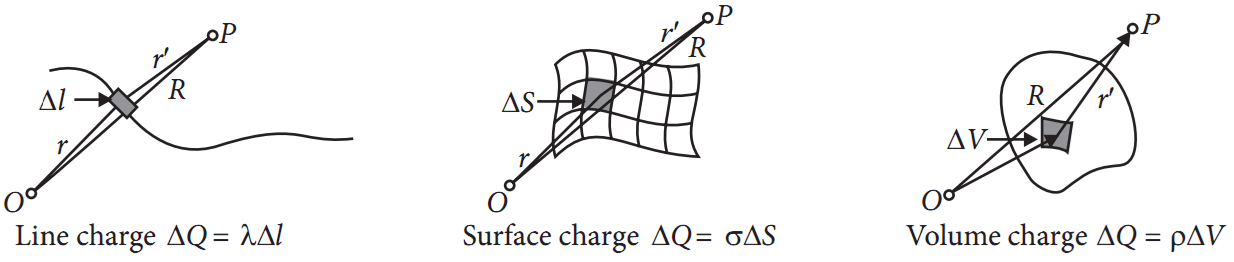
ln practice, we deal with charges much greater in magnitude than the charge on an electron, so we can ignore the quantum nature of charges and imagine that the charge is spread in a region in a continuous manner. Such a charge distribution is known as continuous charge distribution. There are three types of continuous charge distribution : (i) Line charge distribution (ii) Surface charge distribution (iii) Volume charge distribution as shown in figure.
  1. Statement 1: Gauss's law can't be used to calculate an electric field near an electric dipole.
Statement 2: Electric dipole don't have symmetrical charge distribution.
  1. Statement 1 and statement 2 are true.
  2. Statement 1 is false but statement 2 is true.
  3. Statement 1 is true but statement 2 is false.
  4. Both statements are false.
  1. An electric charge of $8.85 \times 10^{-13}C$ is placed at the centre of a sphere of radius 1m. The electric flux through the sphere is:
  1. $0.2NC^{-1} m^2$
  2. $0.1NC^{-1} m^2$
  3. $0.3NC^{-1} m^2$
  4. $0.01NC^{-1} m^2$
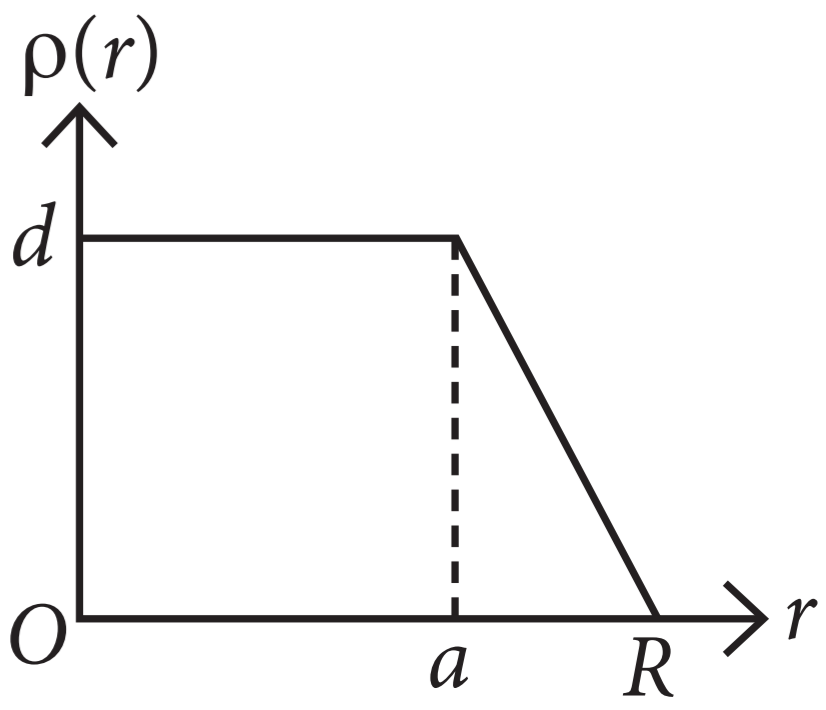
  1. The electric field within the nucleus is generally observed to be linearly dependent on r. So,
  1. a = 0
  2. $\text{a}=\frac{\text{R}}{2}$
  3. a = R
  4. $\text{a}=\frac{\text{2R}}{3}$
  1. What charge would be required to electrify a sphere of radius 25cm so as to get a surface charge density of $\frac{3}{\pi}\text{Cm}^{-2}?$
  1. 0.75C
  2. 7.5C
  3. 75C
  4. Zero
  1. The SI unit of linear charge density is:
  1. Cm
  2. $Cm^{-1}$
  3. $Cm^{-2}$
  4. $Cm^{-3}$
  1. A small compass needle of magnetic moment ‘m’ is free to turn about an axis perpendicular to the direction of uniform magnetic field ‘B’. The moment of inertia of the needle about the axis is ‘I’. The needle is slightly disturbed from its stable position and then released. Prove that it executes simple harmonic motion. Hence deduce the expression for its time period.
  2. A compass needle, free to turn in a vertical plane orients itself with its axis vertical at a certain place on the earth. Find out the values of (i) horizontal component of earth’s magnetic field and (ii) angle of dip at the place.
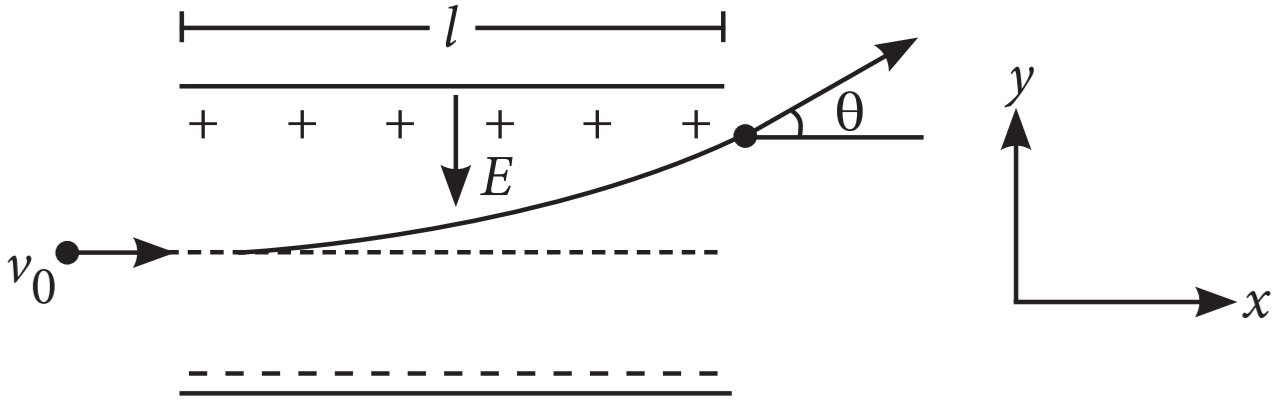
When a charged particle is placed in an electric field, it experiences an electrical force. If this is the only force on the particle, it must be the net force. The net force will cause the particle to accelerate according to Newton's second law. So $\vec{\text{F}}_\text{e}=\text{q}\vec{\text{E}}=\text{m}\vec{\text{a}}$

If $\vec{\text{E}}$ is uniform, then $\vec{\text{a}}$ is constant and $\vec{\text{a}}=\text{q}\vec{\text{E}}\text{/ m.}$ If the particle has a positive charge, its acceleration is in the direction of the field. If the particle has a negative charge, its acceleration is in the direction opposite to the electric field. Since the acceleration is constant, the kinematic equations can be used.
  1. An electron of mass m, charge e falls through a distance h metre in a uniform electric field E. Then time of fall,
  1. $\text{t}=\sqrt{\frac{\text{2hm}}{\text{eE}}}$
  2. $\text{t}=\frac{\text{2hm}}{\text{eE}}$
  3. $\text{t}=\sqrt{\frac{\text{2eE}}{\text{hm}}}$
  4. $\text{t}=\frac{\text{2eE}}{\text{hm}}$
  1. An electron moving with a constant velocity v along X-axis enters a uniform electric field applied along Y-axis. Then the electron moves:
  1. With uniform acceleration along Y-axis
  2. Without any acceleration along Y-axis
  3. In a trajectory represented as $y = ax^2$
  4. In a trajectory represented as y = ax
  1. Two equal and opposite charges of masses $m_1$ and $m_2$ are accelerated in an uniform electric field through the same distance. What is the ratio of their accelerations if their ratio of masses is $\frac{\text{m}_1}{\text{m}_2}=0.5?$
  1. $\frac{\text{a}_1}{\text{a}_2}=2$
  2. $\frac{\text{a}_1}{\text{a}_2}=0.5$
  3. $\frac{\text{a}_1}{\text{a}_2}=3$
  4. $\frac{\text{a}_1}{\text{a}_2}=1$
  1. A particle of mass m carrying charge q is kept at rest in a uniform electric field E and then released. The kinetic energy gained by the particle, when it moves through a distance y is:
  1. $\frac{1}{2}\text{qEy}^2$
  2. $qEy$
  3. $qEy^2$
  4. $qE^2y$
  1. A charged particle is free to move in an electric field. It will travel:
  1. Always along a line of force.
  2. Along a line of force, if its initial velocity is zero.
  3. Along a line of force, if it has some initial velocity in the direction of an acute angle with the line of force.
  4. None of these.
(a) An electron is revolving with a speed of 2 $\times 10^5 m / s$ in the orbit of radius $0.51 A$ in a hydrogen atom. Calculate the magnetic moment of the electron.
(b) Equivalent electric current due to orbital speed of electron.
(c) Magnetic field generated at the centre of the nucleus.
The half-life of $^{226}Ra$ is $1602y$. Calculate the activity of 0.1g of $RaCl_2$ in which all the radium is in the form of $^{226}Ra.$ Taken atomic weight of Ra to be $226g/mol^{-1}$ and that of Cl to be $35.5g/mol^{-1}.$
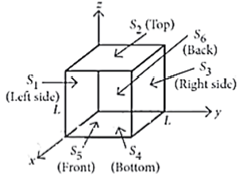
Net electric flux through a cube is the sum of fluxes through its six faces. Consider a cube as shown in figure, having sides of length $L =10.0 \ cm$. The electric field is uniform, has a magnitude $E =4.00 \times 10^3 NC ^{-1}$ and is parallel to the $xy$ plane at an angle of $37^{\circ}$ measured from the $+ x -$axis towards the $+ y -$axis.
Image
$(i)$ Electric flux passing through surface $S_6$ is
$(a) \ -24 \ Nm ^2 C ^{-1}$
$(b) \ 32 \ Nm ^2 C ^{-1}$
$(c) \ -32 \ Nm ^2 C ^{-1}$
$(d)\  24 \ Nm ^2 C ^{-1}$
$(ii)$ Electric flux passing through surface $S_1$ is
$(a)-32 \ Nm ^2 C ^{-1}$
$(b) -24 \ Nm ^2 C ^{-1}$
$(c)\ 32 \ Nm ^2 C ^{-1}$
$(d)\ 24 \ Nm ^2 C ^{-1}$
$(iii)$ The surfaces that have zero flux are
$(a) S _2$ and $S _4  \ (b)  S_3$ and $S_6  \ (c)  S _1$ and $S _2  \ (d)  S _1$ and $S _3$
$(iv)$ he total net electric flux through all faces of the cube is $a) 24 \ Nm^2 C-1 c)-8 \ Nm^2 C-1$
$(a) \ 24 \ Nm ^2 C ^{-1}  \ (b) \  8 \ Nm ^2 C ^{-1}  \ (c)  \ -8 \ Nm ^2 C ^{-1}  \ (d)$ zero
OR
The dimensional formula of surface integral $\oint \vec{E} \cdot d \vec{S}$ of an electric field is
$(a) \ \left[ M ^{-1} L^3 T^{-3} A\right]$
$(b)\  \left[ M L ^2 T^{-2} A^{-1}\right]$
$(c) \ \left[ ML ^3 T^{-3} A^{-1}\right]$
$(d) \ \left[ M L ^{-3} T^{-3} A^{-1}\right]$
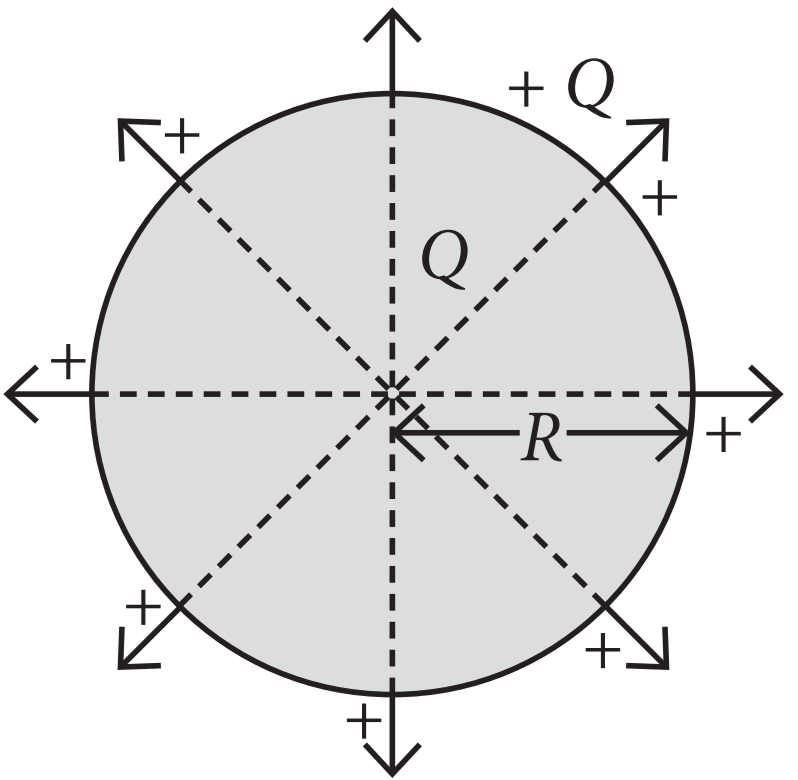
The electrical capacitance of a conductor is the measure of its ability to hold electric charge. An isolated spherical conductor of radius R. The charge Q is uniformly distributed over its entire surface. It can be assumed to be concentrated at the centre of the sphere. The potential at any point on the surface of the spherical conductor will be $\text{V}=\frac{1}{4\pi\in_0}\frac{\text{Q}}{\text{R}}.$

Capacitance of the spherical conductor situated in vacuum is $\text{C}=\frac{\text{Q}}{\text{V}}=\frac{\text{Q}}{\frac{1}{4\pi\in_0}.\frac{\text{Q}}{\text{R}}}$ or $\text{C}=4\pi\in_0\text{R}$ Clearly, the capacitance of a spherical conductor is proportional to its radius. The radius of the spherical conductor of 1F capacitance is $\text{R}=\frac{1}{4\pi\in_0}.$ C and this radius is about 1500 times the radius of the earth $(\sim6\times10^3\text{km}).$
  1. If an isolated sphere has a capacitance 50pE Then radius is:
  1. 90cm
  2. 45cm
  3. 45m
  4. 90m
  1. How much charge should be placed on a capacitance of 25 pF to raise its potential to 105V?
  1. $1\mu\text{C}$
  2. $1.5\mu\text{C}$
  3. $2\mu\text{C}$
  4. $2.5\mu\text{C}$
  1. Dimensions of capacitance is:
  1. $[M L^{-2} T^4 A^2]$
  2. $[M^{-1} L^{-1} T^3 A^1]$
  3. $[M^-L^{-2} T^4 A^2]$
  4. $[M^0 L^{-2} T^4 A^1]$
  1. Metallic sphere of radius R is charged to potential V. Then charge q is proportional to:
  1. V
  2. R
  3. Both V and R
  4. None of these
  1. If 64 identical spheres of charge q and capacitance C each are combined to form a large sphere. The charge and capacitance of the large sphere is:
  1. 64q, C
  2. 16q, 4C
  3. 64q, 4C
  4. 16q, 64C
A simple pendulum of length I is suspended from the ceiling of a car moving with a speed v on a circular horizontal road of radius r.
  1. Find the tension in the string when it is at rest with respect to the car.
  2. Find the time period of small oscillation.