Question
When a charged particle is placed in an electric field, it experiences an electrical force. If this is the only force on the particle, it must be the net force. The net force will cause the particle to accelerate according to Newton's second law. So $\vec{\text{F}}_\text{e}=\text{q}\vec{\text{E}}=\text{m}\vec{\text{a}}$
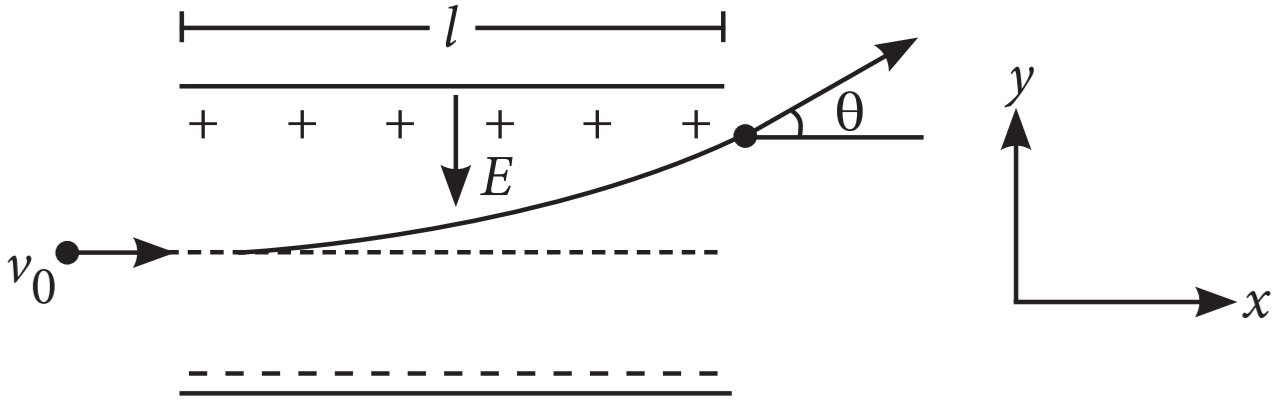
If $\vec{\text{E}}$ is uniform, then $\vec{\text{a}}$ is constant and $\vec{\text{a}}=\text{q}\vec{\text{E}}\text{/ m.}$ If the particle has a positive charge, its acceleration is in the direction of the field. If the particle has a negative charge, its acceleration is in the direction opposite to the electric field. Since the acceleration is constant, the kinematic equations can be used.
  1. An electron of mass m, charge e falls through a distance h metre in a uniform electric field E. Then time of fall,
  1. $\text{t}=\sqrt{\frac{\text{2hm}}{\text{eE}}}$
  2. $\text{t}=\frac{\text{2hm}}{\text{eE}}$
  3. $\text{t}=\sqrt{\frac{\text{2eE}}{\text{hm}}}$
  4. $\text{t}=\frac{\text{2eE}}{\text{hm}}$
  1. An electron moving with a constant velocity v along X-axis enters a uniform electric field applied along Y-axis. Then the electron moves:
  1. With uniform acceleration along Y-axis
  2. Without any acceleration along Y-axis
  3. In a trajectory represented as $y = ax^2$
  4. In a trajectory represented as y = ax
  1. Two equal and opposite charges of masses $m_1$ and $m_2$ are accelerated in an uniform electric field through the same distance. What is the ratio of their accelerations if their ratio of masses is $\frac{\text{m}_1}{\text{m}_2}=0.5?$
  1. $\frac{\text{a}_1}{\text{a}_2}=2$
  2. $\frac{\text{a}_1}{\text{a}_2}=0.5$
  3. $\frac{\text{a}_1}{\text{a}_2}=3$
  4. $\frac{\text{a}_1}{\text{a}_2}=1$
  1. A particle of mass m carrying charge q is kept at rest in a uniform electric field E and then released. The kinetic energy gained by the particle, when it moves through a distance y is:
  1. $\frac{1}{2}\text{qEy}^2$
  2. $qEy$
  3. $qEy^2$
  4. $qE^2y$
  1. A charged particle is free to move in an electric field. It will travel:
  1. Always along a line of force.
  2. Along a line of force, if its initial velocity is zero.
  3. Along a line of force, if it has some initial velocity in the direction of an acute angle with the line of force.
  4. None of these.

Answer

  1. (a) $\text{t}=\sqrt{\frac{\text{2hm}}{\text{eE}}}$
Explanation:
From Newton's law,
$\text{F}=\text{m}\vec{\text{a}}$
Or $\text{qE}=\text{m}\vec{\text{a}}$
$\Rightarrow\text{a}=\frac{\text{qE}}{\text{m}}=\frac{\text{eE}}{\text{m}}$
Using, $\text{s}=\text{ut}+\frac{1}{2}\text{at}^2$
$\therefore\text{ h}=0+\frac{1}{2}\times\frac{\text{eE}}{\text{m}}\text{t}^2$
$\Rightarrow\text{t}=\sqrt{\frac{\text{2hm}}{\text{eE}}}$
  1. (c) In a trajectory represented as $y = ax^2$
  2. (b) $\frac{\text{a}_1}{\text{a}_2}=0.5$
Explanation:
Force is same in magnitude for both.
$\therefore m_1a_1 = m_2a_2;$
$\frac{\text{a}_1}{\text{a}_2}=\frac{\text{m}_2}{\text{m}_1}=\frac{1}{0.5}=2$
  1. (b) qEy
Explanation:
Here, u = 0;
$\text{a}=\frac{\text{qE}}{\text{m}};\text{ s}=\text{y}$
Using, $v^2 - u^2= 2as$
$\Rightarrow\text{v}^2=2\frac{\text{qE}}{\text{m}}\text{y}$
$\therefore\text{ K.E.}=\frac{\text{1}}{\text{2}}\text{my}^2=\text{qEy}$
  1. (b) Along a line of force, if its initial velocity is zero.
Explanation:
If charge particle is put at rest in electric field, then it will move along line of force.

Need a full question paper?

Generate a complete, print-ready paper with questions like this in minutes — across 16+ boards, with answer keys.

Start Generating Free

Similar questions

To keep valuable instruments away from the earth's magnetic field, they are enclosed in iron boxes. Explain.
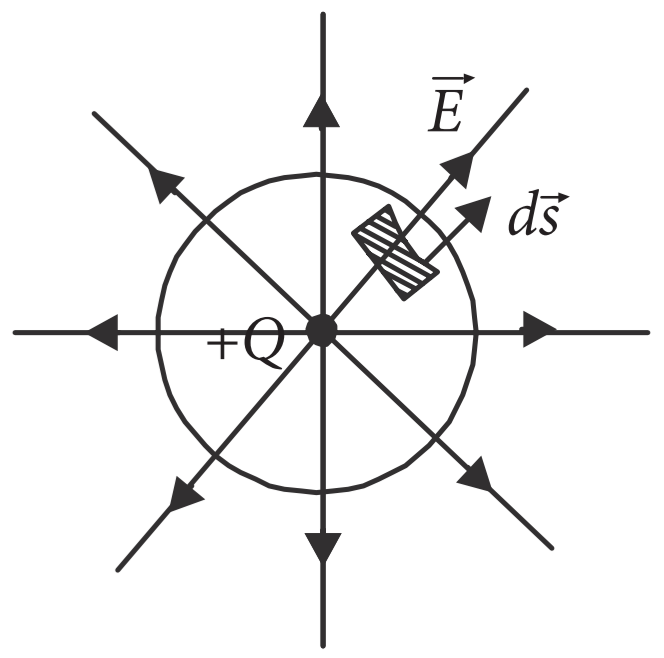
Gauss's law and Coulomb's law, although expressed in different forms, are equivalent ways of describing the relation between charge and electric field in static conditions. Gauss's law is $\in_0\phi=\text{q}_{\text{end},}$ when $\text{q}_{\text{encl}}$ is the net charge inside an imaginary closed surface called Gaussian surface. $\phi=\oint\vec{\text{E}}\cdot\text{d}\vec{\text{A}}$ gives the electric flux through the Gaussian surface. The two equations hold only when the net charge is in vacuum or air.
  1. If there is only one type of charge in the universe, then ($\vec{\text{E}}\rightarrow$ Electric field, $\text{d}\vec{\text{s}}\rightarrow$ Area vector).
  1. $\oint\vec{\text{E}}\cdot\text{d}\vec{\text{s}}\not=0$ on any surface.
  2. $\oint\vec{\text{E}}\cdot\text{d}\vec{\text{s}}$ could not be defined.
  3. $\oint\vec{\text{E}}\cdot\text{d}\vec{\text{s}}=\infty$ if charge is inside.
  4. $\oint\vec{\text{E}}\cdot\text{d}\vec{\text{s}}=0$ if charge is outside, $\oint\vec{\text{E}}\cdot\text{d}\vec{\text{s}}=\frac{\text{q}}{\in_0}$ if charge is inside.
  1. What is the nature of Gaussian surface involved in Gauss law of electrostatic?
  1. Magnetic.
  2. Scalar.
  3. Vector.
  4. Electrical.
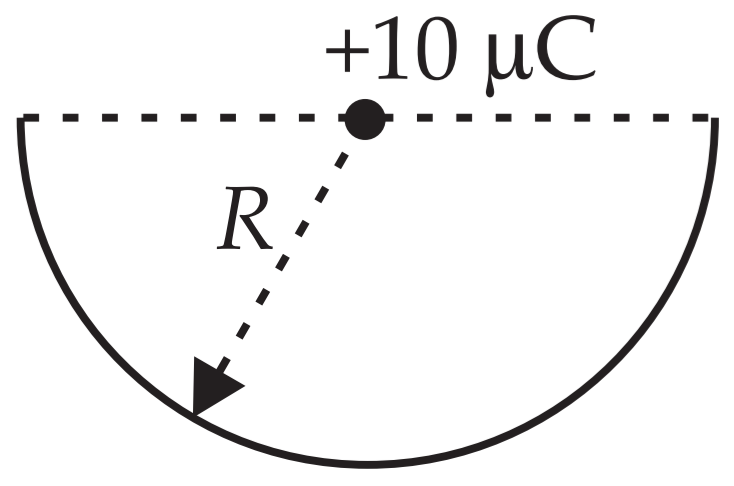
  1. A charge $10\mu\text{C}$ is placed at the centre of a hemisphere of radius R = 10cm as shown. The electric flux through the hemisphere (in MKS units) is:
  1. $20 \times 10^5$
  2. $10 \times 10^5$
  3. $6 \times 10^5$
  4. $2 \times 10^5$
  1. The electric flux through a closed surface area S enclosing charge Q is $\phi$. If the surface area is doubled, then the flux is:
  1. $2\phi$
  2. $\frac{\phi}{2}$
  3. $\frac{\phi}{4}$
  4. $\phi$
  1. A Gaussian surface encloses a dipole. The electric flux through this surface is:
  1. $\frac{\text{q}}{\in_0}$
  2. $\frac{\text{2q}}{\in_0}$
  3. $\frac{\text{q}}{2\in_0}$
  4. $\text{Zero}$
A metallic loop is placed in a nonuniform magnetic field. Will an emf be induced in the loop?
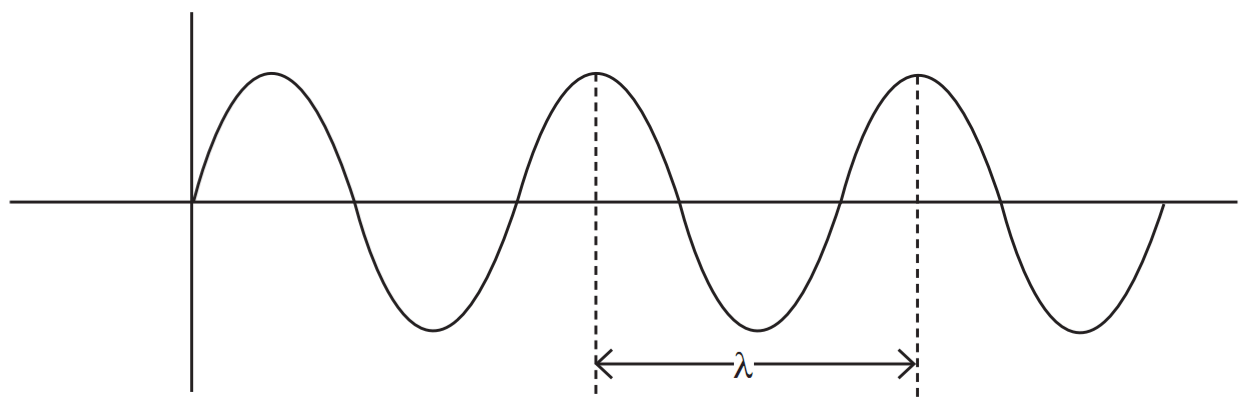
According to de-Broglie, a moving material particle sometimes acts as a wave and sometimes as a particle or a wave associated with moving material particle which controls the particle in every respect. The wave associated with moving particle is called matter wave or de-Broglie wave where wavelength called de-Broglie wavelength, rs given by $\lambda=\frac{\text{h}}{\text{mv}}$.
  1. If a proton and an electron have the same de Broglie wavelength, then:
  1. Kinetic energy of electron < kinetic energy of proton.
  2. Kinetic energy of electron = kinetic energy of proton.
  3. Momentum of electron = momentum of proton.
  4. momentum of electron < momentum of proton.
  1. Which of these particles having the same kinetic energy has the largest de Broglie wavelength?
  1. Electron
  2. Alpha particle
  3. Proton
  4. Neutron
  1. Two particles $A_1$ and $A_2$ of masses $m_1, m_2 (m_1 > m_2)$ have the same de Broglie wavelength. Then:
  1. Their momenta are the same.
  2. Their energies are the same.
  3. Momentum of $A_1$ is less than the momentum of $A_1$.
  4. Energy of $A_1$ is more than the energy of $A_2.$
  1. When the velocity of an electron increases, its de Broglie wavelength:
  1. Increases.
  2. Decreases.
  3. Remains same.
  4. May increase or decrease.
  1. Proton and $\alpha$ - particle have the same de-Broglie wavelength. What is same for both of them?
  1. Time period
  2. Energy
  3. Frequency
  4. Momentum
For a circular coil of radius R and N turns carrying current I, the magnitude of the magnetic field at a point on its axis at a distance x from its centre is given by,
$\text{B}=\frac{\mu_{0}\text{IR}^{2}\text{N}}{2(\text{x}^{2}+\text{R}^{2})^{\frac{3}{2}}}$
  1. Show that this reduces to the familiar result for field at the centre of the coil.
  2. Consider two parallel co-axial circular coils of equal radius R, and number of turns N, carrying equal currents in the same direction, and separated by a distance R. Show that the field on the axis around the mid-point between the coils is uniform over a distance that is small as compared to R, and is given by,$\text{B}=0.72\frac{\mu_{0}\text{NI}}{\text{R}}$, approximately.
[Such an arrangement to produce a nearly uniform magnetic field over a small region is known as Helmholtz coils.]
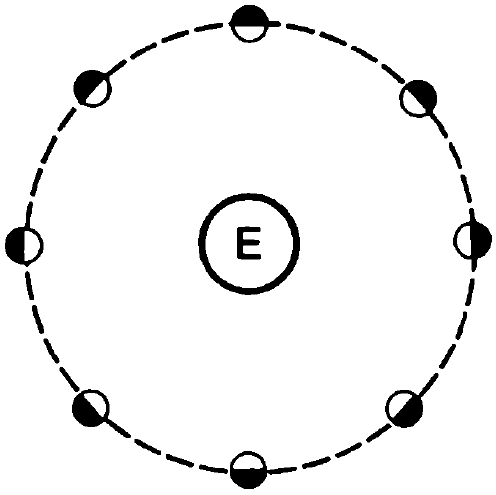
The moon rotates about the earth in such a way that only one hemisphere of the moon faces the earth. Can we ever see the ''other face'' of the moon from the earth? Can a person on the moon ever see all the faces of the earth?
Motion of Charge in Magnetic Field
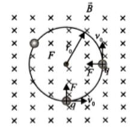
An electron with speed $V_0$ << c moves in a circle of radius $r _{\circ}$ in a uniform magnetic field. This electron is able to traverse a circular path as the magnetic force acting on the electron is perpendicular to both $V_0$ and B ,as shown in the figure. This force continuously deflects the particle sideways without changing its speed and the particle will move along a circle perpendicular to the field. The time required for one revolution of the electron is $T _{ o }$.

Image

(i) If the speed of the electron is now doubled to 2vo. The radius of the circle will change to
(A) $4 r_0$ (B) $2 r_0$ (C) $r _{ o }$ (D) $r _0 / 2$

(ii) If v = 2vo, then the time required for one revolution of the electron (To ) will change to
(A) $4 T_0$ (B) $2 T_{ O }$ (C) $T _{ o }$ (D) $T _{ d } / 2$
(iii) A charged particles is projected in a magnetic field . The acceleration of the particle is found to be. Find the value of x.
(A) $4 ms^{-2}$ (B) $-4 ms^{-2}$ (C) $-2 ms^{-2}$ (D) $2 ms^{-2}$

(iv) If the given electron has a velocity not perpendicular to B, then trajectory of the electron is
(A) straight line (B) circular (C) helical (D) zig-zag

OR

If this electron of charge (e) is moving parallel to uniform magnetic field with constant velocity v, the force acting on the electron is
(A) Bev (B) Be/v (C) B/ev (D) Zero
For the $L - C - R$ series $AC$ circuit derive the phase relationship between instantaneous current and voltage, using the phasor diagram.
There are materials which absorb photons of shorter wavelength and emit photons of longer wavelength. Can there be stable substances which absorb photons of larger wavelength and emit light of shorter wavelength.