MCQ
A common emitter amplifier is designed with $NPN$  transistor ($\alpha = 0.99$). The input impedance is $1 K \Omega$ and load is $10 K \Omega$The voltage gain will be
  • A
    $9.9$
  • B
    $99$
  • $990$
  • D
    $9900$

Answer

Correct option: C.
$990$
c
(c)Voltage gain $= \beta × $ Resistance gain
$\beta = \frac{\alpha }{{1 - \alpha }} = \frac{{0.99}}{{(1 - 0.99)}} = 99$
Resistance gain $ = \frac{{10 \times {{10}^3}}}{{{{10}^3}}} = 10$
==> Voltage gain $= 99 × 10 = 990.$

Need a full question paper?

Generate a complete, print-ready paper with questions like this in minutes — across 16+ boards, with answer keys.
Start Generating Free

Similar questions

A string is wrapped around the rim of a wheel of moment of inertia $0.40 \mathrm{kgm}^2$ and radius $10 \mathrm{~cm}$. The wheel is free to rotate about its axis. Initially the wheel is at rest. The string is now pulled by a force of $40 \mathrm{~N}$. The angular velocity of the wheel after $10$ $\mathrm{s}$ is $\mathrm{x} \mathrm{rad} / \mathrm{s}$, where $\mathrm{x}$ is $\qquad$
A man is standing at a spring platform. Reading of spring balance is $60\, kg$ wt. If man jumps outside platform, then reading of spring balance
A diatomic gas of molecules weight $30\,\, gm/mole$ is filled in a container at $27\,^oC$. It is moving at a velocity $100\,\, m/s$. If it is suddenly stopped, the rise in temperature of gas is : 
A spaceship in space sweeps stationary interplanetary dust. As a result, its mass increases at a rate $\frac{ dM ( t )}{ dt }= bv ^{2}( t ),$ where $v ( t )$ is its instantaneous velocity. The instantaneous acceleration of the satellite is
A butterfly is flying with a velocity $4 \sqrt{2} \,{m} / {s}$ in North-East direction. Wind is slowly blowing at $1$ ${m} / {s}$ from North to South. The resultant displacement of the butterfly in $3\, seconds$ is $....\,{m}.$
A ball of weight $0.1\, kg$ coming with speed $30\, m/s$ strikes with a bat and returns in opposite direction with speed $40 \,m/s$, then the impulse is (Taking final velocity as positive)
In finding out refractive index of glass slab the following observations were made through travelling microscope $50$ vernier scale division $= 49\ \text{MSD}; 20$ divisions on main scale in each $\ cm$ For mark on paper
$\text{MSR} = 8.45 \ cm, VC = 26$
For mark on paper seen through slab
$\text{MSR} = 7.12 \ cm, VC = 41$
For powder particle on the top surface of the glass slab
$\text{MSR} = 4.05 \ cm, VC = 1$
$(\text{MSR} =$ Main Scale Reading, $VC =$ Vernier Coincidence$)$
Refractive index of the glass slab is:
Two waves having sinusoidal waveforms have different wavelengths and different amplitude. They will be having
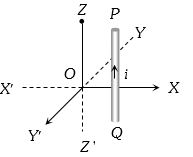
A vertical wire kept in $Z-X$ plane carries a current from $Q$ to $P$ (see figure). The magnetic field due to current will have the direction at the origin $O$ along
A force $F$ is given by $F = at + b{t^2}$, where $t$ is time. What are the dimensions of $a$ and $b$