MCQ
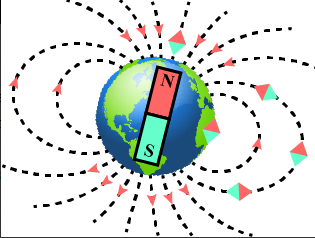
A compass needle, which shows the direction at the earth's magnetic pole is:
- AVertical.
- BNo particular direction.
- CBent at 45° to the vertical.
- DHorizontal.
Explanation:
For a compass to show the direction of magnetic pole moment, they must be placed at ether of the 2 geographic poles. It is because the direction of magnetic moment is from south to north pole.
The compass therefore will be vertical at both the poles.
Generate a complete, print-ready paper with questions like this in minutes — across 16+ boards, with answer keys.
A potentiometer consists of a wire of length 4 m and resistance 10 W. It is connected to cell of emf 2 V. The potential difference per unit length of the wire will be
|
(a) 0.5 V/m |
(b) 10 V/m |
(c) 2 V/m |
(d) 5 V/m |
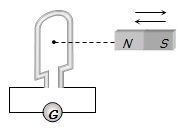
When a magnet is pushed in and out of a circular coil C connected to a very sensitive galvanometer G as shown in the adjoining diagram with a frequency v, then
|
(a) Constant deflection is observed in the galvanometer |
|
(b) Visible small oscillations will be observed in the galvanometer if v is about 50 Hz |
|
(c) Oscillations in the deflection will be observed clearly if v = 1 or 2 Hz |
|
(d) No variation in the deflection will be seen if v = 1 or 2 Hz |
An external resistance R is connected to a battery of e.m.f. V and internal resistance r. The joule heat produced in resistor R is maximum when R is equal to
|
(a) r |
(b) |
(c) 2r |
(d) Infinitely large |
Calculate the equivalent resistance between A and B

|
(a) |
(b) 3 W |
(c) 6 W |
(d) |
In a Young's experiment, two coherent sources are placed 0.90 mm apart and the fringes are observed one metre away. If it produces the second dark fringe at a distance of 1 mm from the central fringe, the wavelength of monochromatic light used would be
|
(a) 60 |
(b) 10 |
(c) 10 |
(d) 6 |
The magnetic flux linked with a coil, in webers, is given by the equations ∅ =  Then the magnitude of induced e.m.f. at t = 2 second will be
|
(a) 2 volt |
(b) 4 volt |
(c) 8 volt |
(d) 16 volt |


