MCQ 11 Mark
The perfect pairs for a superconductor substance is-
- A$\chi=1$ व $\mu_r=0$
- B$\chi=0$ व $\mu_r=1$
- ✓$\chi=-1$ व $\mu_r=0$
- D$\chi=0$ व $\mu_r=-1$
Answer
View full question & answer→Correct option: C.
$\chi=-1$ व $\mu_r=0$
C
50 questions · timed · auto-graded
Explanation:
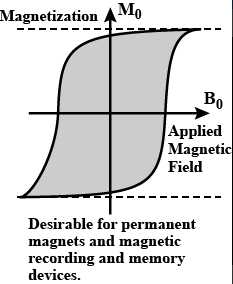
Permanent magnet should have large coercivity and large retentivity. Therefore, the hysteresis cycle of the material should be tall and wide.
Explanation:
Ferromagnetic substance, Because they get magnetize in external magnetic field and don't lose their magnetic property.
Explanation:
Above curie temperature ferromagnetic material behaves like paramganetic materials. There magnetic susceptibilty starts varying linearly with temperature. Their I becomes too small above curies temperature.
Therefore, nature of ferrromagnetic materials becomes paramagnetic.
Explanation:
Magnetic dip or inclination at a place is defined as the angle made by the Earth’s magnetic field with the horizontal in the magnetic
meridian. It is denoted by $\delta$.
Magnetic declination at a place is defined as the angle between the geographic meridian and magnetic meridian.
Explanation:
All the electrons have magnetic moment & All the protons have magnetic moment.
Explanation:
Þ Diamagnctism occurs in all materials.
Þ The Magnetic field of Induced magnetic moment is opposite to the applied field.
Explanation:
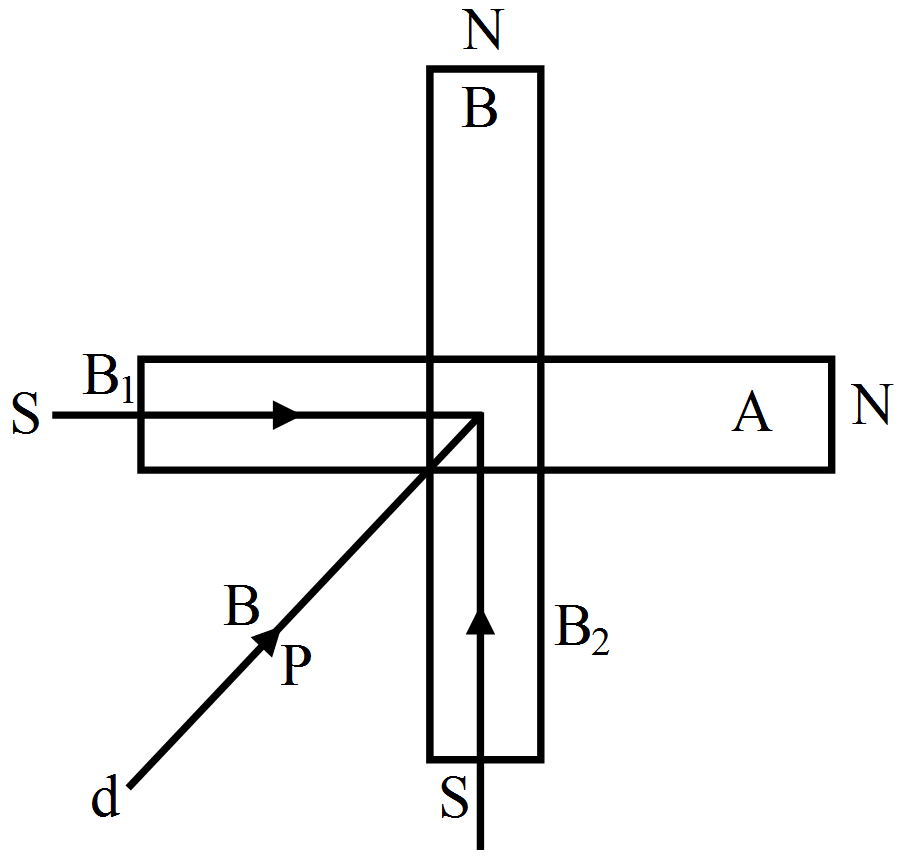
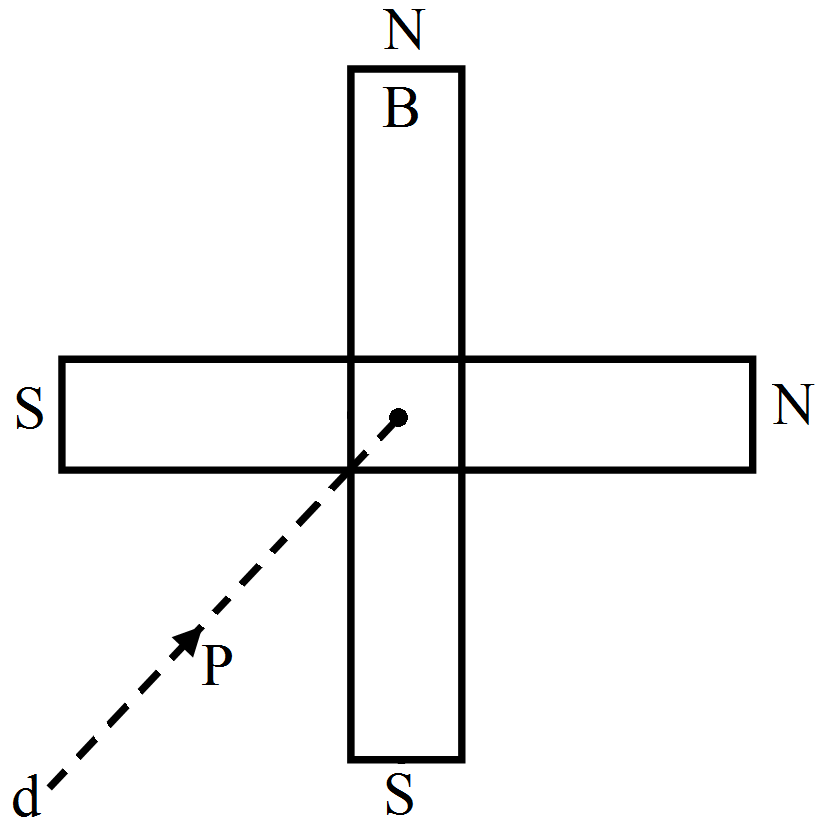
Magnetic field (B1) due to the short dipole A of dipole moment M at an axial point is given by,
$\vec{\text{B}_1}=\frac{\mu_0}{4\pi}\frac{2\text{M}}{\text{d}^3}\dots(1)$
Magnetic field (B2) due to the short dipole B of dipole moment M at an axial point is given by,
$\vec{\text{B}_2}=\frac{\mu_0}{4\pi}\frac{2\text{M}}{\text{d}_3}\dots(2)$
Resultant magnetic field (B) will be,
$\text{B}=\sqrt{\text{B}_1^2+\text{B}_2^2}$
$\text{B}=\frac{\mu_0}{4\pi}\frac{\sqrt[2]{2}\text{M}}{\text{d}^3}$
Explanation:
The power of magnetism after the inducing agency is removed, is called Retentivity of a substance.
Retentivity is used for remanence measured in units of magnetic flux density.
Steel retains magneto-field longer, iron acquires the field easier but decays sooner.
Explanation:
A freely suspended magnet aligns in north-south direction.
Explanation:
A superconductor exhibits perfect diamagnetism.
Explanation:
Electromagnetic cores should have:
Explanation:
The permanent magnetic moment of the atoms of a material is zero. The material must be diamagnetic.
Explanation:
Curie - Wiess Law states that all ferromagnetic substances become paramagnteic above the curie temperature.
Explanation:
Magnetic susceptibility is a dimensionless proportionality constant that indicates the degree of magnetisation of a material in response to an applied magnetic field.
Substances such as copper, iron have negative susceptibility as these substances are diamagnetic substances.
Substances with negative susceptibility signifies that they are repelled by magnets.
Explanation:
Ferromagnetic substances have high susceptibility to magnetisation. Liquid and gases aren't prone to be magnetised.
Explanation:
In cassette player, materials used for magnetic tapes is NiFe2O4.
Ferrites (Ferromagnetic material) is used for Coating magnetic tapes.
In cassette player or for building memory store in modern computers.
Most common ones are MnFe2O4, FeFe2O4, NiFe2O4 etc.
Explanation:
Hysteresis cycle curve for the material of a permanent magnet is given in the image.
It is clear from the image that hysteresis cycle curve for the material of a permanent magnet is tall and wide.
Explanation:
The SI unit of magnetic flux is Weber.
Explanation:
he Gauss’s law states that the surface integral of a magnetic field over a closed surface is always zero. But the surface integral of a magnetic field over a surface gives magnetic flux through that surface.
Explanation:
When we break a magnet into two, both act as magnets, that is both have a north and south pole each. In both these pieces the corresponding north and south poles remain on the sides as in the original magnet. This means that the 2 broken sides must get oppositely polarized.
Explanation:
Ferromagnetic materials exhibit a long-range ordering phenomenon at the atomic level which causes the unpaired electron spins to line up parallel with each other in a region called a domain. Within the domain, the magnetic field is intense, but in a bulk sample the material will usually be unmagnetized because the many domains will themselves be randomly oriented with respect to one another. Ferromagnets will tend to stay magnetized to some extent after being subjected to an external magnetic field. This tendency to "remember their magnetic history" is called hysteresis.
\Nickel, iron and cobalt are such materials. Ferromagnetic materials exhibit a long-range ordering phenomenon at the atomic level which causes the unpaired electron spins to line up parallel with each other in a region called a domain. Within the domain, the magnetic field is intense, but in a bulk sample the material will usually be unmagnetized because the many domains will themselves be randomly oriented with respect to one another.Ferromagnets will tend to stay magnetized to some extent after being subjected to an external magnetic field. This tendency to "remember their magnetic history" is called hysteresis. Nickel, iron and cobalt are such materials.
Explanation:
Diamagnetic substances are those which are freebly repelled by the magnetic field.
$\therefore$ Copper, Hydrogen, Silver are diamagnetic as their atoms have net magnetic dipole moment zero.
Explanation:
An electric current is produced in the wire. The production of electricity from magnetism is called electromagnetic induction.
Solution:
Key concept: The magnetic field intensity H = nl, where n = number of turns per metre of a solenoid and I = current and $\text{B}=\mu_0\mu_\text{r}\text{I}$.
Also, at normal temperature, a solenoid behaves as a ferromagnetic substance and at the temperature beyond the Curie temperature, it behaves as a paramagnetic substance.
We know, for solenoid H = nI.
⇒ H = 1000 × 1 = 1000Am
Thus, H is a constant, so it is nearly unchanged because on heating n and I remain constant.
But $\text{B}=\mu_0\mu_\text{r}\text{nI}$
$=\mu_0\text{n I}\mu_\text{r}$
$=\text{k}\text{(constant)}\mu_\text{r}$
but there is a large decrease in the susceptibility of the core on heating it beyond critical temperature, hence magnetic field will decrease drastically. Now, for magnetisation in the core, when temperature of the iron core of a solenoid is raised beyond Curie temperature, then it behaves as a paramagnetic material, where
$(\chi_\text{m})_\text{Fero}\approx10^{3}$
and $(\chi_\text{m})_\text{para}\approx10^{-5}$
$\Rightarrow\ \frac{(\chi_\text{m})_\text{Fero}}{(\chi_\text{m})_\text{para}}=\frac{10^3}{10^{-5}}=10^{8}$