Question
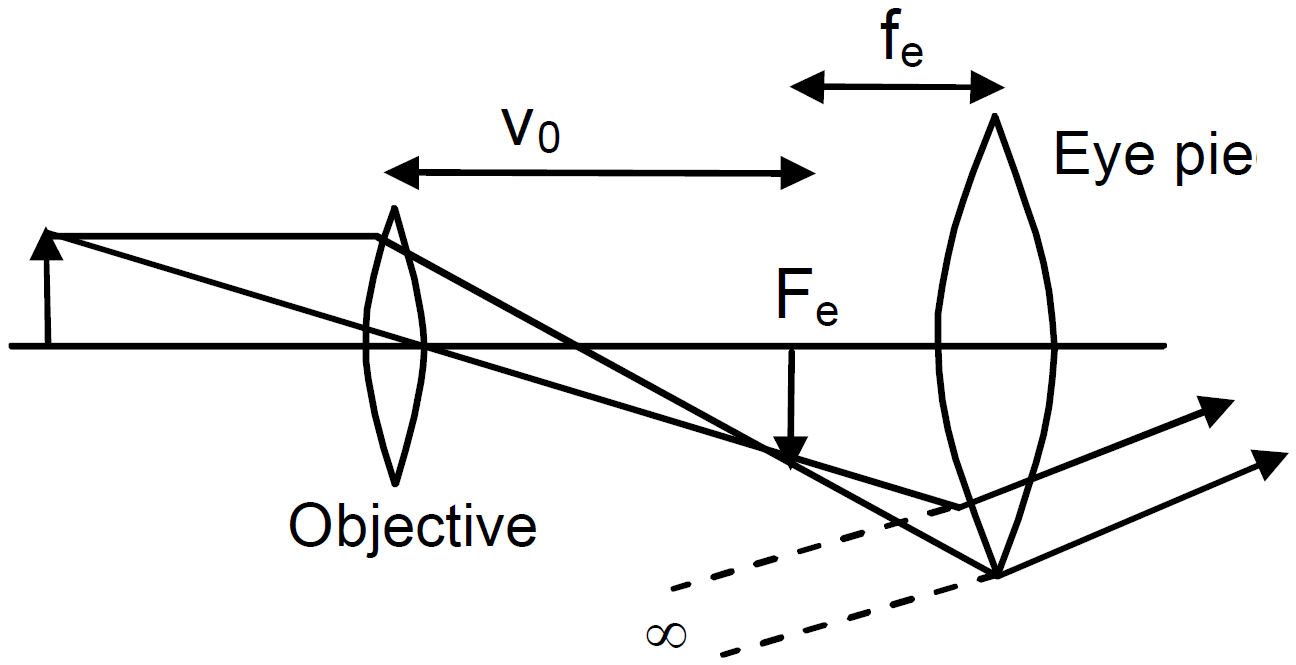
A compound microscope has a magnifying power of 100 when the image is formed at infinity. The objective has a focal length of 0.5cm and the tube length is 6.5cm. Find the focal length of the eyepiece.

Answer

For the give compound microscope, f0 = 0.5cm, tube length = 6.5cm magnifying power = 100 (normal adjustment) Since, the image is formed at infinity, the real image produced by the objective lens should lie on the focus of the eye piece.

So, vo + fe = 6.5cm ...(1)

Again, magnifying power $\text{m}=\frac{\text{v}_0}{\text{u}_0}\times\frac{\text{D}}{\text{f}_\text{e}}$ [for normal adjustment]

$\Rightarrow\text{m}=\Big[1-\frac{\text{V}_0}{\text{f}_0}\Big]\frac{\text{D}}{\text{f}_\text{e}}$ 

$\Rightarrow100=-\Big[1-\frac{\text{V}_0}{0.5}\Big]\times\frac{25}{\text{f}_\text{e}}$ [Taking D = 25cm]

$\Rightarrow100\text{f}_\text{e}=-(1-2\text{v}_0)\times25$

$\Rightarrow2\text{v}_0-4\text{f}_\text{e}=1 $ ...(2)

Solving equation (1) and (2) we can get,

V0 = 4.5cm and fe = 2cm

So, the focal length of the eye piece is 2cm.
Need a full question paper?

Generate a complete, print-ready paper with questions like this in minutes — across 16+ boards, with answer keys.
Start Generating Free

Similar questions

The plates of a capacitor of capacitance $10\mu\text{F},$ charged to $60\mu\text{C},$ are joined together by a wire of resistance $10\Omega$ at t = 0. Find the charge on the capacitor in the circuit at (a) t = 0 (b) $\text{t}=30\mu\text{s}$ (c) $\text{t}=120\mu\text{s}$ and (d) t = 1.0ms.
A uniform chain of length L and mass M overhangs a horizontal table with its two third part on the table. The friction coefficient between the table and the chain is $\mu.$ Find the work done by the friction during the period the chain slips off the table.
Derive an expression for magnetic field intensity due to a magnetic dipole at a point lies on its equatorial line.
Explain with the help of a circuit diagram how the value of unknown resistance can be determined using a Wheatstone Bridge. Give the formula used.
The door of an almirah is 6ft high, 1.5ft wide and weighs 8kg. The door is supported by two hinges situated at a distance of 1ft from the ends. If the magnitudes of the forces exerted by the hinges on the door are equal, find this magnitude.
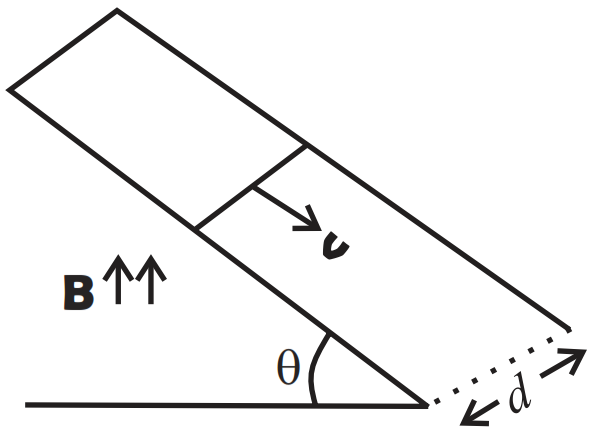
A rod of mass m and resistance R slides smoothly over two parallel perfectly conducting wires kept sloping at an angle θ with respect to the horizontal (Fig). The circuit is closed through a perfect conductor at the top. There is a constant magnetic field B along the vertical direction. If the rod is initially at rest, find the velocity of the rod as a function of time.

A conducting loop of area 5.0cm2 is placed in a magnetic field which varies sinusoidally with time as $\text{B}=\text{B}_0\sin\omega\text{t}$ wherer $\text{B}_0=0.20\text{T}$ and $\omega=300\text{s}^{-1}.$ The normal to the coil makes an angle of 60° with the field. Find
  1. The maximum emf induced in the coil.
  2. The emf induced at $\text{t}=\Big(\frac{\pi}{900}\Big)\text{s}$
  3. $\text{t}=\Big(\frac{\pi}{600}\Big)\text{s}.$
  4. The emf induced at $\text{t}=\Big(\frac{\pi}{600}\Big)\text{s}.$
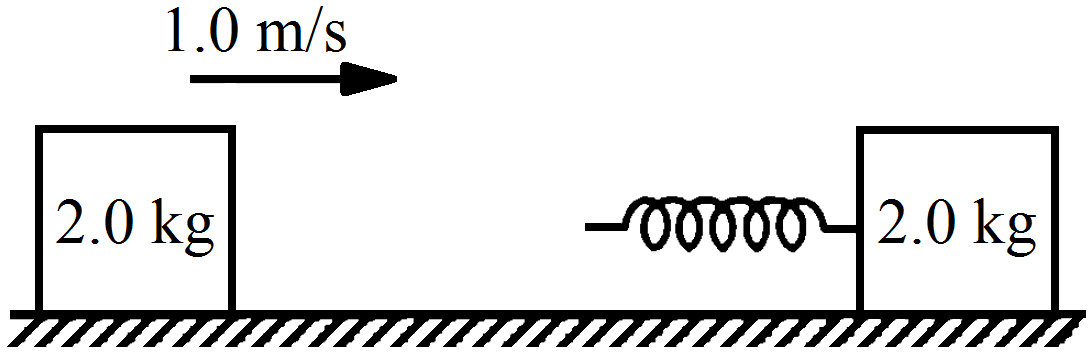
A block of mass 2.0kg is moving on a frictionless horizontal surface with a velocity of 1.0m/s towards another block of equal mass kept at rest. The spring constant of the spring fixed at one end is 100N/m. Find the maximum compression of the spring.

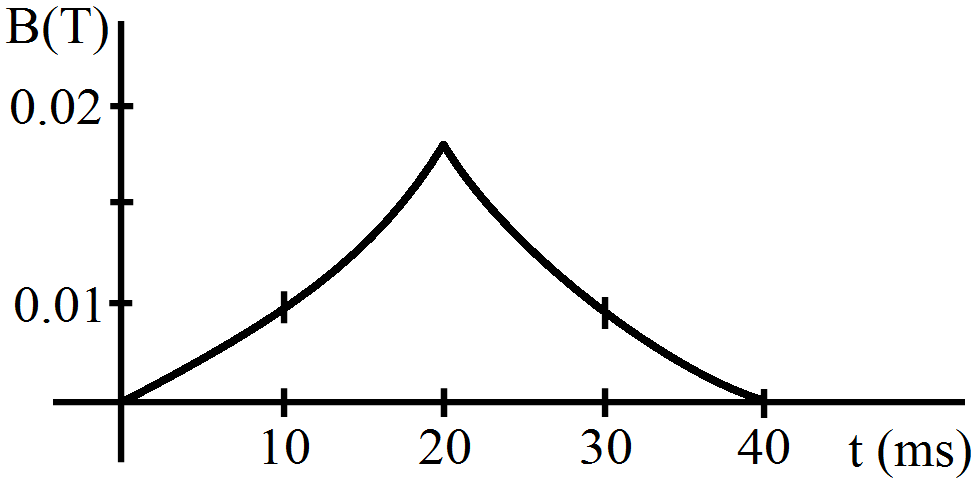
  1. The magnetic field in a region varies as shown in figure. Calculate the average induced emf in a conducting loop of area 2.0 × 10⁻³m2 placed perpendicular to the field in each of the 10ms intervals shown.
  2. In which intervals is the emf not constant? Neglect the behaviour near the ends of 10ms intervals.

An electron emitted by a heated cathode and accelerated through a potential difference of 2.0 kV, enters a region with uniform magnetic field of 0.15 T. Determine the trajectory of the electron if the field,
  1. is transverse to its initial velocity,
  2. makes an angle of 30º with the initial velocity.