Question
A compound microscope is an optical instrument used for observing highly magnified images of tiny objects. Magnifying power of a compound microscope is defined as the ratio of the angle subtended at the eye by the final image to the angle subtended at the eye by the object, when both the final image and the object are situated at the least distance of distinct vision from the eye. It can be given that : $m = m_e \times m_0,$ where $m_e$ is magnification produced by eye lens and $m0$ is magnification produced by objective lens.
Consider a compound microscope that consists of an objective lens of focal length $2.0\ cm$ and an eyepiece of focal length $6.25\ cm$ separated by a distance of $15\ cm.$
  1. The object distance for eye$-$piece, so that final image is formed at the least distance of distinct vision, will be:
  1. $3.45\ cm$
  2. $5\ cm$
  3. $1.29\ cm$
  4. $2.59\ cm$
  1. How far from the objective should an object be placed in order to obtain the condition described in part $(i)$?
  1. $4.5\ cm$
  2. $2.5\ cm$
  3. $1.5\ cm$
  4. $3.0\ cm$
  1. What is the magnifying power of the microscope in case of least distinct vision?
  1. $20$
  2. $30$
  3. $40$
  4. $10$
  1. The intermediate image formed by the objective of a compound microscope is:
  1. Real, inverted and magnified.
  2. Real, erect, and magnified.
  3. Virtual, erect and magnified.
  4. Virtual, inverted and magnified.
  1. The magnifying power of a compound microscope increases with :
  1. The focal length of objective lens is increased and that of eye lens is decreased.
  2. The focal length of eye lens is increased and that of objective lens is decreased.
  3. Focal lengths of both objects and eye$-$piece are increased.
  4. Focal lengths of both objects and eye$-$piece are decreased.
Answer

  1. $(b)\ 5\ cm$
Here$, f_0 = 2.0, f_e = 6.25\ cm, u_0 = ?$
When the final image is obtained at the least distance of distinct vision:
$v_e = -25\ cm$
As $\frac{1}{\text{v}_\text{e}}-\frac{1}{\text{}_\text{e}}=\frac{1}{\text{f}_\text{e}}$
$\therefore \frac{1}{\text{u}_\text{e}}\frac{1}{\text{v}_\text{e}}\frac{1}{\text{f}_\text{e}}=\frac{1}{-25}-\frac{1}{6.25}$
$=\frac{-1-4}{25}=\frac{-5}{25}=-\frac{1}{5}$
or $\text{u}_\text{e}=-5\text{cm}$
  1. $(b)\ 2.5\ cm$
Distance between objective and eye$-$piece $= 15\ cm$
$\therefore$ Distance of the image from objective is $\text{v}_0=15-5=10\text{cm}$
$\therefore\frac{1}{\text{u}_0}=\frac{1}{\text{v}_0}-\frac{1}{\text{f}_0}=\frac{1}{\text{10}}-\frac{1}{\text{2}}=\frac{1-5}{\text{10}}=-\frac{2}{5}$
or $\text{u}_0=-\frac{5}{2}=-2.5\text{cm}$
$\therefore$ Distance of object from objective $= 2.5\ cm$
  1. $(a)\ 20$
Magnifying power,
$\text{m}=\text{m}_0\times\text{m}_\text{e}=\frac{\text{v}_0}{\text{u}_0}(1+\frac{\text{D}}{\text{fe}})=\frac{10}{2.5}(1+\frac{25}{6.25})=20$
  1. $(a)$ Real, inverted and magnified.
The intermediate image formed by the objective of a compound microscope is real, inverted and magnified.
  1. $(d)$ Focal lengths of both objects and eye$-$piece are decreased.
Need a full question paper?

Generate a complete, print-ready paper with questions like this in minutes — across 16+ boards, with answer keys.

Start Generating Free

Similar questions

Currents can be induced not only in conducting coils, but also in conducting sheets or blocks. Current is induced in solid metallic masses when the magnetic flux threading through them changes. Such currents flow in the from of irregularly shaped loops throughout the body of the metal. These currents look like eddies or whirlpools in water so they are known as eddy currents. Eddy currents have both undesirable effects and practically useful applications. For example it causes unnecessary heating and wastage of power in electric motors, dynamos and in the cores of transformers.
  1. The working of speedometers of trains is based on:
  1. Wattless currents.
  2. Eddy currents.
  3. alternating currents.
  4. pulsating currents.
  1. Identify the wrong statement.
  1. Eddy currents are produced in a steady magnetic field.
  2. Induction furnace uses eddy currents to produce heat.
  3. Eddy currents can be used to produce braking force in moving trains.
  4. Power meters work on the principle of eddy currents.
  1. Which of the following is the best method to reduce eddy currents?
  1. Laminating core.
  2. Using thick wires.
  3. By reducing hysteresis loss.
  4. None of these.
  1. The direction of eddy currents is given by:
  1. Fleming's left hand rule.
  2. Biot-Savart law.
  3. Lenz's law
  4. Ampere-circuital law.
  1. Eddy currents can be used to heat localised tissues of the human body. This branch of medical therapy is called:
  1. Hyperthermia.
  2. Diathermy.
  3. Inductothermy.
  4. None of these.
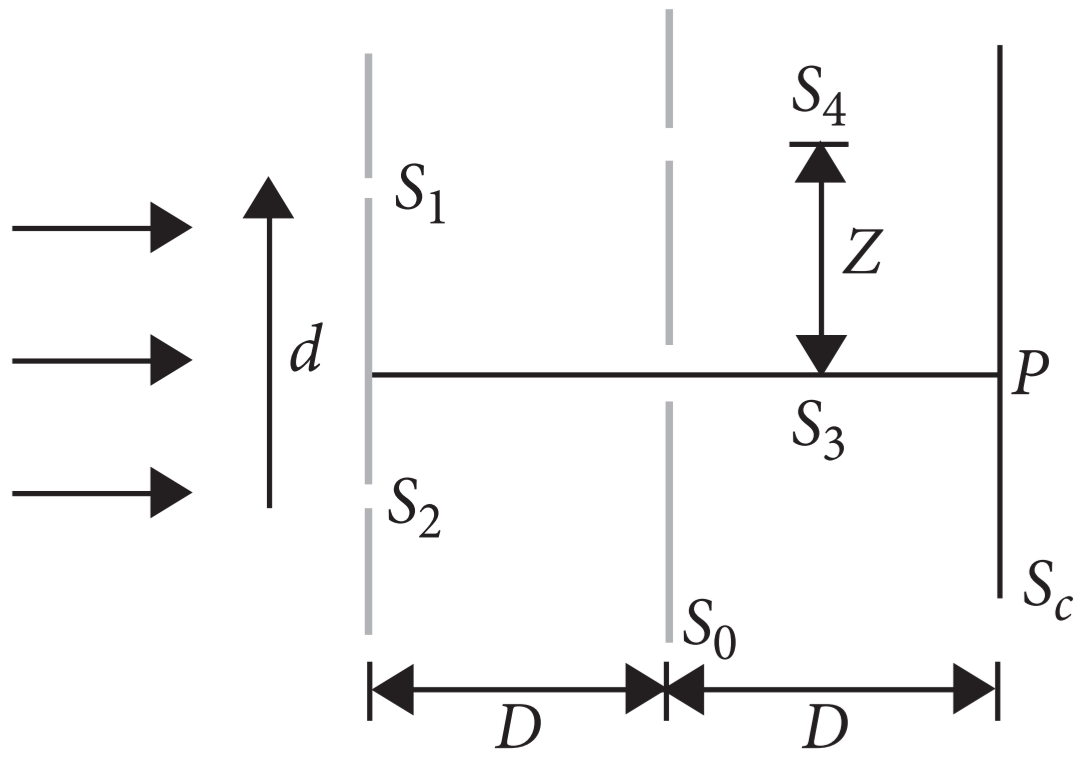
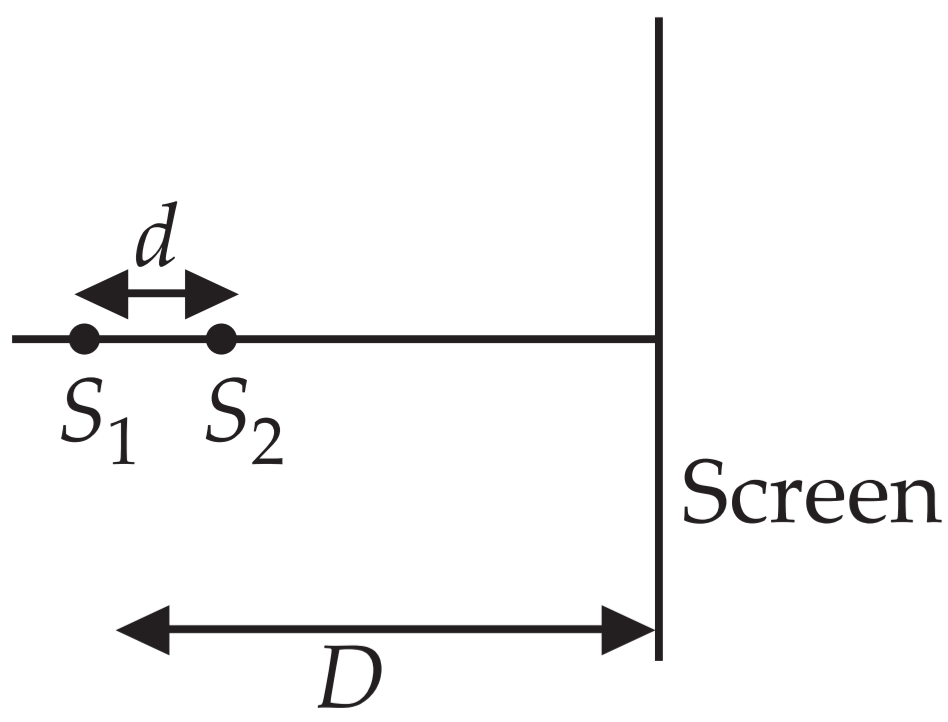
Consider the situation shown in figure. The two slits $S_1$ and $S_1$ placed symmetrically around the central line are illuminated by monochromatic light of wavelength $\lambda$. The separation between the slits is $d$. The light transmitted by the slits falls on a screen $S_0$ place at a distance $D$ from the slits. The slits $S_3$ is at the central line and the slit $S_4$ is at a distance from $S_3$. Another screen $S_c$ is placed a further distance $D$ away from $S_c$.
  1. Find the path difference if $\text{z}=\frac{\lambda\text{D}}{2\text{d}}$.
  1. $5A^2$
  2. $13A^2$
  3. $7A^2$
  4. $19A^2$
  5. Two monochromatic light waves of amplitudes $3_A$ and $2_A$ interfering at a point have a phase difference of $60^\circ$ .
  6. The intensity at that point will be proportional to:
  7. $\Big(\text{n}+\frac{1}{2}\Big)\lambda$
  8. $\text{n}\lambda$
  9. $\Big(\text{n}-\frac{1}{2}\Big)\lambda$
  10. $\frac{\lambda}{2}$
  11. ln the case of light waves from two coherent sources $S_1$ and $S_2,$ there will be constructive interference at an arbitrary point $P, $ if the path difference $\ce{S_1P - S_2P}$ is:
  12. Concentric circles.
  13. Points.
  14. Straight lines.
  15. Semi $-$ circles.
  16. Two coherent point sources $S_1$ and $S_2$ are separated by a small distanced as shown in figure. The fringes obtained on the screen will be:
  17. $4$
  18. $2$
  19. $\infty$
  20. $1$
  21. Find the ratio of the maximum to minimum intensity observed on $S_c$ if $\text{z}=\frac{\lambda\text{D}}{\text{d}}$
  22. $\lambda$
  23. $\frac{\lambda}{2}$
  24. $\frac{3}{2\lambda}$
  25. $2\lambda$
The density of nuclear matter is the ratio of the mass of a nucleus to its volume. As the volume of a nucleus is directly proportional to its mass number $A,$ so the density of nuclear matter is independent of the size of the nucleus. Thus, the nuclear matter behaves like a liquid of constant density. Different nuclei are like drops of this liquid, of different sizes but of same density. Let $A$ be the mass number and $R$ be the radius of a nucleus. If $m$ is the average mass of a nucleon, then. Mass of nucleus $= mA$
Volume of nucleus $=\frac{4}{3}\pi\text{R}^3=\frac{4}{3}\pi\big(\text{R}_0\text{A}\frac{1}{3}\big)=\frac{4}{3}\pi\text{R}^3_0\text{A}$
$\therefore$ Nuclear density $,\rho\text{nu}=\frac{\text{Mass of nucleus}}{\text{Volume of nucleus}}$ or $\ \rho\text{nu}$
$=\frac{\text{MA}}{\frac{4}{3}\pi\text{R}_0^3\text{A}}=\frac{3\text{m}}{4\pi\text{R}_0^3}$
Clearly, nuclear density is independent of mass number $A$ or the size of the nucleus. The nuclear mass density is of the order $10^{17}kg m^{-3}$ This density is very large as compared to the density of ordinary matter, say water, for which $\rho = 1.0 \times 10^3\ kg m^{-3}$
  1. The nuclear radius of $_8^{16}\text{O} is 3 \times 10^{-15}m$. The density of nuclear matter is.
  1. $2.9 \times 10^{34}kg m^{-3}$
  2. $1.2 \times 10^{17}kg m^{-3}$
  3. $16 \times 10^{27}kg m^{-3}$
  4. $2.4 \times 10^{17}kg m^{-3}$
  1. What is the density of hydrogen nucleus in $SI$ units? Given $R_o= 1.1$ fermi and $m_P = 1.007825$ amu.
  1. $1.2 \times 10^{17}kg m^{-3}$
  2. $3.0 \times 10^{34}kg m^{-3}$
  3. $1.99 \times 10^{11}kg m^{-3}$
  4. $7.85 \times 10^{17}kg m^{-3}$
  1. Density of a nucleus is.
  1. More for lighter elements and less for heavier elements.
  2. More for heavier elements and less for lighter elements.
  3. Very less compared to ordinary matter.
  4. A constant.
  1. The nuclear mass of $_{23}^{56}\text{Fe}$ is $55.85$ amu. The its nuclear density is.
  1. $5.0 \times 10^{19}kg m^{-3}$
  2. $1.5 \times 10^{19}kg m^{-3}$
  3. $2.9 \times 10^{17}kg m^{-3}$
  4. $9.2 \times 10^{26}kg m^{-3}$
  1. If the nucleus of $_{13}^{27}\text{Al}$ has s a nuclear radius of about $3.6 fm,$ then $_{52}^{125}\text{Te}$ would have its radius approximately as.
  1. $9.6fm$
  2. $12fm$
  3. $4.8fm$
  4. $6fm$

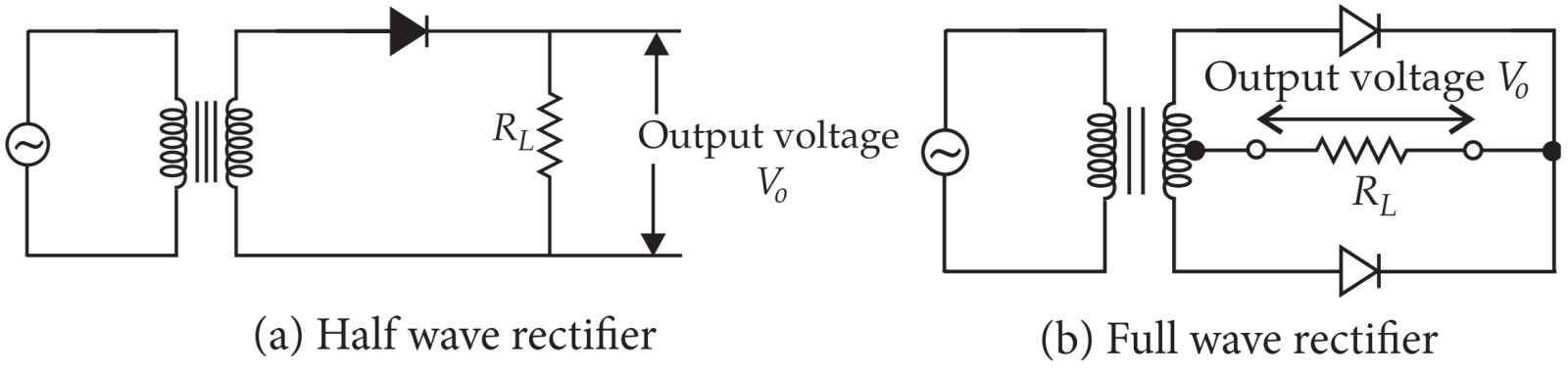
Rectifier is a device which is used for converting alternating current or voltage into direct current or voltage. Its working is based on the fact that the resistance of p-n junction becomes low when forward biased and becomes high when reverse biased. A half-wave rectifier uses only a single diode while a full wave rectifier uses two diodes as shown in figures (a) and (b).
  1. If the rms value of sinusoidal input to a full wave rectifier is $\frac{\text{V}_0}{\sqrt{2}}$ then the rms value of the rectifier's output is:
  1. $\frac{\text{V}_0}{\sqrt{2}}$
  2. $\frac{\text{V}_0^2}{\sqrt{2}}$
  3. $\frac{\text{V}_0^2}{2}$
  4. $\sqrt{2}\text{V}_0^2$
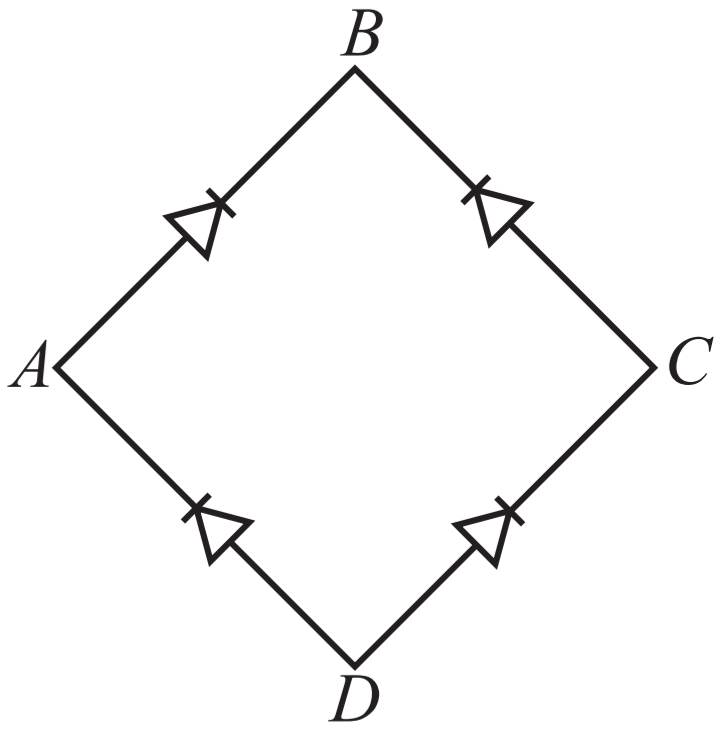
  1. In the diagram, the input ac is across the terminals A and C. The output across B and D is:
  1. Same as the input.
  2. Half wave rectified.
  3. Zero.
  4. Full wave rectified.
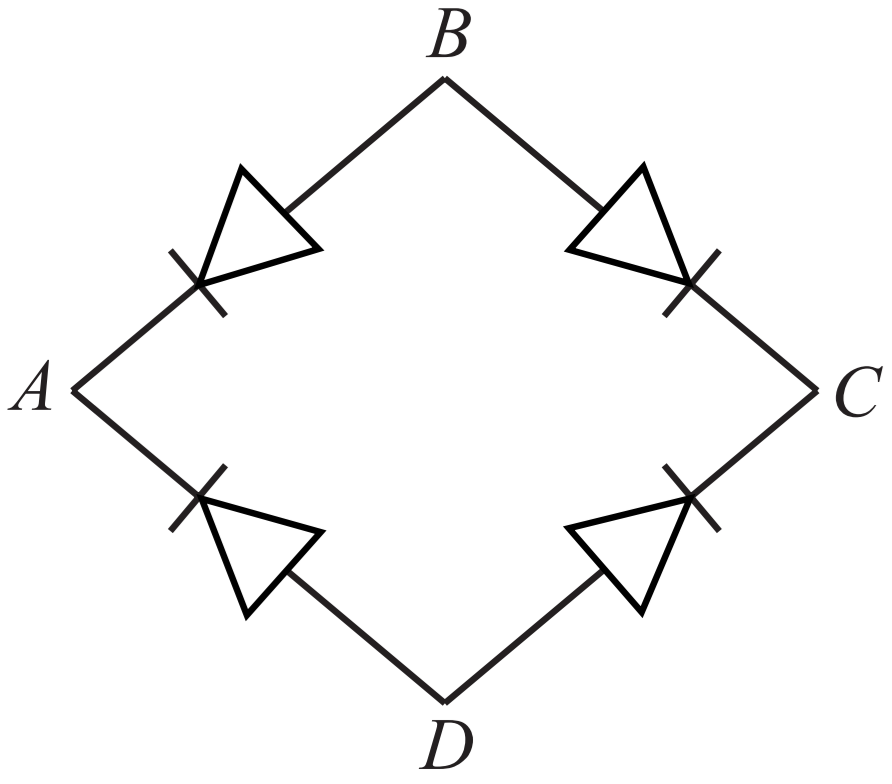
  1. A bridge rectifier is shown in figure. Alternating input is given across A and C. If output is taken across BD, then it is:
  1. Zero.
  2. Same as input.
  3. Half wave rectified.
  4. Full wave rectified.
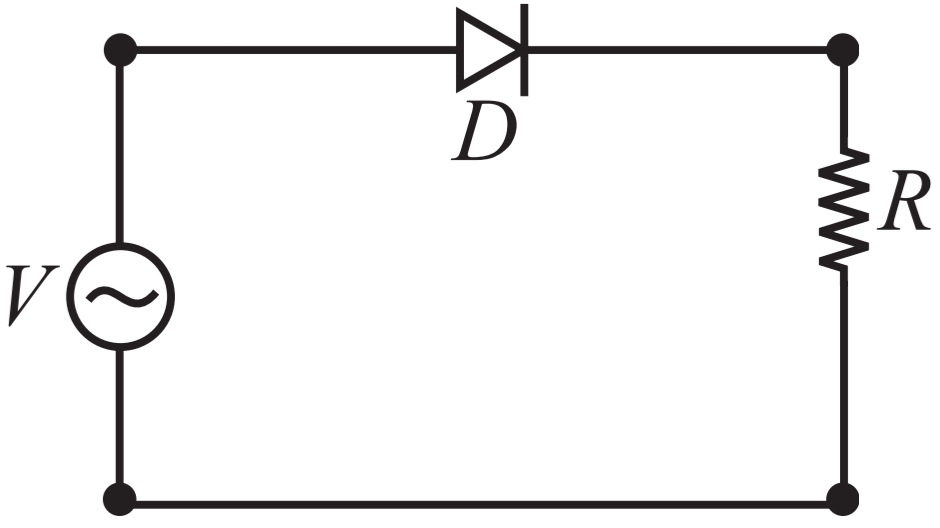
  1. A p-n junction (D) shown in the figure can act as a rectifier. An alternating current source (V) is connected in the circuit. The current (I) in the resistor (R) can be shown by:

  1. With an ac input from 50Hz power line, the ripple frequency is:
  1. 50Hz in the de output of half wave as well as full wave rectifier.
  2. 100Hz in the de output of half wave as well as full wave rectifier.
  3. 50Hz in the de output of half wave and I 00Hz in de output of full wave rectifier.
  4. 100Hz in the de output of half wave and 50Hz in the de output of full wave rectifier.
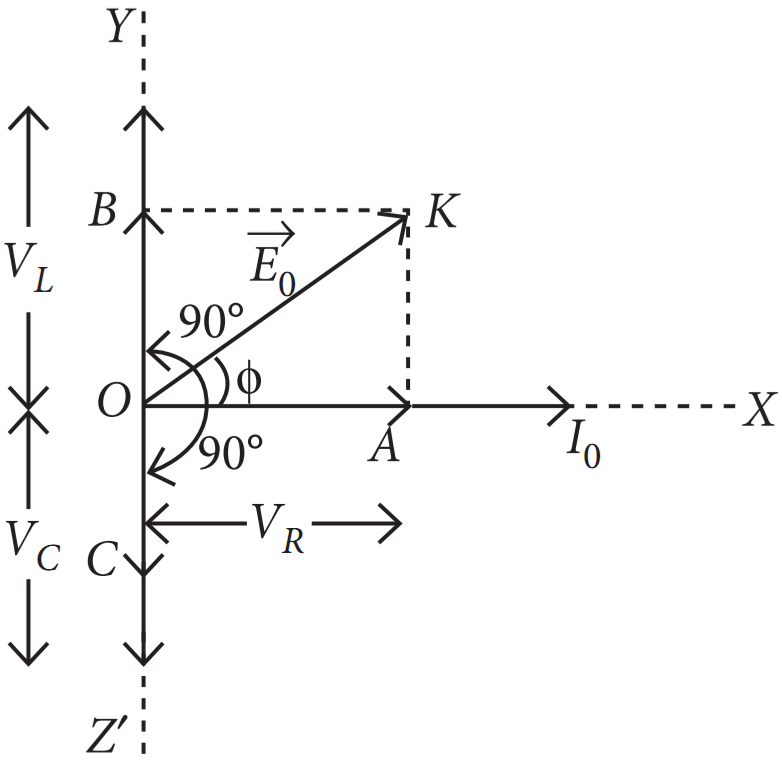
When a pure resistance $R,$ pure inductor $L$ and an ideal capacitor of capacitance $C$ is connected in series to a source of alternating $e.m.f.,$ then current at any instant through the three elements has the same amplitude and is represented as $\text{I} = \text{I}_0\sin\omega\text{t}.$ However, voltage across each element has a different phase relationship with the current as shown in graph. The effective resistance of $\ce{RLC}$ circuit is called impedance $(Z)$ of the circuit and the voltage leads the current by a phase angle $\phi.$

A resistor of $12\Omega,$ a capacitor ofreactance $14\Omega,$ and a pure inductor of inductance $0.1H$ are joined in series and placed across $200V, 50\ \ce{Hz} \ a.c.$ supply.
  1. The value of inductive reactance is:
  1. $15\Omega$
  2. $31.4\Omega$
  3. $20\Omega$
  4. $30\Omega$
  1. The value of impedance is:
  1. $20\Omega$
  2. $15\Omega$
  3. $30\Omega$
  4. $21.13\Omega$
  1. What is the value of current in the circuit?
  1. $5A$
  2. $15A$
  3. $10A$
  4. $9.46A$
  1. What is the value of the phase angle between current and voltage?
  1. $53^\circ 9\ '$
  2. $63^\circ 9\ '$
  3. $55^\circ 4\ '$
  4. $50^\circ$
  1. From graph, which one is true from following?
  1. $\ce{V_L \geq V_C}$
  2. $\ce{V_L < V_C}$
  3. $\ce{V_L < V_C}$
  4. $\ce{V_L < V_C}$
P-n junction is a single crystal of Ge or Si doped in such a manner that one half portion of it acts asp-type semiconductor and other half functions as n-type semiconductor. As soon as a p-n junction is formed, the holes from the p-region diffuse into then-region, and electron from n region diffuse in top-region. This results in the development of V 8 across the junction which opposes the further diffusion of electrons and holes through the junction.
  1. In an unbiased p-n junction electrons diffuse from n-region top-region because:
  1. Holes in p-region attract them.
  2. Electrons travel across the junction due to potential difference.
  3. Electron concentration inn-region is more as compared to that in p-region.
  4. Only electrons move from n top region and not the vice-versa.
  1. Electron hole recombination in p-n junction may lead to emission of:
  1. Light.
  2. Ultraviolet rays.
  3. Sound.
  4. Radioactive rays.
  1. In an unbiased p-n junction:
  1. Potential at pis equal to that at n.
  2. Potential at pis + ve and that at n is - ve.
  3. Potential at pis more than that at n.
  4. Potential at pis less than that at n.
  1. The potential of depletion layer is due to:
  1. Electrons.
  2. Holes.
  3. Ions.
  4. Forbidden band.
  1. In the depletion layer of unbiased p-n junction,
  1. It is devoid of charge carriers.
  2. Has only electrons.
  3. Has only holes.
  4. P-n junction has a weak electric field.
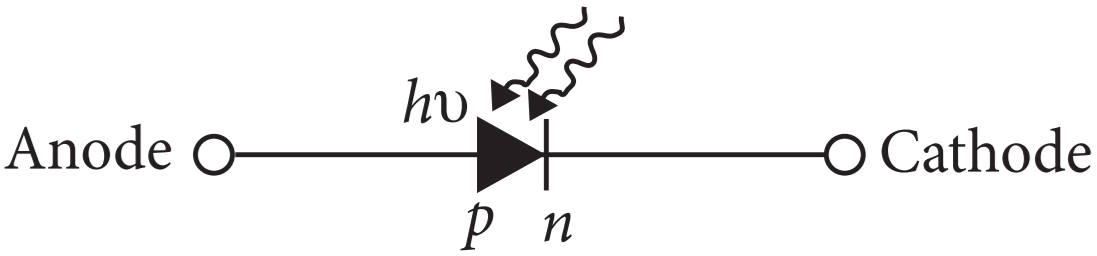
A photodiode is an optoelectronic device in which current carriers are generated by photons through photo $-$ excitation i.e., photo conduction by light. It is a $p-n$ junction fabricated from a photosensitive semiconductor and provided with a transparent window so as allow light to fall on its function. A photodiode can turn its current $ON$ and $\text{OFF}$ in nanoseconds. So, it can be used as a fastest photo $-$ detector.
  1. A $p-n$ photodiode is fabricated from a semiconductor with a band gap of $2.5\ eV$. It can detect a signal of wavelength:
  1. $4000\ nm.$
  2. $6000\ nm.$
  3. $4000Â.$
  4. $6000Â.$
  1. Three photo diodes $D_1 ,D_2$ and $D_3$ are made of semiconductors having band gap of $2.5\ eV, 2\ eV,$ and $3 \ eV ,$ respectively. Which one will be able to detect light of wavelength $6000Â$?
  1. $D_1$
  2. $D_2$
  3. $D_3$
  4. $D_1$ and $D_2$ both.
  1. Photodiode is a device:
  1. Which is always operated in reverse bias.
  2. Which of always operated in forward bias.
  3. In which photo current is independent of intensity of incident radiation.
  4. Which may be operated in forward or reverse bias.
  1. To detect light of wavelength $500\ nm,$ the photodiode must be fabricated from a semiconductor of minimum bandwidth of:
  1. $1.24\ eV$
  2. $0.62\ eV$
  3. $2.48\ eV$
  4. $3.2eV$
  1. Photodiode can be used as a photodetector to detect :
  1. Optical signals.
  2. Electrical signals.
  3. Both $(a)$ and $(b)$.
  4. None of these.
A tangent galvanometer shows a deflection of $45^\circ$ when $10mA$ of current is passed through it. If the horizontal component of the earth's magnetic field is $B_H = 3.6\times 10^{-5}\ T$ and radius of the coil is 1$0\ cm,$ find the number of turns in the coil.

Solar cell is a p-n junction diode which converts solar energy into electric energy. It is basically a solar energy converter. The upperlayer of solar cell is of p-type semiconductor and very thin so that the incident light photons may easily reach the p-n junction. On the top face of p-layer, the metal finger electrodes are prepared in order to have enough spacing between the fingers for the lights to reach the p-n junction through p-layer.
  1. The schematic symbol of solar cell is:
  1. The p-n junction which generates an emf when solar radiations fall an it, with no external bias applied, is a:
  1. Light emitting diode.
  2. Photodiode.
  3. Solar cell.
  4. None of these.
  1. For satellites the source of energy is:
  1. Solar cell.
  2. Fuel cell.
  3. Edison cell.
  4. None of these.
  1. Which of the following material is used in solar cell?
  1. Barium.
  2. Silicon.
  3. Silver.
  4. Selenium.
  1. The efficiency of a solar cell may be in the range:
  1. 2 to 5%
  2. 10 to 15%
  3. 30 to 40%
  4. 70 to 80%
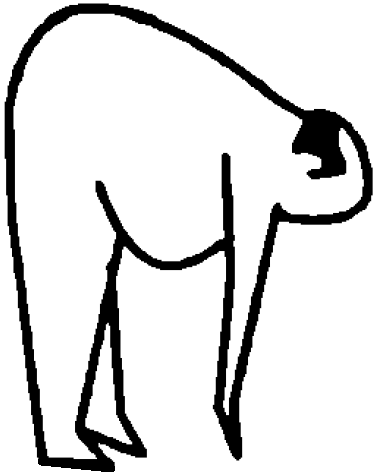
When a fat person tries to touch his toes, keeping the legs straight, he generally falls. Explain with reference to figure.