Question
Rectifier is a device which is used for converting alternating current or voltage into direct current or voltage. Its working is based on the fact that the resistance of p-n junction becomes low when forward biased and becomes high when reverse biased. A half-wave rectifier uses only a single diode while a full wave rectifier uses two diodes as shown in figures (a) and (b).
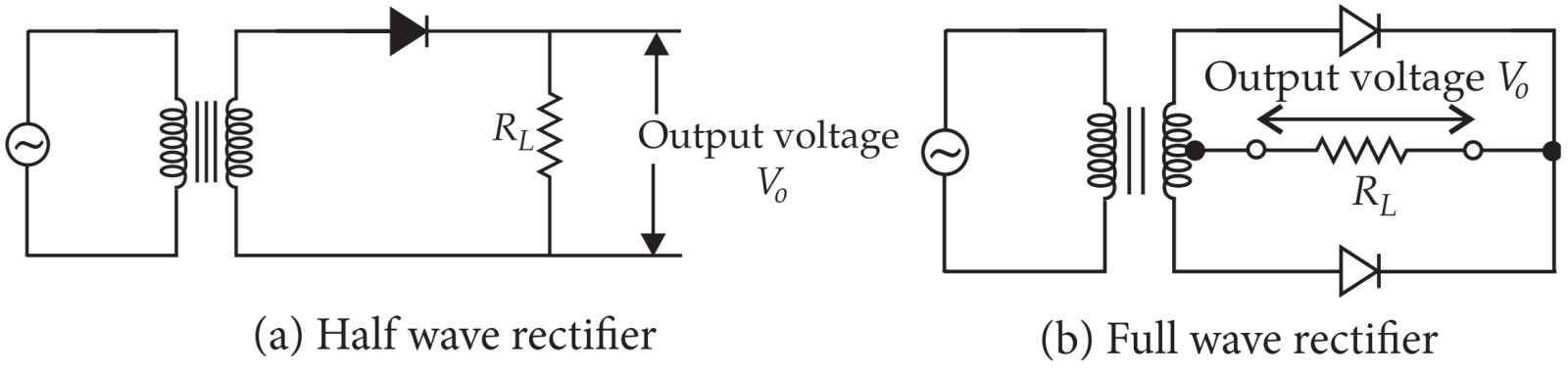
- If the rms value of sinusoidal input to a full wave rectifier is $\frac{\text{V}_0}{\sqrt{2}}$ then the rms value of the rectifier's output is:
- $\frac{\text{V}_0}{\sqrt{2}}$
- $\frac{\text{V}_0^2}{\sqrt{2}}$
- $\frac{\text{V}_0^2}{2}$
- $\sqrt{2}\text{V}_0^2$
- In the diagram, the input ac is across the terminals A and C. The output across B and D is:
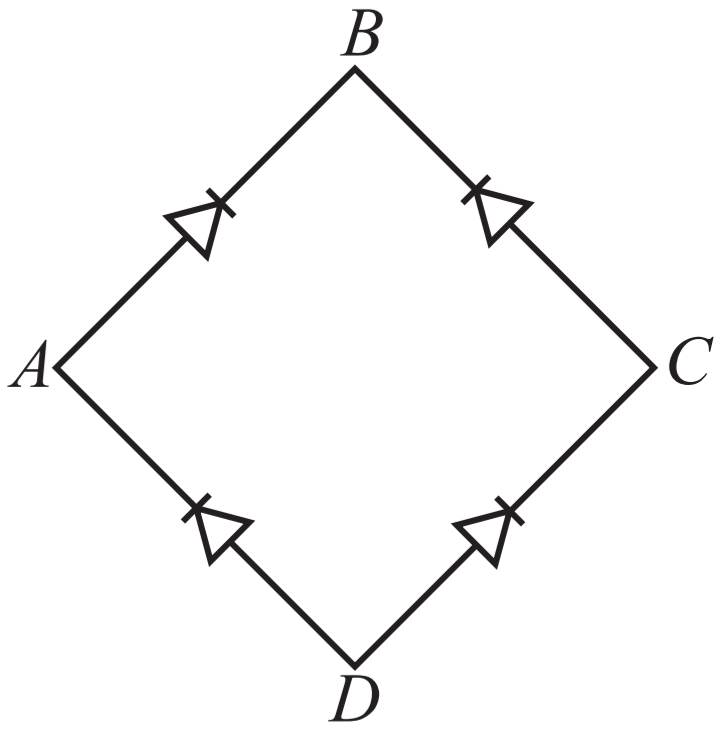
- Same as the input.
- Half wave rectified.
- Zero.
- Full wave rectified.
- A bridge rectifier is shown in figure. Alternating input is given across A and C. If output is taken across BD, then it is:
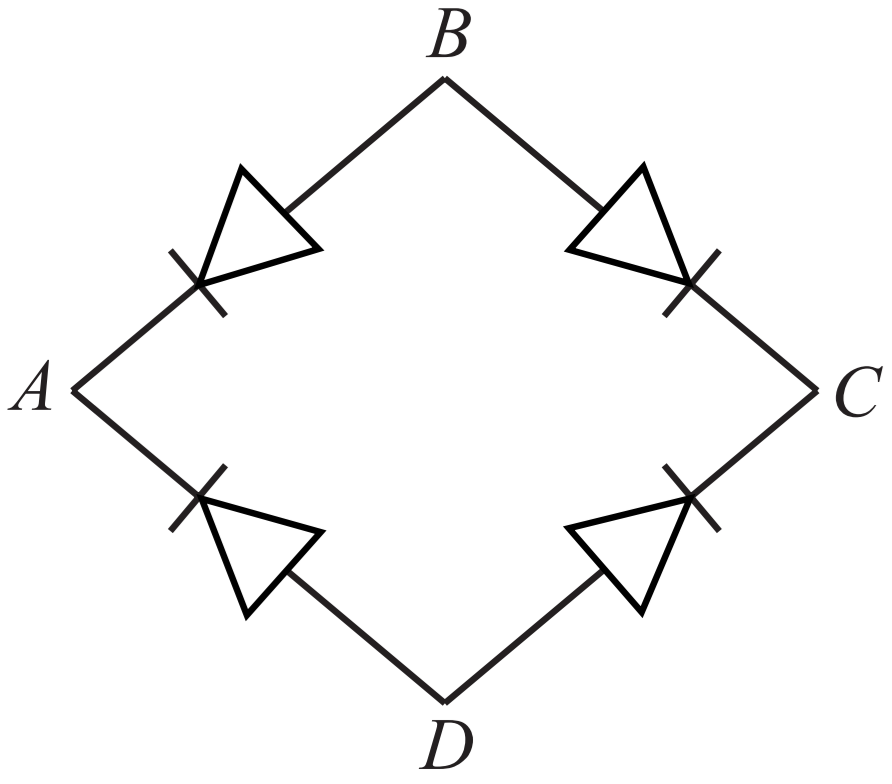
- Zero.
- Same as input.
- Half wave rectified.
- Full wave rectified.
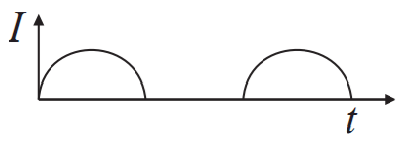
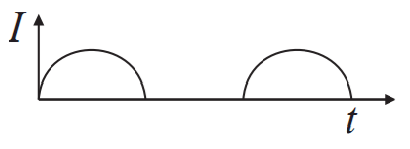
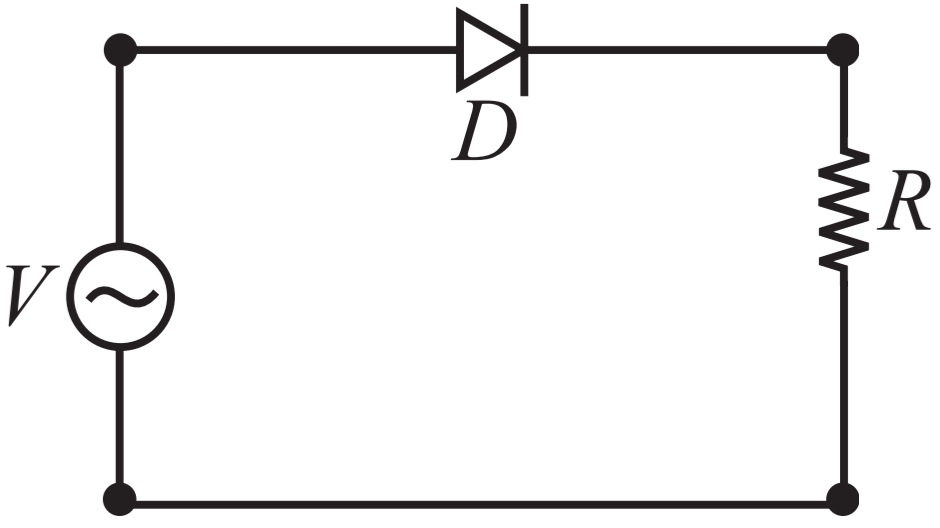
- A p-n junction (D) shown in the figure can act as a rectifier. An alternating current source (V) is connected in the circuit. The current (I) in the resistor (R) can be shown by:

- With an ac input from 50Hz power line, the ripple frequency is:
- 50Hz in the de output of half wave as well as full wave rectifier.
- 100Hz in the de output of half wave as well as full wave rectifier.
- 50Hz in the de output of half wave and I 00Hz in de output of full wave rectifier.
- 100Hz in the de output of half wave and 50Hz in the de output of full wave rectifier.