MCQ
A compound which liberates reddish brown gas around the anode during electrolysis in its molten state is-
  • A
    Sodium chloride.
  • B
    Copper (II) oxide.
  • C
    Copper (II) sulphate.
  • D
    Lead (II) bromide.

Answer

  1. Lead (II) bromide.

Explanation:

We know that Bromine gas is reddish brown in colour and which can only liberates during electrolysis of Lead (II) bromide (PbBr2​) During electrolysis of Lead (II) bromide , Positive lead ions (cations) move to the cathode and gain electrons to become lead metal and negative bromide ions (anions) move to the anode and loose an electron to make chlorine atoms. Two bromine atoms then combine and the diatomic bromine gas (Br2​) is released at the anode.

Need a full question paper?

Generate a complete, print-ready paper with questions like this in minutes — across 16+ boards, with answer keys.
Start Generating Free

Similar questions

Conc. ${H_2}S{O_4}$ has a density of $1.98\,gm/ml$ and is $98\%$  ${H_2}S{O_4}$ by weight. Its normality is ......... $N$.
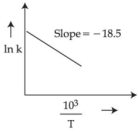
The rate constants for decomposition of acetaldehyde have been measured over the temperature range $700-1000\, K$. The data has been analysed by plotting $ln\, k\,$vs$\,\frac{10^{3}}{ T }$ graph. The value of activation energy for the reaction is $......\,kJ mol ^{-1}$. (Nearest integer) (Given : $R =8.31\, J \,K ^{-1} \,mol ^{-1}$ )
Which of the following metal is present in Brass, Bronze and German silver ?
In the given reaction sequence :

$\begin{array}{*{20}{c}}
  {C{H_2} - COOH} \\ 
  {|\,\,\,\,\,\,\,\,\,\,\,\,\,\,\,\,\,\,\,\,\,\,\,\,\,\,\,\,\,\,\,\,} \\ 
  {C{H_2} - COOH} 
\end{array}\xrightarrow{\Delta }(A)\xrightarrow{{C{H_3} - C{H_2}N{H_2}/\Delta }}(B)$

$(B)$ will be :
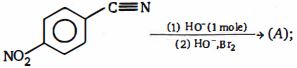
Product $(A)$ is
Amylopectin is composed of
The increasing order of the boiling points for the following compounds is

$\mathop {{C_2}{H_5}OH}\limits_{\left( I \right)} $    $\mathop {{C_2}{H_5}Cl}\limits_{\left( {II} \right)} $   $\mathop {{C_2}{H_5}C{H_3}}\limits_{\left( {III} \right)} $   $\mathop {{C_2}{H_5}OC{H_3}}\limits_{\left( {IV} \right)} $

$1\,g$ of non-volatile non-electrolyte solute is dissolved in $100\,g$ of two different solvents $A$ and $B$ whose ebullioscopic constants are in the ratio of $1 : 5.$ The ratio of the elevation in their boiling points, $\frac{{\Delta \,{T_b}\,(A)}}{{\Delta \,{T_b}\,(B)}}$ is
The rate constant of a first order reaction is $15\times 10^{-3}\,s^{-1}$. ....... $\sec$ long will $5.0\,g$ of this reactant take to reduce to $3.0\,g$.
$E^o _{Fe^{2+}/Fe} = - 0.441 \,V$ and $E^o _{Fe^{3+}/Fe^{2+}} = 0.771\, V,$ the standard $EMF$ of the reaction $Fe + 2Fe^{3+} \rightarrow 3Fe^{2+}$ will be .......... $V$.