A compressive force, $F$ is applied at the two ends of a long thin steel rod. It is heated, simultaneously, such that its temperature increases by $\Delta T$. The net change in its length is zero. Let $l$ be the length of the rod, $A$ its area of cross- section, $Y$ its Young's modulus, and $\alpha $ its coefficient of linear expansion. Then, $F$ is equal to
JEE MAIN 2017, Medium


Download our appand get started for free
Experience the future of education. Simply download our apps or reach out to us for more information. Let's shape the future of learning together!No signup needed.*
Similar Questions
- 1If the breaking force for a given wire is $F$, If the thickness of the wire is doubled, then the breaking force will beView Solution
- 2On applying a stress of $20 \times {10^8}N/{m^2}$ the length of a perfectly elastic wire is doubled. Its Young’s modulus will beView Solution
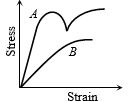
- 3The diagram shows stress v/s strain curve for the materials $A$ and $B$. From the curves we infer thatView Solution
- 4View SolutionBulk modulus was first defined by
- 5Join the relation of physical quantities in Column$-I$ to the details given in Column$-II$ appropriately :View Solution
Column $-I$ Column $-II$ $(a)$ Stress $\propto $ Strain $(i)$ $M^1\,L^{-1}\,T^{-2}$ $(b)$ Dimensional formula for compressibility $(ii)$ $M^{-1}\,L^{1}\,T^{-2}$ $(iii)$ Poisson’s ratio $(iv)$ Hooke’s law - 6What must be the lengths of steel and copper rods at $0^o C$ for the difference in their lengths to be $10\,cm$ at any common temperature? $(\alpha_{steel}=1.2 \times {10^{-5}} \;^o C^{-1})$ and $(\alpha_{copper} = 1.8 \times 10^{-5} \;^o C^{-1})$View Solution
- 7The following four wires of length $L$ and radius $r$ are made of the same material. Which of these will have the largest extension, when the same tension is applied?View Solution
- 8View SolutionThe ratio of the adiabatic to isothermal elasticities of a triatomic gas is
- 9The increase in length on stretching a wire is $0.05\%$. If its Poisson's ratio is $0.4$, then its diameterView Solution
- 10A steel rod of length $\ell$, cross sectional area $A$, young's modulus of elasticity $Y$, and thermal coefficient of linear expansion $'a'$ is heated so that its temperature increases by $t\,^oC$. Work that can be done by rod on heating will beView Solution