Question

A conducting loop carrying a current I is placed in a uniform magnetic field pointing into the plane of the paper as shown. The loop will have a tendency to
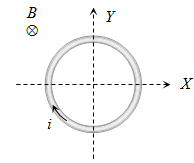
(a) Contract

(b) Expand

(c) Move towards +ve x –axis

(d) Move towards –ve x-axis

Answer

(b) Expand

Need a full question paper?

Generate a complete, print-ready paper with questions like this in minutes — across 16+ boards, with answer keys.

Start Generating Free

Similar questions

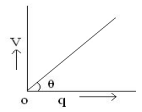
For an isolated object, the graph between potential and charge is given below. The capacity of an object is-
Image

Assertion   :   Bending a wire does not effect electrical resistance.

Reason       : Resistance of wire is proportional to resistivity of material.

(a) If both assertion and reason are true and the reason is the correct explanation of the assertion.

(b) If both assertion and reason are true but reason is not the correct explanation of the assertion.

(c) If assertion is true but reason is false.

(d) If the assertion and reason both are false.

Consider the following statements A to B  and identify the correct answer

A. Polarised light can be used to study the helical surface of nucleic acids.

B. Optics axis is a direction and not any particular line in the crystal

(a) A and B are correct

(b) A and B are wrong

(c) A is correct but B is wrong

(d) A is wrong but B is correct

Light of wavelength 4000 Å is incident on a sodium surface for which the threshold wave length of photo – electrons is 5420 Å. The work function of sodium is

(a) 4.58 eV

(b) 2.29 eV

(c) 1.14 eV

(d) 0.57 eV

Cathode ray consists of:
 The electrostatic potential on the perpendicular bisector due to an electric dipole is _____________.

If the cathode–anode potential difference in an X-ray tube be 105 V, then the maximum energy of X-ray photon can be

(a) 105 J  

(b) 105 MeV

(c) 10–1 MeV

(d) 105 KeV

The permanent magnetic moment of the atoms of a material is zero. The material:
Modern atomic mass scale is based on the mass of:

For the myopic eye, the defect is cured by


(a) Convex lens

(b) Concave lens 

(c) Cylindrical lens

(d) Toric lens