MCQ
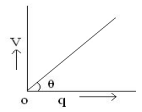
For an isolated object, the graph between potential and charge is given below. The capacity of
an object is-
- A$\sin \theta$
- B$\cos \theta$
- C$\tan \theta$
- ✓$\cot \theta$
Generate a complete, print-ready paper with questions like this in minutes — across 16+ boards, with answer keys.
A uniform electric field having a magnitude  and direction along the positive X - axis exists. If the potential V is zero at x = 0, then its value at X = +x will be
|
(a) |
(b) |
(c) |
(d) |
A star is moving towards the earth with a speed of 4.5  m/s. If the true wavelength of a certain line in the spectrum received from the star is 5890 Å, its apparent wavelength will be about [c = 3
  ]
]
|
(a) 5890 Å |
(b) 5978 Å |
(c) 5802 Å |
(d) 5896 Å |
The ratio of the energy of an X-ray photon of wavelength 1 Å to that of visible light of wavelength 5000 Å is
| (a) 1: 5000 | (b) 5000 : 1 | (c) 1 :25 × 106 | (d) 25 × 106 |
The nuclear reaction  (mass of deuteron = 2.0141 a.m.u. and mass of He = 4.0024 a.m.u.) is
|
(a) Fusion reaction releasing 24 MeV energy |
|
(b) Fusion reaction absorbing 24 MeV energy |
|
(c) Fission reaction releasing 0.0258 MeV energy |
|
(d) Fission reaction absorbing 0.0258 MeV energy |
Two charges each of 1 coulomb are at a distance 1 km apart, the force between them is
|
(a) |
(b) 9 |
|
(c) |
(d) |
A convex mirror of focal length f forms an image which is  times the object. The distance of the object from the mirror is
|
(a) (n – 1)f |
(b) |
(c) |
(d) (n + 1)f |
If the operating potential of an X-ray tube is 50 kV, the velocity of X-rays coming out of it is
|
(a) 4 |
(b) 3 |
(c) |
(d) 3 m/s |
A substance is behaving as convex lens in air and concave in water, then its refractive index is
|
(a) Smaller than air |
(b) Greater than both air and water |
|
(c) Greater than air but less than water |
(d) Almost equal to water |