Question
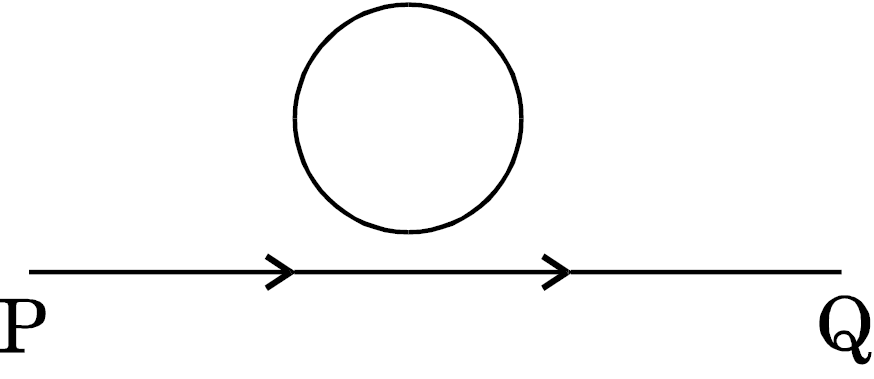
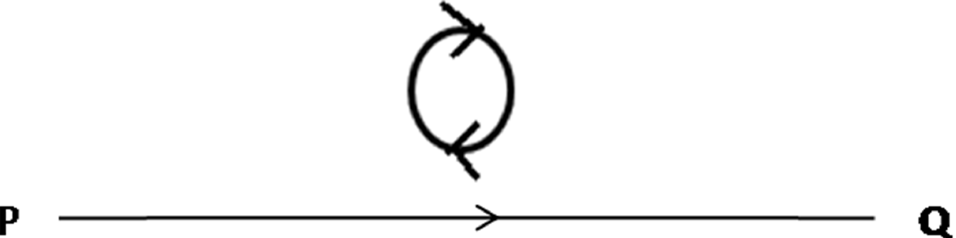
A conducting loop is held above a current carrying wire ‘PQ’ as shown in the figure. Depict the direction of the current induced in the loop when the current in the wire PQ is constantly increasing.
Answer

Clockwise.

Need a full question paper?

Generate a complete, print-ready paper with questions like this in minutes — across 16+ boards, with answer keys.

Start Generating Free

Similar questions

A sample contains a mixture of $^{108}Ag$ and $^{110}Ag$ isotopes each having an activity of $8.0 \times 10^8$ disintegration per second. $^{110}Ag$ is known to have larger half-life than $^{108}Ag$. The activity A is measured as a function of time and the following data are obtained.
Time (s) Activity (A) $(10^8$ disinte- grations $s^{-1})$ Time (s) Activity (A) $(10^8$ disinte-grations $s^{-1})$
20 11.799 200 3.0828
40 9.1680 300 1.8899
60 7.4492 400 1.1671
80 6.2684 500 0.7212
100 5.4115    
  1. Plot ln $\Big(\frac{\text{A}}{\text{A}_0}\Big)$ versus time.
  2. See that for large values of time, the plot is nearly linear. Deduce the half-life of $^{110}Ag$ from this portion of the plot.
  3. Use the half-life of $^{110}Ag$ to calculate the activity corresponding to $^{108}Ag$ in the first 50s.
  4. Plot In $\Big(\frac{\text{A}}{\text{A}_0}\Big)$ versus time for $^{108}Ag$ for the first 50s.
  5. Find the half-life of $^{108}Ag.$
If you are walking on the moon, can you hear the sound of stones cracking behind you? Can you hear the sound of your own footsteps?
Maxwell showed that the speed of an electromagnetic wave depends on the penneability and pennittivity of the medium through which it travels. The speed of an electromagnetic wave in free space is given by $\text{c}=\frac{1}{\sqrt{\mu_0\in_0}}.$ The fact led Maxwell to predict that light is an electromagnetic wave. The emergence of the speed of light from purely electromagnetic considerations is the crowning achievement of Maxwell's electromagnetic theory. The speed of an electromagnetic wave in any medium of permeability $\mu$ and pennittivity $\in$ will be $\frac{\text{c}}{\sqrt{\text{K}\mu_\text{r}}}$ where K is the dielectric constant of the medium and $\mu,$ is the relative permeability.
  1. The dimensions of $\frac{1}{2}\in_0\text{E}^2$ ($\in:$ pennittivity of free space; E = electric field) is:
  1. $MLT^{-1}$
  2. $ML^2T^{-2}$
  3. $ML^{-1}T^{-2}$
  4. $ML^2T^{-1}$
  1. Let $[\in_0]$ denote the dimensional formula of the permittivity of the vacuum. UM = mass, L = length, T = time and A = electric current, then
  1. $[\in_0]=\text{M}^{-1}\text{L}^{-3}\text{T}^2\text{A}$
  2. $[\in_0]=\text{M}^{-1}\text{L}^{-3}\text{T}^4\text{A}^2$
  3. $[\in_0]=\text{MLT}^{-2}\text{A}^{-2}$
  4. $[\in_0]=\text{ML}^{2}\text{A}^{-1}$
  1. An electromagnetic wave offrequency 3MHz passes from vacuum into adielectricmedium with permittivity $\in=4.$ Then
  1. Wavelength and frequency both remain unchanged.
  2. Wavelength is doubled and the frequency remains unchanged.
  3. Wavelength is doubled and the frequency becomes half.
  4. Wavelength is halved and the frequency remains unchanged.
  1. Which of the following are not electromagnetic waves?
  1. Cosmic rays
  2. $\gamma-\text{rays}$
  3. $\beta-\text{rays}$
  4. X-rays
  1. The electromagnetic waves travel with,
  1. The same speed in all media.
  2. The speed oflight $c = 3 \times 10^8ms^{-1}$ in free space.
  3. The speed oflight $c = 3 \times 10^8ms^{-1}$ in solid medium
  4. The speed of light $c = 3 \times 10^8ms^{-1}$ in fluid medium.
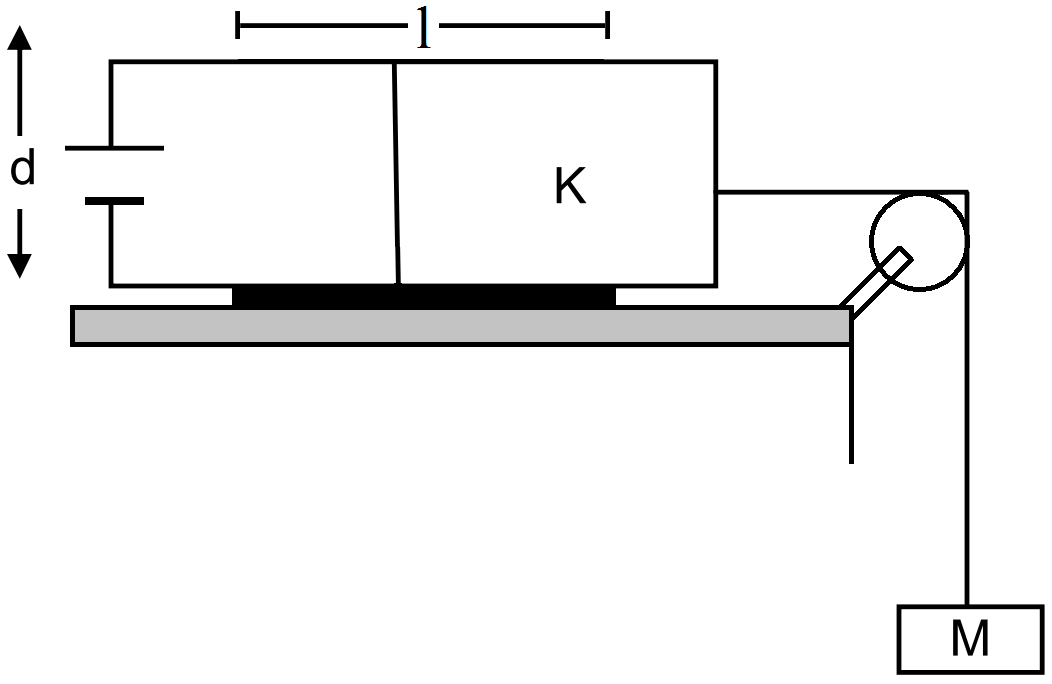
Consider the situation shown in figure. The width of each plate is b. The capacitor plates are rigidly clamped in the laboratory and connected to a battery of emf $\in.$ All surfaces are frictionless. Calculate the value of M for which the dielectric slab will stay in equilibrium.
A long bar magnet has a pole strength of 10A-m. Find the magnetic field at a point on the axis of the magnet at a distance of 5cm from the north pole of the magnet.
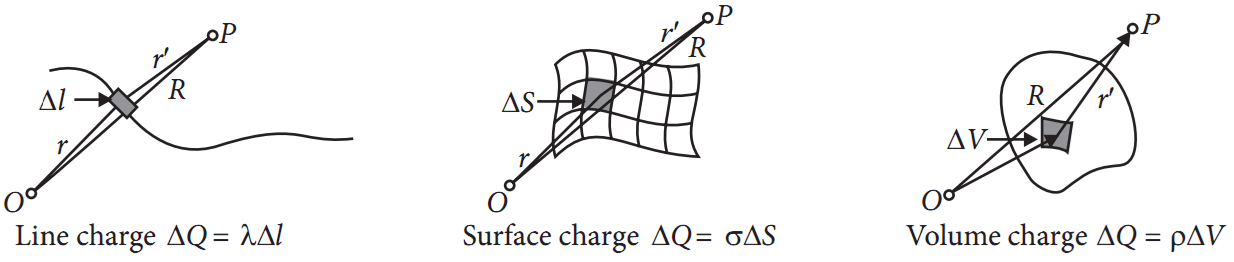
ln practice, we deal with charges much greater in magnitude than the charge on an electron, so we can ignore the quantum nature of charges and imagine that the charge is spread in a region in a continuous manner. Such a charge distribution is known as continuous charge distribution. There are three types of continuous charge distribution : (i) Line charge distribution (ii) Surface charge distribution (iii) Volume charge distribution as shown in figure.
  1. Statement 1: Gauss's law can't be used to calculate an electric field near an electric dipole.
Statement 2: Electric dipole don't have symmetrical charge distribution.
  1. Statement 1 and statement 2 are true.
  2. Statement 1 is false but statement 2 is true.
  3. Statement 1 is true but statement 2 is false.
  4. Both statements are false.
  1. An electric charge of $8.85 \times 10^{-13}C$ is placed at the centre of a sphere of radius 1m. The electric flux through the sphere is:
  1. $0.2NC^{-1} m^2$
  2. $0.1NC^{-1} m^2$
  3. $0.3NC^{-1} m^2$
  4. $0.01NC^{-1} m^2$
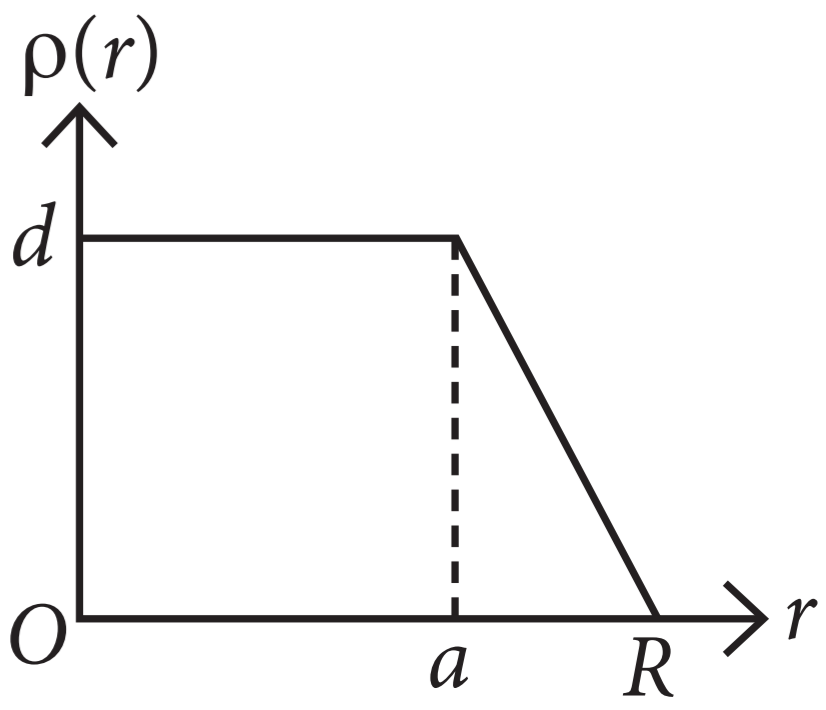
  1. The electric field within the nucleus is generally observed to be linearly dependent on r. So,
  1. a = 0
  2. $\text{a}=\frac{\text{R}}{2}$
  3. a = R
  4. $\text{a}=\frac{\text{2R}}{3}$
  1. What charge would be required to electrify a sphere of radius 25cm so as to get a surface charge density of $\frac{3}{\pi}\text{Cm}^{-2}?$
  1. 0.75C
  2. 7.5C
  3. 75C
  4. Zero
  1. The SI unit of linear charge density is:
  1. Cm
  2. $Cm^{-1}$
  3. $Cm^{-2}$
  4. $Cm^{-3}$
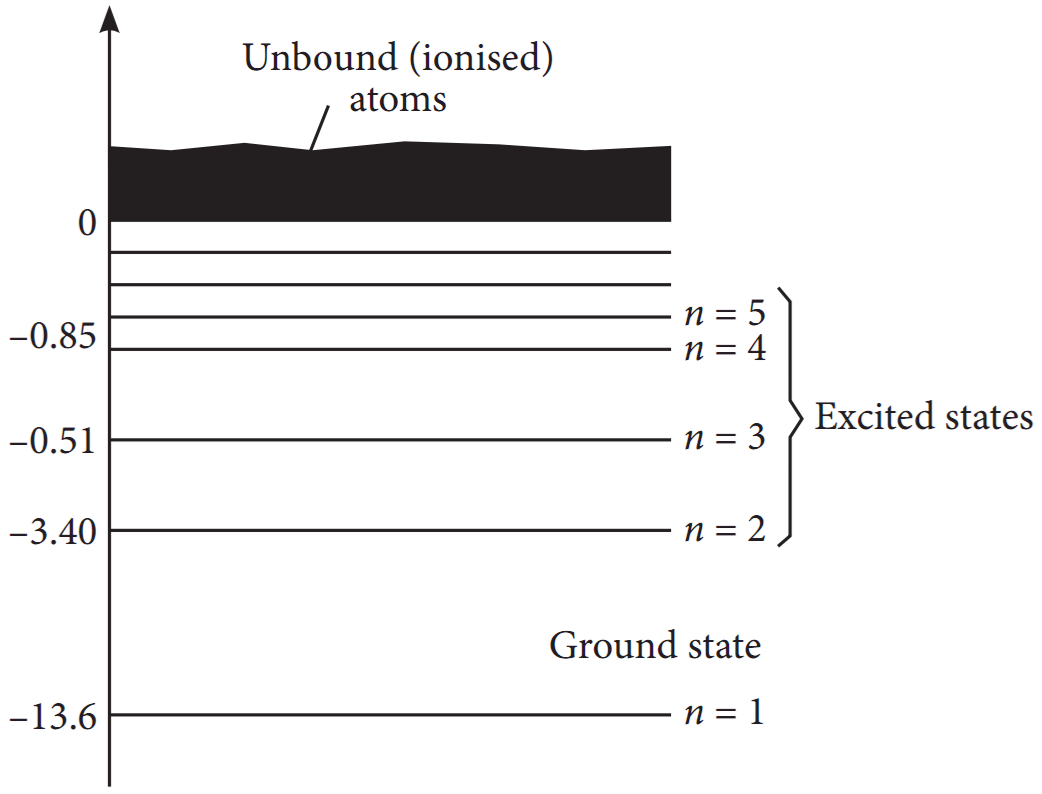
At room temperature, most of the H-atoms are in ground state. When an atom receives some energy (i.e., by electron collisions), the atom may acquire sufficient energy to raise electron to higher energy state. In this condition, the atom is said to be in excited state. From the excited state, the electron can fall back to a state of lower energy emitting a photon equal to the energy difference of the orbit.

In a mixture of He-He gas $(He^+$ is singleionized He atom$)$. H-atoms and $He^+$ ions are excited to their respective first excited states. Subsequently, H-atoms transfer their total excitation energy to $He^+$ ions (by collisions)
  1. The quantum number n of the state finally populated in $He^+$ ions is.
  1. 2
  2. 3
  3. 4
  4. 5
  1. The wavelength of light emitted in the visible region by $He^+$ ions after collisions with H-atoms is.
  1. $6.5 \times 10^{-7} m$
  2. $5.6 \times 10^{-7} m$
  3. $4.8 \times 10^{-7} m$
  4. $4.0 \times 10^{-7} m$
  1. The ratio of kinetic energy of the electrons for the H-atoms to that of $He^+$ ion for n = 2 is.
  1. $\frac{1}{4}$
  2. $\frac{1}{2}$
  3. 1
  4. 2
  1. The radius of the ground state orbit of H-atoms is.
  1. $\frac{\in_0}{\text{h}\pi\text{me}^2}$
  2. $\frac{\text{h}^2\in_0}{\pi\text{me}^2}$
  3. $\frac{\pi\text{me}^2}{\text{h}}$
  4. $\frac{2\pi\text{h}\in_0}{\text{me}^2}$
  1. Angular momentum of an electron in H-atom in first excited state is.
  1. $\frac{\text{h}}{\pi}$
  2. $\frac{\text{h}}{2\pi}$
  3. $\frac{2\pi}{\text{h}}$
  4. $\frac{\pi}{\text{h}}$
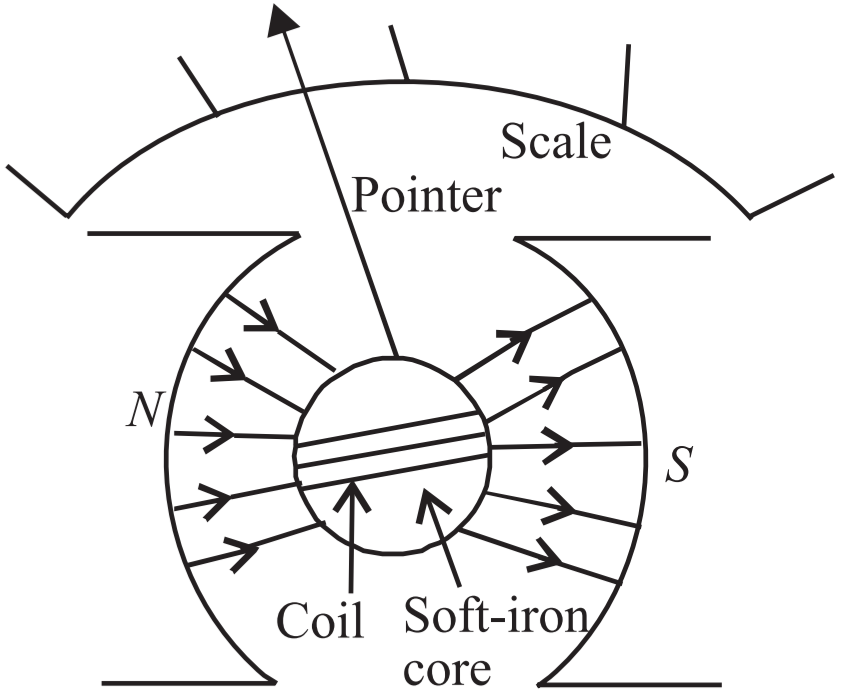
Moving coil galvanometer operates on Permanent Magnet Moving Coil (PMMC) mechanism and was designed by the scientist D'arsonval. Moving coil galvanometers are of two types.
  1. Suspended coil.
  2. Pivoted coil type or tangent galvanometer.
Its working is based on the fact that when a current carrying coil is placed in a magnetic field, it experiences a torque. This torque tends to rotate the coil about its axis of suspension in such a way that the magnetic flux passing through the coil is maximum.
  1. A moving coil galvanometer is an instrument which:
  1. Is used to measure emf.
  2. Is used to measure potential difference.
  3. Is used to measure resistance.
  4. Is a deflection instrument which gives a deflection when a current flows through its coil.
  1. To make the field radial in a moving coil galvanometer.
  1. Number of turns of coil is kept small.
  2. Magnet is taken in the form of horse-shoe.
  3. Poles are of very strong magnets.
  4. Poles are cylindrically cut.
  1. The deflection in a moving coil galvanometer is:
  1. Directly proportional to torsional constant of spring.
  2. Directly proportional to the number of turns in the coil.
  3. Inversely proportional to the area of the coil.
  4. Inversely proportional to the current in the coil.
  1. In a moving coil galvanometer, having a coil of N-turns of area A and carrying current I is placed in a radial field of strength B.
The torque acting on the coil is:
  1. $NA^2B^2I$
  2. $NABI^2$
  3. $N^2ABI$
  4. $NABI$
  1. To increase the current sensitivity of a moving coil galvanometer, we should decrease:
  1. Strength of magnet.
  2. Torsional constant of spring.
  3. Number of turns in coil.
  4. Area of coil.
The lens maker's formula relates the focallength of a lens to the refractive index of the lens material and the radii of curvature of its two surfaces. This formula is called so because it is used by manufacturers to design lenses of required focal length from a glass of given refractive index.
If the object is placed at infinity, the image will be fanned at focus for both double convex lens and double concave lens.
Therefore, lens maker's formula is, $\frac{1}{\text{f}}=[\frac{\mu_2-\mu_1}{\mu_1}][\frac{1}{\text{R}_1}-\frac{1}{\text{R}_2}]$
When lens is placed in air, $\mu_1=1$ and $\mu_2=\mu.$ The lens maker formula takes the form, $\frac{1}{\text{f}}=(\mu-1)[\frac{1}{\text{R}_1}-\frac{1}{\text{R}_2}]$
  1. The radius of curvature of each face of biconcave lens with refractive index 1.5 is 30cm. The focal length of the lens in air is:
  1. 12cm
  2. 10cm
  3. 20cm
  4. 30cm
  1. The radii of curvature of the faces of a double convex lens are 10cm and 15cm. If focal length is 12cm, then refractive index of glass is:
  1. 1.5
  2. 1.78
  3. 2.0
  4. 2.52
  1. An under-water swinuner cannot see very clearly even in absolutely clear water because of:
  1. Absorption of light in water.
  2. Scattering of light in water.
  3. Reduction of speed of light in water.
  4. Change in the focal length of eye-lens.
  1. A thin lens of glass $(\mu=1.5)$ of focal length 10cm is immersed in water $(\mu=1.33).$ The new focal length is:
  1. 20cm
  2. 40cm
  3. 48cm
  4. 12cm
  1. An object is immersed in a fluid. In order that the object becomes invisible, it should,
  1. Behave as a perfect reflector.
  2. Absorb all light falling on it.
  3. I have refractive index one.
  4. Have refractive index exactly matching with that of the surrounding fluid.
Electrons oscillating in a circuit give rise to radiowaves. A transmitting antenna radiates most effectively the radiowaves of wavelength equal to the size of the antenna. The infrared waves incident on a substance set into oscillation all its electrons, atoms and molecules. This increases the internal energy and hence the temperature of the substance.
  1. If $v_g, v_x$ and $v_m$ are the speeds of gamma rays, X-rays and microwaves respectively in vacuum, the
  1. $v_g > v_x > v_m$
  2. $v_g < v_x < v_m$
  3. $v_g > v_x > v_m$
  4. $v_g = v_x = v_m$
  1. Which of the following wi II deflect in electric field?
  1. X-rays.
  2. $\gamma-\text{rays}.$
  3. Cathode rays.
  4. Ultraviolet rays.
  1. $\gamma-\text{rays}$ are detected by:
  1. Point contact diodes.
  2. Thennopiles.
  3. Ionization chamber.
  4. Photocells.
  1. The frequency of electromagnetic wave, which best suited to observe a particle ofradius $3 \times 10^{-4}cm$ is the order of,
  1. $10^{15}Hz$
  2. $10^{14} Hz$
  3. $10^{13}Hz$
  4. $10^{12}Hz$
  1. We consider the radiation emitted by the human body. Which one of the following statements is true?
  1. The radiation emitted is in the infrared region.
  2. The radiation is emitted only during the day.
  3. The radiation is emitted during the summers and absorbed during the winters.
  4. The radiation emitted lies in the ultraviolet region and hence it is not visible.