MCQ
A conducting loop is placed in a uniform magnetic field with its plane perpendicular to the field. An emf is induced in the loop if:
- AIt is translated.
- BIt is rotated about its axis.
- CIt is rotated about a diameter.
- DIt is deformed.
Explanation:
þ An emf is induced in the loop is it is rotated about a diameter
þ An emf is induced in the loop if it is deformed.
Generate a complete, print-ready paper with questions like this in minutes — across 16+ boards, with answer keys.
A uniform magnetic field acts at right angles to the direction of motion of electrons. As a result, the electron moves in a circular path of radius 2 cm. If the speed of the electrons is doubled, then the radius of the circular path will be
|
(a) 2.0 cm |
(b) 0.5 cm |
(c) 4.0 cm |
(d) 1.0 cm |
Magnets A and B are geometrically similar but the magnetic moment of A is twice that of B. If T1 and T2 be the time periods of the oscillation when their like poles and unlike poles are kept together respectively, then  will be
(a) 
|
(b) 
|
(c) 
|
(d) 
|
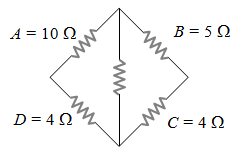
In a typical Wheatstone network, the resistances in cyclic order are A = 10 W, B = 5 W, C = 4 W and D = 4 W for the bridge to be balanced
|
(a) 10 W should be connected in parallel with A |
|
(b) 10 W should be connected in series with A |
|
(c) 5 W should be connected in series with B |
|
(d) 5 W should be connected in parallel with B |
A circular loop has a radius of 5 cm and it is carrying a current of 0.1 amp. Its magnetic moment is
|
(a) 1.32 |
(b) 2.62 |
|
(c) 5.25 |
(d) 7.85 |
Half lives of two radioactive substances A and B are respectively 20 minutes and 40 minutes. Initially the sample of A and B have equal number of nuclei. After 80 minutes, the ratio of remaining number of A and B nuclei is
|
(a) 1 : 16 |
(b) 4 : 1 |
(c) 1 : 4 |
(d) 1 : 1 |
Gases begin to conduct electricity at low pressure because
|
(a) At low pressure, gases turn to plasma |
|
(b) Colliding electrons can acquire higher kinetic energy due to increased mean free path leading to ionisation of atoms |
|
(c) Atoms break up into electrons and protons |
|
(d) The electrons in atoms can move freely at low pressure |
