Question
A cone, a hemisphere and a cylinder stand on equal bases and have the same height. Show that their volumes are in the ratio 1 : 2 : 3.
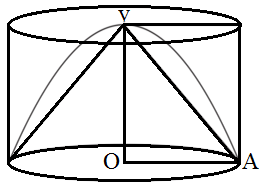
Answer

Let r be the radius of the base.
and h be the height.
Here, h = r.

Now,
The ratio of their volumes will be
Volume of cone : volume of hemisphere : volume of a cylinder
$\frac{1}{3}\pi\text{r}^2\text{h}:\frac{2}{3}\pi\text{r}^3:\pi\text{r}^2\text{h}$
$\text{V}_1:\text{V}_2:\text{V}_3=\frac{1}{3}\pi\text{r}^3:\frac{2}{3}\pi\text{r}^3:\pi\text{r}^3$
Hence, $\text{V}_1:\text{V}_2:\text{V}_3=1:2:3$

Need a full question paper?

Generate a complete, print-ready paper with questions like this in minutes — across 16+ boards, with answer keys.

Start Generating Free

Similar questions

In a $\triangle\text{ABC,D}\ \text{and E}$ are points on the sides $AB$ and $AC$ respectively such that $DE || BC$.
If $AD = x, DB = x - 2, AE = x + 2$ and $EC = x - 1$, find the value of $x$.
The difference of squares of two number is $88$. If the larger number is $5$ less than twice the smaller number, then find the two numbers.
In what ratio does the point $(1,3)$ divide line segment joining the points $(3,6)$ and $(-5,-6)$ ?
Mr. Trivedi invested Rs.45,000 in shares of face value Rs.100 at market value Rs.125. If the company declared 30% dividend at the end of the year, what was the income from dividend?
Prove : $\left(\frac{1}{\cos \theta}+\frac{1}{\cot \theta}\right)=(\sec \theta-\tan \theta)=1$
A bag contains 3 red balls and 5 black balls. A ball is drawn at random from the bag. What is the probability that the ball drawn is:
  1. Red.
  2. Black.
The base radii of two right circular cones of the same height are in the ratio 2 : 3. Find ratio of their volumes.
Find the value of k for which the following system of equations has no solution:
$2x - ky + 3 = 0$
$3x + 2y - 1 = 0$
Prashant bought 50 shares of FV Rs. 100, having MV Rs. 180. Company gave 40% dividend on the shares. Find the rate of return on investment.
If $\triangle\text{ABC}$ and $\triangle\text{DEF}$ are two triangles such that $\frac{\text{AB}}{\text{DE}}=\frac{\text{BC}}{\text{EF}}=\frac{\text{CA}}{\text{FD}}=\frac{3}{4},$ then write $\text{Area}(\triangle\text{ABC}):\text{Area}(\triangle\text{DEF.})$