Question 13 Marks
If the heights of two right circular cones are in the ratio $1 : 2$ and the perimeters of their bases are in the ratio $3 : 4$, what is the ratio of their volumes?
AnswerGiven that
ratio of height of right circular cones
$h_1: h_2 = 1 : 2$
ratio of base of perimeter
$2\pi\text{r}_1:2\pi\text{r}_2=3:4$
$\Rightarrow\text{r}_1:\text{r}_2=3:4$
therefore,
the ratio of volume of their cones
$=\text{v}_1:\text{v}_2=\frac{1}{3}\pi\text{r}^2_1\text{h}_1:\frac{1}{3}\pi\text{r}^2_2\text{h}_2$
$=\frac{\frac{1}{3}\pi\text{r}^2_1\text{h}_1}{\frac{1}{3}\pi\text{r}^2_2\text{h}_2}$
$=\frac{\text{r}^2_1\text{h}_1}{\text{r}^2_2}=\Big(\frac{3}{4}^2\Big)\times\frac{1}{2}$
$=\frac{9}{32}$
$\Rightarrow\text{V}_1:\text{V}_2=9:32$
Hence, the ratio of their volumes are $9:32$
View full question & answer→Question 23 Marks
A well of diameter $3\ m$ is dug $14\ m$ deep. The earth taken out of it has been spread evenly all around it to a width of $4\ m$ to form an embankment. Find the height of the embankment.
AnswerThe inner radius of the well is $\frac{3}{2}\text{m}$ and the height is 14m. Therefore, the volume of the Earth taken out of it is
$\text{V}_1=\pi\times\Big(\frac{3}{2}\Big)^2\times14\text{m}^3$
The inner and outer radii of the embankment are $\frac{3}{2}\text{m}$ and $4+\frac{3}{2}=\frac{11}{2}$ respectively. Let the height of the embankment be h. Therefore, the volume of the embankment is
$\text{V}_2=\pi\times\Big\{\Big(\frac{11}{2}\Big)^2-\Big(\frac{3}{2}\Big)^2\Big\}\times\text{h m}^3$
Since, the volume of the well is same as the volume of the embankment; we have
$V_1 = V_2$
$\Rightarrow\pi\times\Big(\frac{3}{2}\Big)^2\times14=\pi\times\Big\{\Big(\frac{11}{2}\Big)-\Big(\frac{3}{2}\Big)^2\Big\}\times\text{h}$
$\Rightarrow\text{h}=\frac{9\times14}{112}$
$\Rightarrow\text{h}=\frac{9}{8}\text{m} $
Hence, the height of the embankment is $\text{h}=\frac{9}{8}\text{m}$
View full question & answer→Question 33 Marks
A cylindrical tank full of water is emptied by a pipe at the rate of 225 litres per minute. How much time will it take to empty half the tank, if the diameter of its base is 3m and its height is 3.5m?
AnswerDiameter of cylindrical tank = 3m
height (h) = 3.5m = $\frac{7}{2}\text{m}$
$\therefore$ Radius (r) = $\frac{3}{2}\text{m}$
Volume of water filled in it
$=\pi\text{r}^2\text{h}=\frac{22}{7}\times\frac{3}{2}\times\frac{3}{2}\times\frac{7}{2}\text{m}^3$
$=\frac{99}{4}\text{m}^3$
Volume of water in half the tank
$=\frac{99}{4\times2}\times1000=\frac{9900}{8}\text{l}$
water flow at the rate of 225 l per min.
$\therefore$ Total time taken to empting the bank
$=\frac{99000}{8\times225}$
$= 55\ \text{minutes}$
View full question & answer→Question 43 Marks
What is the ratio of the volumes of a cylinder, a cone and a sphere, if each has the same diameter and same height?
AnswerGiven that:
Eact solid has the same diameter and height
Therefore,
$r_1 = r_2 = r_3= r = h_{1 =}h_2$
The volume of cylinder $\text{V}_1=\pi\text{r}_1^2\text{h}_1$
The volume of cone $\text{V}_2=\pi\text{r}_2^2\text{h}_2$
The volume of sphere $\text{V}_3=\frac{4}{3}\pi\text{r}^3$
The ratio of their volumes
$\text{V}_1:\text{V}_2:\text{V}_3=\pi\text{r}^2\text{h}:\pi\text{r}^2\text{h}:\frac{4}{3}\pi\text{r}^3$
$=1:\frac{1}{3}:\frac{4}{3}$
$\text{V}_1:\text{V}_2:\text{V}_3=3:1:4$
Hence, the required ratio are $3 : 1 : 4$
View full question & answer→Question 53 Marks
The height of a solid cylinder is $15\ cm$ and the diameter of its base is $7\ cm.$ Two equal conical holes each of radius $3\ cm$, and height $4\ cm$ are cut off. Find the volume of the remaining solid.
AnswerDiameter of the base of a cylinder $=7 cm$
$\therefore$ Radius $\left(r_1\right)=\left(\frac{7}{2}\right) cm$
Height of cylinder $\left(h_1\right)=15 cm$
$\therefore$ Volume of cylinder $=\pi r _1^2 h_1$
$=\frac{22}{7}\left(\frac{7}{2}\right)^2 \times 15 cm^3$
$=\frac{22}{7} \times \frac{49}{4} \times 15=\frac{1155}{2} cm^2$
Radius of each conical hole $\left(r_2\right)=3 cm$
anf height $\left(h_2\right)=4 cm$
Volume of 2 such conical holes
$=2 \times \frac{1}{3} \pi r_2^2 h _2$
$=\frac{2}{3} \times \frac{22}{7} \times(3)^2 \times 4=\frac{2}{3} \times \frac{22}{7} \times 9 \times 4 cm^3$
$=\frac{528}{7} cm^3$
$\therefore \text { Volume of remaining solid }=\frac{1155}{2}-\frac{528}{7}$
$=\frac{8085-1056}{14}=\frac{7029}{14} cm^3$
$=502.07=502.1 cm^3$
View full question & answer→Question 63 Marks
Find the volume of the largest right circular cone that can be cut out of a cube whose edge is 9cm.
AnswerEdge of cube = 9cm
$\therefore$ Diameter of cone = 9cm
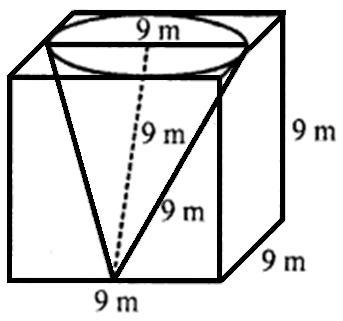
And radius (r) $=\frac{9}{2}\text{cm}$
Hieght(h) = 9cm
$\therefore\text{volume}=\frac{1}{3}\pi\text{r}^2\text{h}$
$=\frac{1}{3}\times\frac{22}{7}\times\frac{9}{2}\times\frac{9}{2}\times9=190.93\text{cm}^3$ View full question & answer→Question 73 Marks
A cone of radius 4cm is divided into two parts by drawing a plane through the mid point of its axis and parallel to its base. Compare the volumes of two parts.
AnswerLet h be the height of the given cone. One dividing the cone through the mid-point of its axis and parallel to its base into two parts, we obtain the following figure:
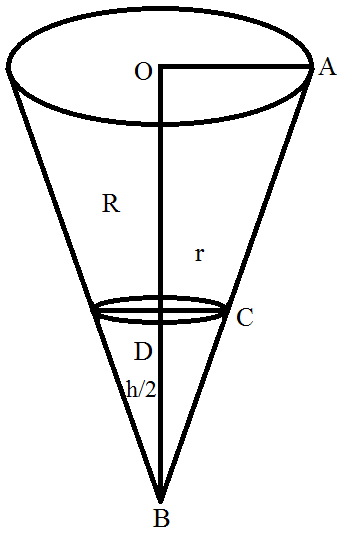 In two similar triagles OAB and DCB, we have $\frac{\text{OA}}{\text{CD}}=\frac{\text{OB}}{\text{BD}}$ This implies $\frac{4}{\text{r}}=\frac{\text{h}}{\frac{\text{h}}{2}}$
Therefore, r = 2
Therefore,
$\frac{\text{volume of the smaller cone}}{\text{Volume of the frustum of the cone}}$
$=\frac{\frac{1}{3}\pi\times(2)^2\times\Big(\frac{\text{h}}{2}\Big)}{\frac{1}{3}\pi\times\Big(\frac{\text{h}}{2}\Big)[4^2+2^2+4\times2]}=\frac{1}{7}$
Therefore the ratio of volume of the smaller cone to the volume of the frustum of the cone is 1:7 View full question & answer→Question 83 Marks
The surface area of a sphere is $616\ cm^2$. Find its radius.
AnswerThe surface area of sphere $= 616\ cm^2$
We know that
$4\pi\text{r}^2=616$
$\text{r}^2=\frac{616}{4\pi}$
Taking square root both the side
$\sqrt{\text{r}^2}=\sqrt{\frac{616}{4\pi}}$
$\text{r}=7\text{cm}$
View full question & answer→Question 93 Marks
Three cubes of a metal whose edges are in the ratio $3 : 4 : 5$ are melted and converted into a single cube whose diagonal is $12\sqrt{3}\text{cm}.$ Find the edges of the three cubes.
AnswerLet the edges of three cubes (in cm) be $3x, 4x$ and $5x$, respectively.
Volume of the cubes after melting is $= (3x)^3 + (4x)^3 + (5x)^3 = 216 \times 3\ cm^3$
Let a be the side of new cube so formed after melting. Therefore, $a^3 = 216x^3$
So, a = 6x, $\text{Diagonal}=\sqrt{\text{a}+\text{a}^2+\text{a}^2}=\text{a}\sqrt{3}$
But it is given that diagonal of that diagonal of the new cube is $12\sqrt{3}\text{cm}.$ Therefore, $\text{a}\sqrt{3}=12\sqrt{3},$
i.e. $a = 12$
This gives $x = 2$
Therefore, edges of the three cubes are $6\ cm, 8\ cm$ and $10\ cm$ respectively.
View full question & answer→Question 103 Marks
$500$ persons have to dip in a rectangular tank which is $80m$ long and $50m$ broad. What is the rise in the level of water in the tank, if the average displacement of water by a person is $0.04m^3$?
AnswerThe average displacement of water by a person is $0.04$ cubic m.
Hence, the total displacement of water in the rectangular tank by $500$ persons is $V = 500 \times 0.04 = 20$ Cubic m.
The length and width of the rectangular tank are 80m and 50m respectively. Upon dipping in the tank, let the height of the raised water is be h m. Therefore, the volume of the raised
water is $V_1 = 80 \times 50 \times h$
$= 4000h$ cubic m
Since, the volume of the raised water is same as the volume of the water displaced by 500 persons, we have
$V_1 = V$
$\Rightarrow 4000h = 20$
$\Rightarrow\text{h}=\frac{20}{4000}$
$\Rightarrow 0.005$
Therefore, the water will be raised by $0.005m$ or $0.5cm$
View full question & answer→Question 113 Marks
The radii of two cylinders are in the ratio $3 : 5$ and their heights are in the ratio $2 : 3$. What is the ratio of their curved surface areas?
AnswerGiven that:
Ratio of radii of two cylinder
$r_1 : r_2 = 3 : 5$
Ratioof height of two cylinder
$h_1 : h_2 = 2 : 3$
Now, the ratio of their curved surface area
$\text{S}_1:\text{S}_2=2\pi\text{r}_1\text{h}_1:2\pi\text{r}_2\text{h}_2$
$\Rightarrow\frac{\text{S}_1}{\text{S}_2}=\frac{2\pi\text{r}_1\text{h}_1}{2\pi\text{r}_2\text{h}_2}=\frac{3}{5}\times\frac{2}{3}$
$\Rightarrow\frac{\text{S}_1}{\text{S}_2}=\frac{6}{15}=\frac{2}{5}$
$\Rightarrow S_1 : S_2 = 2 : 5$
Hence, the ratio of their curved surface area are $2 : 5$
View full question & answer→Question 123 Marks
The difference between outside and inside surface areas of cylindrical metallic pipe $14\ cm$ long is $44m^2$. If the pipe is made of $99cm^3$ of metal, find the outer and inner radii of the pipe.
AnswerLet inner radius of pipe be $r_1$
Radius of outer cylinder be $r_2$
Length of cylinder $(h) = 14\ cm.$
Surface area of hollow cylinder $(r_2 - r_1)$ $=2\pi$
Given surface area of cylinder $= 44m^2$
$2\pi\text{Rh}-2\pi\text{r}\text{h}=44$
$2\pi\text{h}(\text{R}-\text{r})=44$
$2\times\frac{22}{7}\times14(\text{R}-\text{r})=44$
$\text{R}-\text{r}=\frac{44\times7}{2\times22\times14}$
$\text{R}-\text{r}=\frac{1}{2}\ ...(1)$
Now,
Volume of pipe $= 99cm^3$
$\pi\text{R}^2\text{h}-\pi_2\text{r}^2\text{h}=99$
$\pi\text{h}(\text{R}^2-\text{r}^2)=99$
$(\text{R}^2-\text{r}^2)=\frac{99}{\pi\times\text{h}}$
$(\text{R}+\text{r})(\text{R}-\text{r})=\frac{99\times7}{22\times14}$
$(\text{R}+\text{r})(\text{R}-\text{r})=\frac{99}{22\times2}$
Putting value of $\text{R}-\text{r}=\frac{1}{2}$
$(\text{R}+\text{r})\frac{1}{2}=\frac{99}{22\times2}$
$(\text{R}+\text{r})=\frac{9}{2}\ ...(2)$
Adding equation (1) and (2)
$\text{R}-\text{r}=\frac{1}{2}$
$\text{R}+\text{r}=\frac{9}{2}$
$2\text{R}=5$
$\text{R}=2.5$
And $\text{r}=\frac{9}{2}-\frac{5}{2}$
$\text{r}=2\text{cm}$
View full question & answer→Question 133 Marks
A hemisphere and a cone have equal bases. If their heights are also equal, then what is the ratio of their curved surfaces?
AnswerGiven that:
The base of the cone and hemisphere are equal.
Therefore,
Radius of the hemisphere = Height of the cone
Then, the salant height of the cone
$\text{l}=\sqrt{\text{r}^2+\text{h}^2}$
$=\sqrt{\text{r}^2+\text{r}^2}$
$=\sqrt{2}\text{r}$
Curved surface area of hemisphere
$\text{S}_1=2\pi\text{r}^2$
And the curved surface area of the cone
$\text{S}_2=\pi\text{rl}$
Now,
$\Rightarrow\frac{\text{S}_1}{\text{S}_2}=\frac{2\pi\text{r}^2}{\pi\text{rl}}=\frac{2\pi\text{r}^2}{\pi\text{r}\sqrt{2}\text{r}}$
$\Rightarrow\frac{\text{S}_1}{\text{S}_2}=\frac{\sqrt{2}}{1}$
Hence, the required ratio are $\sqrt{2}:1$
View full question & answer→Question 143 Marks
A solid metal sphere of 6cm diameter is melted and a circular sheet of thickness 1cm is prepared. Determine the diameter of the sheet.
AnswerDiameter of sphere = 6cm
Therefore,
Radius = 3cm.
Therefore,
Surface area of sphere
$=4\pi\text{r}^2$
$=4\times\pi\times(3)^2$
$=36\pi\ \text{cm}^2$
Area of the circular sheet $=\pi\text{r}^2$
Therefore,
Surface area of sphere = area of the circular sheet
$=\pi\text{r}^2=36\pi$
$\text{r}=6\text{cm}$
Therefore,
Diameter of the sheet = 2 × 6 = 12cm
View full question & answer→Question 153 Marks
If a cone and a sphere have equal radii and equal volumes. What is the ratio of the diameter of the sphere to the height of the cone?
AnswerGiven that:
A cone and a sphere have equal radii and equal volume
Therefore,
Volume of cone = Volume of sphere
$\Rightarrow\frac{1}{3}\pi\text{r}^2\text{h}=\frac{4}{3}\pi\text{r}^3$
$\Rightarrow r^2h = 4r^3$
$\Rightarrow h = 4r$
$\Rightarrow h = 2 (2r)$
$\Rightarrow h = 2d$
$\Rightarrow\frac{\text{h}}{\text{d}}=\frac{2}{1}$
$\Rightarrow d : h = 1 : 2$
Hence, the required eatio are $1 : 2$
View full question & answer→Question 163 Marks
The slant height of the frustum of a cone is $4\ cm$ and the perimeters of its circular ends are $18\ cm$ and $6\ cm$. Find the curved surface of the frustum.
AnswerPerimeter of the top of frustum $= 18\ cm$
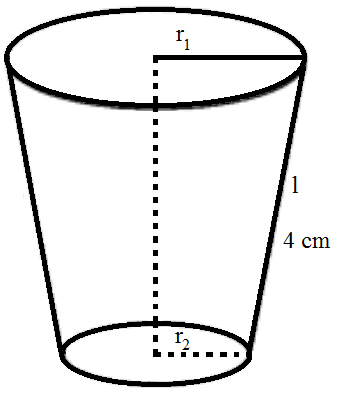
$\therefore $ Radius $(r_1)$ $=\frac{\text{C}}{2\pi}=\frac{18\times7}{2\times22}$
$=\frac{63}{22}\text{cm}$
and perimeter of the bottom $= 6\ cm$
$\therefore$ Radius $(r_2)$ $ =\frac{\text{C}}{2\pi}=\frac{18\times7}{2\times22}=\frac{21}{22}\text{cm}$
and slant height $(l) = 4\ cm$
curved surface area $=\pi (\text{r}_1+\text{r}_2) \text{l} $
$=\frac{22}{7}\Big(\frac{63}{22}+\frac{21}{22}\Big)\times4$
$= \frac{22}{7}\times\frac{84}{22}\times4=48\text{cm}^2$ View full question & answer→Question 173 Marks
A hollow sphere of internal and external radii $2\ cm$ and $4cm$ respectively is melted into a cone of base radius $4\ cm$. Find the height and slant height of the cone.
AnswerThe internal and external radii of the hollow sphere are 2cm and 4cm respectively. Therefore, the volume of the hollow sphere is,
$\text{V}=\frac{4}{3}\pi\{(4)^3-(2)^3\}$
$=\frac{4}{3}\times\frac{22}{7}\times56$
$=\frac{32\times22}{3}$
The hollow sphere is melted to produce a right circular cone of base-radius 4cm. Let, the height and slant height of the cone be h cm and l cm respectively. Then, we have,
$\text{l}^2=(4)^2+\text{h}^2$
$\Rightarrow\text{l}^2=16+\text{h}^2$
The volume of the cone is,
$\text{V}_1=\frac{1}{3}\pi\text{r}^2_1\text{h}_1$
$=\frac{1}{3}\times\frac{22}{7}\times(4)^2\times\text{h}$
Since, the volume of the cone and hollow sphere are same, we have
$V_1 = V$
$\Rightarrow\frac{1}{3}\times\frac{22}{7}\times(4)^2\times\text{h}=\frac{32\times22}{3}$
$\Rightarrow\frac{1}{7}\times(4)^2\times\text{h}=32$
$\Rightarrow\text{h}=\frac{32\times7}{16}$
$\Rightarrow\ =14$
Then, we have
$\text{l}^2=16+(14)^2$
$\Rightarrow\ =212$
$\Rightarrow\text{l}=14.56$
Therefore, the height and the slant height of the cone are $14\ cm$ and $14.56\ cm$ respectively.
View full question & answer→Question 183 Marks
A sphere of diameter 5cm is dropped into a cylindrical vessel partly filled with water. The diameter of the base of the vessel is 10cm. If the sphere is completely submerged, by how much will the level of water rise?
AnswerRadius of sphere $\text{r}=\frac{5}{2}\text{cm}$ radius of cylindrical vessel $\text{r}_1=\frac{10}{2}\text{cm}$
When the sphere is completely submerged into the vessel. The level of water will be raised let xbe height of level of raised water.
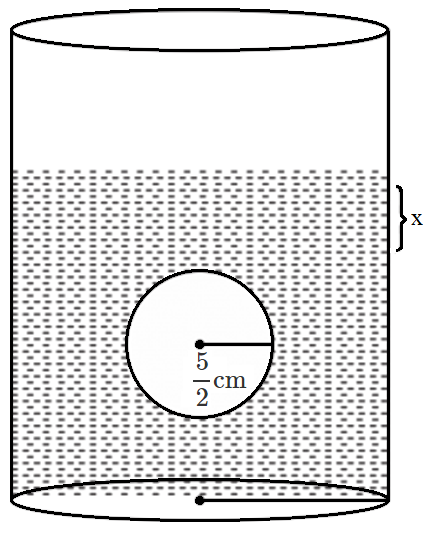
Therefore,
The volume of raised water in cylindrical vessel = volume of sphere
$\pi\times(5)^2\times\text{x}=\frac{4}{3}\pi\Big(\frac{5}{2}\Big)^3$
$25\text{x}=\frac{4\times125}{3\times8}$
$\text{x}=\frac{4\times125}{3\times8\times25}$
$=\frac{5}{6}\text{cm}$
$\text{x}=\frac{5}{6}\text{cm}$
Hence, the level of water rise $=\frac{5}{6}\text{cm}$ View full question & answer→Question 193 Marks
From a solid cube of side $7\ cm$, a conical cavity of height $7\ cm$ and radius $3\ c$m is hollowed out. Find the volume of the remaining solid.
AnswerGiven that, side of a solid cube $(a) = 7\ cm$
Height of conical cavity i.e., cone, $h = 7\ cm$
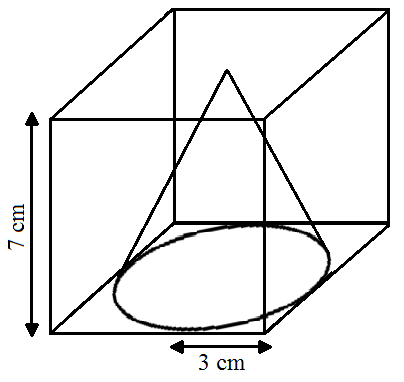
Since, the height of conical cavity and the side of cube is equal that means the conical cavity fit vertically in the cube.
Radius of conical cavity i. e., cone, $r = 3\ cm$
$\Rightarrow $ Diameter $= 2 \times r = 2 \times 3 = 6\ cm$
Since, the diameter is less than the side of a cube that means the base of a
conical cavity is not fit inhorizontal face of cube.
Now, volume of cube $= (side)^3 = a^3 = (7)^3 = 343cm^3$
and volume of conical cavity i.e., cone
$=\frac{1}{3}\pi\times\text{r}^2\times\text{h}$
$=\frac{1}{3}\times\frac{22}{7}\times3\times3\times7=66\text{cm}^3$
$\therefore$ Volume of remaining solid = Volume of cube - Volume of conical Cavity
$= 343 - 66 = 277cm^3$
Hence, the required volume of solid is $277cm^3$ View full question & answer→Question 203 Marks
If the areas of circular bases of a frustum of a cone are $4\ cm^2$ and $9\ cm^2$ respectively and the height of the frustum is $12\ cm$. What is the volume of the frustum?
AnswerGiven that:
Area of circular ends of frustum are
$\pi\text{r}_1^2=4$
$\Rightarrow\text{r}_1^2=\frac{4}{\pi}$
and
$\pi\text{r}_2^2=9$
$\text{r}^2_2=\frac{9}{\pi}$
The height of frustum $h = 12\ cm$
Now, the Volume of frustum
$\text{v}=\frac{\text{h}}{3}(\text{r}_1^2+\text{r}_2^2+\text{r}_1\text{r}_2)$
$=\frac{12}{3}\pi\Big(\frac{4}{\pi}+\frac{9}{\pi}+\sqrt{\frac{4}{\pi}}\times\sqrt{\frac{9}{\pi}}\Big)$
$=4\pi\Big(\frac{13}{\pi}+\sqrt{\frac{36}{\pi^2}}\Big)$
$=4\pi\Big(\frac{13}{\pi}+\frac{6}{\pi}\Big)$
$=4\times19$
$=76\text{cm}^2$
Hence, the Volume of frustum is $76\ cm^3$.
View full question & answer→Question 213 Marks
A cylinder and a cone are of the same base radius and of same height. Find the ratio of the value of the cylinder to that of the cone.
AnswerLet r be the radius of base and h be the height of cylinder and cone
Therefore,
$\Rightarrow\frac{\text{v}_1}{\text{v}_2}=\frac{\pi\text{r}^2\text{h}}{\frac{1}{3}\pi\text{r}^2\text{h}}$
$\Rightarrow\frac{\text{v}_1}{\text{v}_2}=\frac{1}{\frac{1}{3}}$
$\Rightarrow\frac{\text{v}_1}{\text{v}_2}=\frac{3}{1}$
$\Rightarrow\text{v}_1:\text{v}_2=3:1$
Hence, the required ratio are 3 : 1
View full question & answer→Question 223 Marks
A right circular cone and a right circular cylinder have equal base and equal height. If the radius of the base and height are in the ratio 5 : 12, write the ratio of the total surface area of the cylinder to that of the cone.
AnswerLet r = 5x and h = 12x be the base radius and height of the cone and cylinder respectively.
Slant height of the cone
$\text{l}=\sqrt{\text{r}^2+\text{h}^2}$
$=\sqrt{(5\text{x})^2+(12\text{x}^2)^2}$
$=\sqrt{25\text{x}^2+144\text{x}^2}$
$\Rightarrow\text{l}=13\text{x}$
The total surface area of cylinder
$\text{S}_1=2\pi\text{r}(\text{h}+\text{r})$
The total surface area of cone
$\text{s}_2=2\pi\text{r}(\text{l}+\text{r})$
Now,
$\Rightarrow\frac{\text{S}_1}{\text{S}_2}=\frac{2\pi\text{r}(\text{h}+\text{r})}{\pi\text{r}(\text{l}+\text{r})}$
$=\frac{2(\text{h}+\text{r})}{(\text{l}+\text{r})}$
$\Rightarrow\frac{\text{S}_1}{\text{S}_2}=\frac{2(12\text{x}+5\text{x})}{13\text{x}+5\text{x}}$
$\Rightarrow\frac{\text{S}_1}{\text{S}_2}=\frac{2\times17\text{x}}{18\text{x}}$
$\Rightarrow\text{S}_1:\text{S}_2=17:9$
Hence, the required ratio are 17 : 9
View full question & answer→Question 233 Marks
A cylindrical tub of radius $5\ cm$ and length $9.8\ cm$ is full of water. A solid in the form of a right circular cone mounted on a hemisphere is immersed in the tub. If the radius of the hemisphere is immersed in the tub. If the radius of the hemi-sphere is $3.5\ cm$ and height of the cone outside the hemisphere is $5\ cm$, find the volume of the water left in the tube.
AnswerGiven radius of cylinderical tube $(r) = 5\ cm$.
Height of cylindrical tube $(h) = 9.8\ cm$
Volume of cylinder $=\pi\text{r}^2\text{h}$
$\text{V}_1=\pi(5)^2(9.8)=770\text{cm}^3$
Given radius of hemisphere $(r) = 3.5\ cm$
Height of cone $(h) = 5\ cm$
Volume of hemisphere $=\frac{2}{3}\pi\text{r}^3$
$=\frac{2}{3}\times\pi(3.5)^3=89.79\text{cm}^3$
Volume of cone $=\frac{1}{3}\pi\text{r}^2\text{h}$
$=\frac{\pi}{3}(3.5)^25=64.14\text{cm}^3$
Volume of cone + Volume of hemisphere $(V_2) = 39.79 + 64 = 154cm^3$
View full question & answer→Question 243 Marks
A solid iron pole having cylindrical portion $110\ cm$ high and of base diameter $12\ cm$ is surmounted by a cone $9\ cm$ high. Find the mass of the pole, given that the mass of $1\ cm^3$ of iron is $8\ gm$.
AnswerDiamter of the base $= 12\ cm$
$\therefore$ Radius (r) $=\Big(\frac{12}{2}\Big)=6\text{cm}$
Height of the cylindrical portion $(h_1) = 110\ cm$
and height of conical portion $(h_2) = 9\ cm$
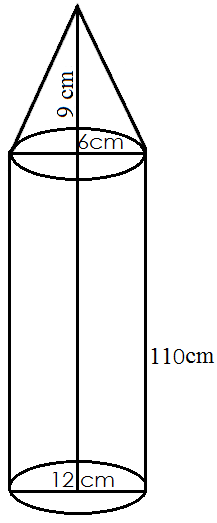
$\therefore$ Total volume of the pole
$=\pi\text{r}^2\text{h}_1+\frac{1}{3}\pi\text{r}^2\text{h}_2$
$=\pi\text{r}^2\Big(\text{h}_1+\frac{1}{3}\text{h}_2\Big)$
$=\frac{22}{7}\times(6)^2\Big(110+\frac{1}{3}\times9\Big)\text{cm}^2$
$=\frac{22}{7}+36(110+3)\text{cm}^3$
$=\frac{22}{7}\times36\times113\text{cm}^3$
$=\frac{89496}{7}\text{cm}^3$
Weight of $1\ cm^3$ of iron $= 8\ gm$
$\therefore$ Total weight $=\frac{89496}{7}\times8\text{gms}$
$=\frac{89496\times8}{7\times1000}\text{kg}=102.281\text{kg}$
$\therefore$ Mass of the pole $= 102.281\ kg$ View full question & answer→Question 253 Marks
$50$ circular plates each of diameter $14\ cm$ and thickness $0.5\ cm$ are placed one above the other to form a right circularcylinder. Find its total surface area.
AnswerGiven that $50$ circular plates each with diameter $= 14\ cm$
Radius of circular plates $(r) = 7\ cm$
Thickness of plates $= 0.5$
Since these plates are placed one above other so total thickness of plates $0.5 \times 50 = 25\ cm$
Total surface area of a cylinder $=2\pi\text{rh}+2\pi\text{r}^2$
$=2\pi\text{rh}+2\pi\text{r}^2$
$=2\pi\text{r}(\text{h}+\text{r})$
$= 2\times\frac{22}{7}\times7(25+7)$
T.S.A $= 1408\ cm^2$
$\therefore$ Total surface area of circular plates is $1408\ cm^2$
View full question & answer→Question 263 Marks
The vertical height of a conical tent is $42\ dm$ and the diameter of its base is $5.4m$.
Find the number of persons it can accommodate if each person is to be allowed $29.16$ cubic dm.
AnswerRadius of conicaltent, $\text{r}=\frac{5.4}{2}$
$= 2.7m$
$= 27dm$
Height of conical tent h = 42dm
The volume of conical tent
$=\frac{1}{3}\pi\text{r}^2\text{h}$
$=\frac{1}{3}\times\frac{22}{7}\times27\times27\times42$
$=22\times27\times27\times2$
$=32076\text{dm}^3$
Since, each person is to be allowed $29.16dm^3$,
Therefore,
$=\frac{\text{Volume of conical tent}}{\text{place to be allow to each person}}$
$=\frac{32076}{29.16}$
$=\frac{3207600}{2916}$
$\text{No. of persons}=1100$
View full question & answer→Question 273 Marks
If the total surface area of a solid hemisphere is $462\ cm^2$, find its volume $\Big(\text{use}\ \pi=\frac{22}{7}\Big)$
AnswerLet the radius of the hemisphere be r cm.
Total surface area of hemisphere $= 462\ cm^2$
$\Rightarrow3\pi\text{r}^2=462$
$\Rightarrow3\times\frac{22}{7}\times(\text{r})^2=462$
$\Rightarrow r^2 = 49$
$\Rightarrow r = 7\ cm$
Now, the volume of hemisphere is given by
$\frac{2}{3}\pi\text{r}^3$
$=\frac{2}{3}\times\frac{22}{7}(7)^3$
$=\frac{2156}{3}$
$=718\frac{2}{8}\text{cm}^3$
View full question & answer→Question 283 Marks
Water flows through a cylindrical pipe, whose inner radius is $1\ cm$, at the rate of $80\ cm/sec$ in an empty cylindrical tank, the radius of whose base is $40\ cm$.
What is the rise of water level in tank in half an hour?
AnswerGiven, radius of tank, $r_1 = 40\ cm$
Let height of water level in tank in half an hour $= h_1$
Also, given internal radius of cylindrical pipe, $r_1 = 1\ cm$
and speed of water $= 80\ cm/s$ in $1$ water flow $= 80\ cm$
$\therefore$ In $30$ (min) water flow $= 80 \times 60 \times 30 = 144000\ cm$
According to the question,
Volume of water in cylindrical tank = Volume of water flow the circular pipe in half an hour
$\Rightarrow\pi\text{r}^2_1\text{h}_1=\pi\text{r}^2_1\text{h}_2$
$\Rightarrow40\times40\times\text{h}_1=1\times144000$
$\therefore\text{h}_1=\Big(\frac{144000}{40\text{x}40}\Big)=90\text{cm}$
Hence, the level of water in cylindrical tank rises $90\ cm$ in half an hour.
View full question & answer→Question 293 Marks
An iron pillar consists of a cylindrical portion 2.8m high and 20cm in diameter and a cone 42cm high is surmounting it. Find the weight of the pillar, given that 1 cubic cm of iron weighs 7.5gm.
AnswerVolume of cylindrical portion
$=\pi\text{r}^2\text{h}$
$=\frac{22}{7}\times\Big(\frac{20}{2}\Big)^2\times280$
$=88000\text{cm}^3$
Volume of conical portion
$\frac{1}{3}\pi\text{r}^2\text{h}$
$=\frac{1}{3}\times\frac{22}{7}\times(10)^2\times42$
$=4400\text{cm}^3$
Total number
= 88000 + 4400
= 92400
So total height
= 92400 × 7.5
= 693000gm
= 693kg
View full question & answer→Question 303 Marks
A solid cone of base radius 10cm is cut into two parts through the mid-point of its height, by a plane parallel to its base. Find the ratio in the volumes of two parts of the cone.
AnswerRadius of solid cone (r) = 10cm
Let total height = h
In $\triangle\text{AOB}$
C is mid point of AO and CD || OB
$\therefore\frac{\text{OB}}{\text{CD}}=\frac{\text{AO}}{\text{AC}}\Rightarrow\frac{10}{\text{CD}}=\frac{\text{h}}{\text{h}}$
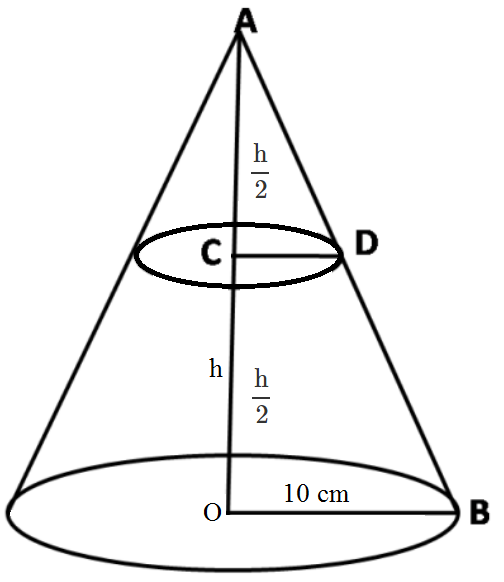
$\Rightarrow\frac{10}{\text{CD}}=\frac{2}{1}\Rightarrow\text{CD}=\frac{10}{2}=5\text{cm}$
$\therefore\text{r}_2=5\text{cm}$
Volume of smaller cone
$=\frac{1}{3}\pi\text{r}^2_2\frac{\text{h}}{2}=\frac{1}{3}\pi\times5\times5\times\frac{\text{h}}{2}=\frac{25}{6}\pi\text{h}$
Volume of frustum $=\frac{1}{3}\pi\frac{\text{h}}{2}(\text{r}^2_1+\text{r}_1\text{r}_2+\text{r}_2^2)$
$=\frac{\text{h}\pi}{6}(10^2+10\times5+5^2)$
$\frac{\pi\text{h}}{6}(100+50+25)$
$=\frac{175}{6}\pi\text{h}$
Ratio between the upper part and lower part
$=\frac{25}{6}\pi\text{h}:\frac{175}{6}\pi\text{h}=1:7$ View full question & answer→Question 313 Marks
If the volumes of two cones are in the ratio $1 : 4$ and their diameters are in the ratio $4 : 5$, then write the ratio of their height.
AnswerLet $r_1 r_2$ be the radii and $h_1, h_2$ be the height of two cones
It is given that the ratio of the volimes of two cones.
$V_1: V_2 = 1 : 4$
and $2r_1 : 2r_2 = 4 : 5$
$\Rightarrow\frac{\text{r}_1}{\text{r}_2}=\frac{4}{5}$
the ratio of Volume of two cones.
$\Rightarrow\frac{\text{V}_1}{\text{v}_2}=\frac{\frac{1}{3}\pi\text{r}_1^2\text{h}_1}{\frac{1}{3}\pi\text{r}_2^2\text{h}_2}$
$\Rightarrow\frac{1}{4}=\Big(\frac{4}{5}\Big)^\times\frac{\text{h}_1}{\text{h}_2}$
$\Rightarrow\frac{1}{4}=\frac{16}{25}\times\frac{\text{h}_1}{\text{h}_2}$
$\Rightarrow\text{h}_1:\text{h}_2=25:64$
Hence, the required ratio are $25 : 64$
View full question & answer→Question 323 Marks
A well with 10m inside diameter is dug 8.4m deep. Earth taken out of it is spread all around it to a width of 7.5m to form an embankment. Find the height of the embankment.
AnswerRadius of well
$\text{r}=\frac{10}{2}$
= 5m
Depth of well h = 8.4m
Clearly,
Volume of earth dugout
$=\pi(5)^2\times8.4$
$=\pi\times25\times8.4$
$=\frac{22\times25\times8.4}{7}\text{m}^3$
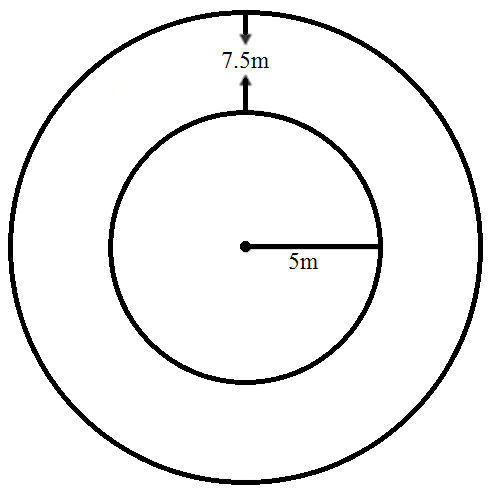
Let h' be the height of embankment
Clearly,
Embankment forms a cylindrical shell whose inner and outer radius are 5m and 12.5m respectively.
$\therefore$ Volume of the embankment
$=\pi\{(12.5)^2-(5)^2\}\times\text{h}'$
$=\pi\times17.5\times7.5\times\text{h}'\ \text{m}^3$
But, volume of earth dugout = volume of the embankment
$\frac{22\times25\times8.4}{7}=\frac{22}{7}\times17.5\times7.5\times\text{h}$
$\text{h}=\frac{258\times8.4}{17.5\times7.5}$
$\text{h}'=1.6\text{m}$ View full question & answer→Question 333 Marks
The radii of the base of a cylinder and a cone are in the ratio $3 : 4$ and their heights are in the ratio $2 : 3$. What is the ratio of their volumes?
AnswerLet $r_1$ and $r_2$ be the radii of the base of a cylinder and a cone.The volume of cylinder $\text{V}_1=\pi\text{r}^2_1\text{h}_1...(1)$
The volume of cone $\text{V}_2=\pi\text{r}^2_2\text{h}_2...(2)$
Dividing (i) by (ii), the, we get
$\frac{\text{V}_1}{\text{V}_2}=\frac{\pi\text{r}^2_1\text{h}_1}{\frac{1}{3}\pi\text{r}^2_2\text{h}_2}$
$\frac{=3\times\Big(\frac{\text{r}_1}{\text{r}_2}\Big)^2\times\Big(\frac{\text{h}_1}{\text{h}_2}\Big)}{\Big(\frac{\text{r}_1}{\text{r}_2}=\frac{3}{4},\frac{\text{h}_1}{\text{h}_2}=\frac{2}{3},\ \text{given}\Big)}$
$\frac{\text{V}_1}{\text{V}_2}=3\times\Big(\frac{3}{4}\Big)^2\times\frac{2}{3}$
$\frac{\text{V}_1}{\text{V}_2}=\frac{9}{8}$
$\text{V}_1:\text{V}_2=9:8$
View full question & answer→Question 343 Marks
Water in a canal $1.5\ m$ wide and 6m deep is flowing with a speed of $10\ km/hr$. How much area will it irrigate in $30$ minutes if $8\ cm$ of standing water is desired?
AnswerThe canal is $1.5\ m$ wide and $6\ m$ deep.
The water is flowing in the canal at $10\ km/hr$.
Hence, in $30$ minutes, the length of the flowing standing water is
$=10\times\frac{30}{60}\text{km}$
$= 5\ km$
$= 5000\ m$
Therefore, the volume of the flowing water in $30$ min is
$V_1 = 5000 \times 1.5 \times 6m^3$
Thus, the irrigated area in $30$ min of$ 8cm = 0.08m$ standing water is
$=\frac{5000\times1.5\times6}{0.08}$
$= 562500\ m^2$
View full question & answer→Question 353 Marks
A tent is in the form of a right circular cylinder surmounted by a cone. The diameter of cylinder is $24\ m$. The height of the cylindrical portion is $11\ m$ while the vertex of the cone is $16\ m$ above the ground. Find the area of canvas required for the tent.
AnswerGiven diameter of cylinder $24\ m$
Radius $(r) =\frac{24}{2}=12\text{m}$
Given height of cylindrical part $(h_1) = 11m$
$\therefore$ Height of cone part $(h_2) = 5m$
Vertex of come above ground $= 11 + 5 = 16m$
Curved surface area of cone $(S_1)$ $=\pi\text{rl}$
$=\frac{22}{7}\times12\times\text{l}$
Let l be slant height of cone
$\text{l}=\sqrt{\text{r}^2+\text{h}^2_2}$
$\Rightarrow\text{l}=\sqrt{12^2+5^2}=13\text{m}$
$l = 13\ m$
$\therefore$ Curved surface area of cone (5) $=\frac{22}{7}\times12\times13\text{m}^2$
View full question & answer→Question 363 Marks
A cylindrical container is filled with ice-cream, whose diameter is 12cm and height is 15cm. the whole ice-cream is distributed to 10 children in equal cones having hemispherical tops. If the height of the conical portion is twice the diameter of its base, find the diameter of the ice-cream.
AnswerVolume of cylindrical container
$=\pi\text{r}^2\text{h}$
$=\pi\times(6)^2\times15$
Amount of ice-cream distributed to 10 children $=\frac{\pi\times(6)^2\times15}{10}$
Therefore,
Height of conical portion = 2 × diameter of its bars
Let the diameter of bare = r
Height = 2r
Therefore,
Volume of the cones
$=\frac{1}{3}\pi\Big(\frac{\text{r}}{2}\Big)^2\text{h}+\frac{2}{3000}\pi\text{r}^3$
$=\frac{1}{3}\pi\Big(\frac{\text{r}}{2}\Big)^2(\text{h}+2\text{r})$
$=\frac{1}{3}\pi\Big(\frac{\text{r}}{2}\Big)^2\Big(2\text{r}+2\times\frac{\text{r}}{2}\Big)$
$=\frac{1}{3}\pi\Big(\frac{\text{r}}{2}\Big)^2\times3$
$\text{r}=\frac{\pi\text{r}^3}{4}$
Therefore,
Volume of the cones = amount distributed
$\frac{\pi\text{r}^3}{4}=\frac{\pi(6)^2\times15}{10}$
$\text{r}^3=\frac{4\times6\times6\times15}{10}=4\times6\times9$
$\text{r}=\sqrt[3]{6\times6\times6}=6\text{cm}$
View full question & answer→Question 373 Marks
The slant height of the frustum of a cone is $5\ cm$. If the difference between the radii of its two circular ends is $4\ cm$, write the height of the frustum.
AnswerLet $r_1$ and $r_2$ be the radius of frustum ends.
$r_1 - r_2 = 4\ cm$
Slant height of the frustum cone
$l = 5\ cm$
$\Rightarrow\text{l}=\sqrt{\text{h}^2+(\text{r}_1-\text{r}_2)^2}$
$=5=\sqrt{\text{h}^2+4^2}$
Squaring both the sides.
$\Rightarrow 25 = h^2 + 16$
$\Rightarrow h^2 = 25 - 16$
$\Rightarrow h^2 = 9cm$
$\Rightarrow h = 3cm$
Hence, the height of frustum is $3\ cm$
View full question & answer→Question 383 Marks
A container open at the top, is in the form of a frustum of a cone of height 24cm with radii of its lower and upper circular ends as 8cm and 20cm respectively. Find the cost of milk which can completely fill the container at the rate of Rs. 21 per litre.
AnswerUpper radius (R) = 20cm
Lower radius (r) = 8cm
Height (h) = 24cm
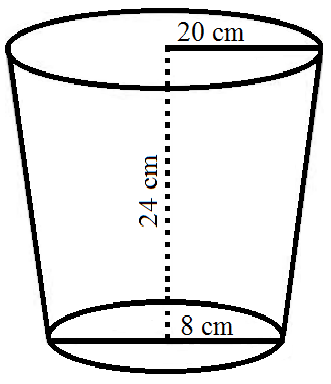
$\therefore$ Volume of frustum
$=\frac{\pi}{3}(\text{R}^2+\text{Rr}+\text{r}^2)\text{h}$
$=\frac{22}{7\times3}[20^2+20\times8+8^2]\times24\text{cm}^3$
$\frac{22}{21}[400+160+64]\times24\text{cm}^3$
$=\frac{22}{21}\times624\times24\text{cm}^3=\frac{329472}{21}\text{cm}^3$
Volume of milk in it
$=\frac{329472}{21}\times\frac{1}{1000}\text{l}$
$\frac{329.472}{21}\text{l}$
Rate of milk = ₹ 21 per l
$\frac{329.472}{21}\times21$
= ₹ 329.47 View full question & answer→Question 393 Marks
From a solid cylinder of height 2.5cm and diameter 4.2cm, a conical cavity of the same height and same diameter is hollowed out. Find the total surface area of the remaining solid.$\Big(\text{use}\ \pi=\frac{22}{7}\Big)$
AnswerDiameter of solid cylinder = 4.2cm
$\therefore$ Radius (r) $\Big(\frac{4.2}{2}\Big)=2.1\text{cm}$
Height (h) = 2.8cm
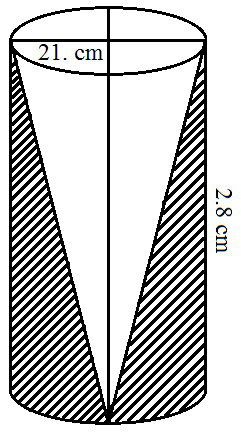
Slant height of cone
$=\sqrt{\text{r}^2+\text{h}^2}$
$=\sqrt{(2.1)^2+(2.8)^2}=\sqrt{4.41+7.84}$
$=\sqrt{12.25}=3.5\text{cm}$
Total surface area of remaining solid = surface area of cylinder + surface area of cone
$=2\pi\text{rh}+\pi\text{r}^2+\pi\text{rl}$
$=\pi\text{r}(2\text{h}+\text{r}+\text{l})$
$=\frac{22}{7}\times2.1(2\times2.8+2.1+3.5)\text{cm}^2$
$=6.6(5.6+2.1+3.5)\text{cm}^2$
$=6.6(11.2)=73.92\text{cm}^2$ View full question & answer→Question 403 Marks
The rain water from a roof of dimensions 22m × 20m drains into a cylindrical vessel having diameter of base 2m and height 3.5m. If the rain water collected from the roof just fills the cylindrical vessel, then find the rain in cm.
AnswerGiven, length of roof = 22m and breadth of roof = 20m
Let the rainfall be a cm.
Volume of water on the roof $=22\times20\times\frac{\text{a}}{100}=\frac{22\text{a}}{5}\text{m}^3$
Also, we have radius of base of the cylinderical vessel = 1m
and height of the cylindrical vessel = 3.5m
$\therefore$ Volume of water in the cylindrical vessel when it is just full
$=\Big(\frac{22}{7}\times1\times1\times\frac{7}{2}\Big)=11\text{m}^3$
Now, volume of water on the roof = volume of water in the vessel
$\Rightarrow\frac{22\text{a}}{5}=11$
$\therefore\text{a}=\frac{11\times5}{22}=2.5$
$\Big[\because$ volume of cylindricer = $\pi\times(\text{radius})^2\times\text{height}\Big]$
Hence, the rainfall is 2.5cm.
View full question & answer→Question 413 Marks
A hemisphere of lead of radius 7cm is cast into a right circular cone of height 49cm. Find the radius of the base.
AnswerRadius of hemisphere r = 7cm
The volume of hemisphere
$=\frac{2}{3}\pi\text{r}^2$
$=\frac{2}{3}\pi\times(7)^3$
$=\frac{2}{3}\pi\times343$
$=\frac{686}{3}\pi\ \text{cm}^3$
Since,
The hemisphere cast into the right circular cone.
The height of cone h = 49cm
Let x be the radius of cone.
Clearly,
Volume of cone = volume of hemisphere
$\frac{1}{3}\pi\times49=\frac{686}{3}\pi$
$\text{x}^2=\frac{686\times3}{49\times3}$
$=14$
$\text{x}^2=14$
$\text{x}=\sqrt{14}$
$\text{x}=3.74\text{cm}$
Thus, the radius of cone = 3.74cm
View full question & answer→Question 423 Marks
A building is in the form of a cylinder surmounted by a hemi-spherical vaulted dome and contains $41\Big(\frac{19}{21}\Big)\text{m}^3$ of air. If the internal diameter of dome is equal to its total height above the floor, find the height of the building?
AnswerLet total height of the building = Internal diameter of the dome = 2m
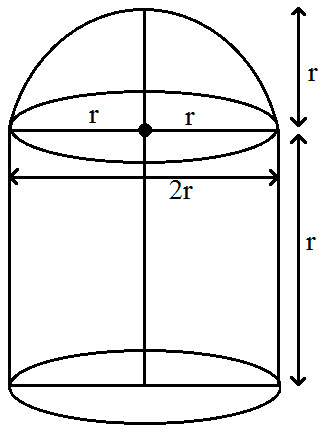
Radius of building (or dome) $=\Big(\frac{2\text{r}}{2}\Big)=\text{r}\ \text{m}$
Height of cylinder = 2r - r = r m
$\therefore$ Volume of the cylinder $=\pi\text{r}^2(\text{r})=\pi\text{r}^3\text{m}^3$
and volume of hemispherical dome cylinder $=\frac{2}{3}\pi\text{r}^3\text{m}^3$
$\therefore$ Total volume of the building = volume of the cylinder + volume of hemispherical dome.
$=\Big(\pi\text{r}^3+\frac{2}{3}\pi\text{r}^3\Big)\text{m}^3=\frac{5}{3}\pi\text{r}^3\text{m}^3$
According to the condition,
Volume of the building = volume of the air
$\Rightarrow\frac{5}{3}\pi\text{r}^3=41\frac{19}{21}\Rightarrow\frac{5}{3}\pi\text{r}^3=\frac{880}{21}$
$\Rightarrow\text{r}^3=\frac{880\times7\times3}{21\times22\times5}=\frac{40\times21}{21\times5}=8$
$\Rightarrow\text{r}^3=8\Rightarrow\text{r}=2$
$\therefore$ Height of the building = 2r = 2 × 2 = 4m. View full question & answer→Question 433 Marks
A hemisphere of lead of radius $7\ cm$ is cast into a right circular cone of height $49\ cm$. Find the radius of the base.
AnswerRadius of hemisphere of lead $(r_1) = 7\ cm$
$\therefore\frac{2}{3}\pi\times7\times7\times7=\frac{686\pi}{3}\text{cm}^3$
Now volume of right circular cone $=\frac{686\pi}{3}\pi\ \text{cm}^3$
Height $(h) = 49\ cm$
Let $r_2$ be the radius, then
Volume $=\frac{1}{3}\pi\text{r}_2^2\text{h}$
$\Rightarrow686\pi=\frac{1}{3}\pi\text{r}_2^2\times49\Rightarrow\text{r}_2^2=\frac{686\pi\times3}{1\times49\pi}$
$\Rightarrow\text{r}_2^2=42\Rightarrow\text{r}_2=\sqrt{42}$
$\therefore$ Radius $=\sqrt{42}=6.480\text{cm}$
View full question & answer→Question 443 Marks
A sphere of maximum volume is cut-out from a solid hemisphere of radius r, what is the ratio of the volume of the hemisphere to that of the cut-out sphere?
AnswerGiven that:
A sphere of maximum volume is cut from a solid hemisphere of radius r.
Therefore radius of sphere $=\frac{\text{r}}{2}$
The volume of sphere $=\frac{4}{3}\pi\Big(\frac{\text{r}}{2}\Big)^3$
$\Rightarrow\text{v}_1=\frac{1}{6}\pi\text{r}^3...(1)$
The volume of hemisphere
$\Rightarrow\text{v}_2=\frac{2}{3}\pi\text{r}^3...(2)$
Dividing Eq. (1) by Eq. (2)
$\Rightarrow\frac{\text{v}_1}{\text{v}_2}=\frac{\frac{1}{6}\pi\text{r}^3}{\frac{2}{3}\pi\text{r}^3}$
$\Rightarrow\frac{\text{v}_1}{\text{v}_2}=\frac{1}{4}$
$\Rightarrow\text{v}_2:\text{v}_1=4:1$
Hence the required ratio are 4 : 1
View full question & answer→Question 453 Marks
A cylindrical vessel of diameter 14cm and height 42cm is fixed symmetrically inside a similar vessel of diameter 16cm and height 42cm. The total space between the two vessels is filled with cork dust for heat insulation purposes. How many cubic centimeters of cork dust will be required?
AnswerDiameter of inner cylinder = 14cm
$\therefore$ Radius (r) $=\Big(\frac{14}{2}\Big)=7\text{cm}$
Diameter of outer cylinder = 16cm
$\therefore$ Radius (R) $\Big(\frac{16}{2}\Big)=8\text{cm}$
Height (h) = 42cm
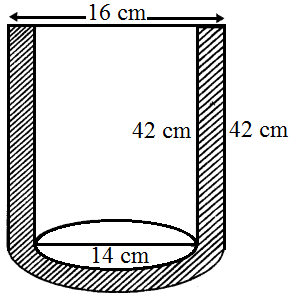
$\therefore$ space between the two cylinders
$=\pi\text{R}^2\text{h}-\pi\text{r}^2\text{h}$
$=\pi\text{h}(\text{R}^2-\text{r}^2)$
$=\frac{22}{7}\times42(8^2-7^2)\text{cm}^2$
$=22\times6\times(64-49)$
$=22\times6\times15\text{cm}^3$
$=1980\text{cm}^3$ View full question & answer→Question 463 Marks
A toy is in the form of a cone mounted on a hemisphere of radius 3.5cm. The total height of the toy is 15.5cm find the total surface area and volume of the toy.
AnswerRadius of the toy (r) = 3.5cm
Total height of the toy = 15.5cm
$\therefore$ Height of the conical part = 15.5 – 3.5 = 12cm
Slant height of the conical part (l)
$=\sqrt{\text{r}^2+\text{h}^2}=\sqrt{(3.5)^2+(12)^2}$
$=\sqrt{12.25+144}=\sqrt{156.25}=12.5\text{cm}$
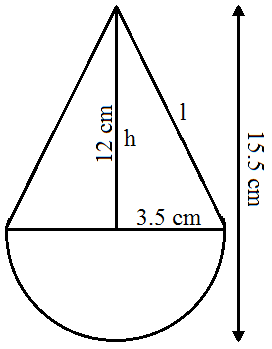
- Now total surface area of the toy = curved surface area of conical part + curved surface area of hemispherical part
$=\pi\text{rl}+2\pi\text{r}^2=\pi\text{r}(\text{l}+2\text{r})$
$=\frac{22}{7}\times3.5(12.5+2\times3.5)\text{cm}^2$
$=214.5\text{cm}^2$
- Volume of the toy $=\frac{1}{3}\pi\text{r}^2\text{h}+\frac{2}{3}\pi\text{r}^3$
$=\frac{1}{3}\pi\text{r}^2(\text{h}+2\text{r})$
$=\frac{1}{3}\times\frac{22}{7}(3.5)^2(12+2\times3.5)\text{cm}^3$
$=\frac{1}{3}\times\frac{22}{7}\times12.25(12+7)\text{cm}^3$
$=\frac{22}{3}\times1.75\times19\text{cm}^3$
$=\frac{731.5}{3}=243.83\text{cm}^3$ View full question & answer→Question 473 Marks
A cylindrical vessel with internal diameter $10\ cm$ and height $10.5\ cm$ is full of water. A solid cone of base diameter $7\ cm$ and height $6\ cm$ is completely immersed in water. Find the value of water (i) displaced out of the cylinder (ii) left in the cylinder. $(\text{take}\ \pi=\frac{22}{7})$
AnswerInternal diameters of cylindrical vessel $= 10\ cm$
$\therefore$ Radius (r) $=\Big(\frac{10}{2}\Big)=5\text{cm}$
and height $(h) = 10.5\ cm$
$\therefore$ Volume of water filled in it
$=\pi\text{r}^2\text{h}=\pi\times(5)^2\times10.5\text{cm}^3$
$=\frac{22}{7}\times2.5\times\frac{105}{10}\text{cm}^3=825\text{cm}^3$
Diameter of the cone $= 7\ cm$
$\therefore$ Radius (r) $\frac{7}{2}\text{cm},$ Height $(h_1) = 6\ cm$
$\therefore$ Volume of cone $=\frac{1}{3}\pi\text{r}_1^2\text{h}_1$
$=\frac{1}{3}\times\frac{22}{7}\times\frac{7}{2}\times\frac{7}{2}\times6\text{cm}^3=77\text{cm}^3$
- $\therefore$ Water displaced out of the cylinder $= 77\ cm^3$
- Water left in the vessal $= (825 - 77)\ cm^3= 748\ cm^3$
View full question & answer→Question 483 Marks
A bucket is in the form of a frustum of a cone and holds 15.25 litres of water. The diameters of the top and bottom are 25cm and 20cm respectively. Find its height and area of tin used in its construction.
AnswerSince volume of frustum
$=\frac{\pi\text{h}}{3}(\text{R}^2+\text{Rr}+\text{r}^2)$
$=15250\text{cm}^3$
$\text{h}\times\frac{\pi}{3}\times\Bigg(\Big(\frac{25}{2}\Big)^2+(10)^2+\frac{25}{2}\times10\Bigg)$
$=15250$
$\text{h}\times\frac{\pi}{3}(156.25+22.5)$
$=15250$
$\text{h}=\frac{3\times7\times15250}{22\times381.25}$
$=38.18\text{cm}$
Area of the required
$=\pi(25.5+10)\sqrt{(12.5-10)+38.18}$
$=3017\text{cm}^2$
View full question & answer→Question 493 Marks
Two right circular cylinders of equal volumes have their heights in the ratio $1 : 2$. What is the ratio of their radii?
AnswerLet $r_1$ and $r_2$ be the radii of two right circular cylinders and $h_1$ and $h_2$ be the heights.
Since,
Both the cylinder has the same volume.
Therefore,
$\pi\text{r}_1^2\text{h}_1=\pi\text{r}_2^2\text{h}_2$
$\Big(\frac{\text{r}_1}{\text{r}_2}\Big)^2=\frac{\text{h}_2}{\text{h}_1}$
$(\text{h}_1:\text{h}_2=1:2,\ \text{given})$
$\Big(\frac{\text{r}_1}{\text{r}_2}\Big)^2=\Big(\frac{2}{1}\Big)$
$\text{r}_1:\text{r}_2=\sqrt{2}:1$
View full question & answer→Question 503 Marks
A toy is in the form of a cone of radius 3.5cm mounted on a hemisphere of same radius. The total height of the toy is 15.5cm. Find the total surface area of the toy.
AnswerRadius of cone (r) = 3.5cm
Total height of the toy = 15.5cm
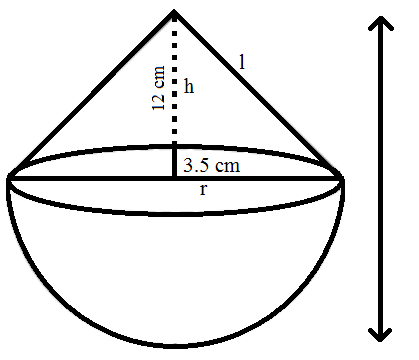
Height of the conical part (h) = 15.5 – 3.5 = 12cm
$\therefore$ Slant height of the cone (l)
$=\sqrt{\text{r}^2+\text{h}^2}=\sqrt{(3.5)^2+(12)^2}$
$=\sqrt{12.25+144}=\sqrt{156.25}=12.5\text{cm}$
Now total srrface area of the toy = curved surface area of the conical part + curved surface area of hemispherical part.
$=\pi\text{rl}+2\pi\text{r}^2=\pi\text{r}(\text{l}+2\text{r})$
$=\frac{22}{7}\times3.5\ (12.5+2\times3.5)\text{cm}^2$
$=\frac{22}{7}\times\frac{7}{2}(12.5+7)\text{cm}^2$
$=11(19.5)=214.5\text{cm}^2$ View full question & answer→Question 513 Marks
How many spherical lead shots of diameter 4cm can be made out of a solid cube of lead whose edge measures 44cm.
AnswerDiameter of the spherical lead shots = 4cm
Edge length of the solid cube (a) = 44cm.
Let n be the number of spherical lead shots made out of the solid cube.
n × Volume of the spherical lead shots = volume of the solid cube
$\Rightarrow\frac{\text{volume of the solid cube}}{\text{volume of the spherical lead shots}}=\text{n}$
$\Rightarrow\frac{\text{a}^3}{\frac{4}{3}\pi\text{r}^3}=\text{n}$
$\Rightarrow\frac{44^3}{\frac{4}{3}\pi\times\Big(\frac{4}{2}\Big)^3}=\text{n}$
$\Rightarrow2541=\text{n}$
Hence, 2541 spherical lead shot can be made.
View full question & answer→Question 523 Marks
A circus tent is in the shape of cylinder surmounted by a conical top of same diameter. If their common diameter is 56m, the height of the cylindrical part is 6m and the total height of the tent above the ground is 27m, find the area of the canvas used in making the tent.
AnswerWe have, diameter of base of cylinder = d = 56m
Radius of base of cylinder = $\text{r}=\Big(\frac{\text{d}}{2}\Big)=\Big(\frac{52}{2}\Big)=28\text{m}$
Height of tent = 27m
Height of cylinder = 6m
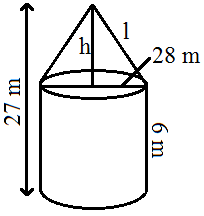
Height of conical portion = 27 – 6 = 21m
Radius of conical portion, r = 28m
Now, slant height of cone $=\text{l}=\sqrt{\text{r}^2+\text{h}^2}$
$=\sqrt{28^2+21^2}=35\text{m}$
Now, Area of canvas used = curved surface area of cylinder + curve surface area of cone.
$=2\pi\text{rh}+\pi\text{rl}$
$=\frac{22}{7}\times28(12+35)$
$=4136\text{m}^2$ View full question & answer→Question 533 Marks
A hemispherical bowl of internal radius $15\ cm$ contains a liquid. The liquid is to be filled into cylindrical-shaped bottles of diameter $5\ cm$ and height $6\ cm$. How many bottles are necessary to empty the bowl?
AnswerInternal radius of hemispherical bowl (r) = 15cm
$\therefore$ Volume of liquid filled in it $=\frac{2}{3}\pi\text{r}^3$
$=\frac{2}{3}\pi(15)^3\text{cm}^3$
$\frac{2}{3}\pi\times15\times15\times15\text{cm}^3=2250\pi\ \text{cm}^3$
Diameter of cylindrical bottle = 5cm
$\therefore$ Radius $(r_1)$ $=\frac{5}{2}\text{cm}$
and height $(h) = 6\ cm$
$\therefore$ Volume of one bottle $=\pi\text{r}^2\text{h}$
$=\pi\Big(\frac{5}{2}\Big)^2\times6\text{cm}^3$
$=\pi\times\frac{25}{4}\times6=\frac{75}{2}\pi\ \text{cm}^3$
$\therefore$ Number of bottles so filled $=2250\pi\div\frac{75}{2}\pi$
$=\frac{2250\pi\times2}{75\pi}=60$
View full question & answer→Question 543 Marks
A toy is in the form of a cone mounted on a hemisphere with the same radius. The diameter of the base of the conical portion is $6\ cm$ and its height is $4\ cm$. Determine the surface area of the toy. $(\text{Use}\ \pi=3.14)$
AnswerRadius of hemisphere and the cone are the same.
So, $r = 3\ cm$
Surface area of the cone
$=\pi\text{rl}$
$=3.14\times3\times\sqrt{3^2+4^2}$
$=47.1\text{cm}^2$
Surface area of the hemisphere
$=2\pi\text{r}^2$
$=2\times3.14\times9$
$=56.52\text{cm}^2$
Total surface area of the toy = surface area of the cone + surface area of the hemisphere
$= 47.1 + 56.52\ cm^2$
$= 103.62\ cm^2$
View full question & answer→Question 553 Marks
Sushant has a vessel, of the form of an inverted cone, open at the top, of height 11cm and radius of top as 2.5cm and is full of water. Metallic spherical balls each of diameter 0.5cm are put in the vessel due to which $\Big(\frac{2}{5}\Big)^\text{th}$ of the water in the vessel flows out. Find how many balls were put in the vessel. Sushant made the arrangement so that the water that flows out irrigates the flower beds. What value has been shown by Sushant?
AnswerLet the number of the balls be n.
Volume of water flows out = Volume of n spherical bolls
$\Rightarrow\frac{2}{5}\times\frac{1}{3}\pi\text{r}^2\text{h}=\text{n}\times\frac{4}{3}\pi\text{r}^3$
$\Rightarrow\frac{2}{5}\times(2.5)^2\times11=\text{n}\times4\Big(\frac{0.5}{2}\Big)^3$
$\Rightarrow27.5=\frac{0.5}{8}\text{n}$
$\Rightarrow\text{n}=440$
View full question & answer→Question 563 Marks
The surface area of a solid metallic sphere is $616\ cm^2$. It is melted and recast into a cone of height $28\ cm$. Find the diameter of the base of the cone so formed $(\text{use}\pi=\frac{22}{7}).$
AnswerThe surface area of the metallic sphere is 616 square cm. Let the radius of the metallic sphere is r. Therefore, we have
$\Rightarrow4\pi\text{r}^2=616$
$4\times\frac{22}{7}\times\text{r}^2=616$
$\text{r}^2=\frac{6.16\times7}{22\times4}$
$\Rightarrow\text{r}^2=7\times7$
$\Rightarrow\text{r}=7$
Therefore, the radius of the metallic sphere is 7cm and the volume of the sphere is $\text{V}_1=\frac{4}{3}\pi\times(7)^3\text{cm}^3$
The sphere is melted to recast a cone of height 28cm. Let the radius of the cone is R cm. Therefore, the volume of the cone is $\text{V}_2=\frac{1}{3}\pi\times(\text{R})^2\times28\text{cm}^3$
Since, the volumes of the sphere and the cone are same; we have
$V_1 = V_2$
$\Rightarrow\frac{4}{3}\pi\times(7)^3=\frac{1}{3}\pi\times(\text{R})^2\times28$
$\Rightarrow\text{R}^2=\frac{4\times(7)^3}{28}$
$\Rightarrow\text{R}^2=7^2$
$\Rightarrow\text{R}=7$
Hence, the diameter of the base of the cone so formed is two times its radius, which is $14\ cm$.
View full question & answer→Question 573 Marks
A canal is $300\ cm$ wide and $120\ cm$ deep. The water in the canal is flowing with a speed of $20\ km/h$. How much area will it irrigate in $20$ minutes if 8cm of standing water is desired?
AnswerVolume of water flows in the canal in one hour = width of the canal $\times $ depth of the canal $\times $ speed of the canal water
$= 3 x 1.2 \times 20 \times 1000m^3 = 72000m^3$
In $20$ minutes the volume of water
$=\frac{72000\times20}{60}\text{m}^3=24000\text{m}^3$
Area irrigated in $20$ minutes, if 8cm,
i.e., $0.08\ m$ standing water is required
Valume of water in canal = Area of field $\times\frac{8}{100}$
$24000=\text{A}\times\frac{8}{100}$
$\frac{24000\times100}{8}=\text{A}$
$\text{A}=300000\text{ m}^2$
$=30\text{ hectares.}$
View full question & answer→Question 583 Marks
Two cones have their heights in the ratio 1 : 3 and radii 3 : 1. What is the ratio of their volumes?
AnswerLet the radius of cones be 3r and r then the height of the cone be h and 3h
Then,
the volume of first cone
$\text{V}_1=\frac{1}{3}\pi\text{r}^2_1\text{h}_1$
$=\frac{1}{3}\pi(3\text{r})^2\times\text{h}$
$=\frac{1}{3}\pi\times9\text{r}^2\times\text{h}$
$=3\pi\text{r}^2\text{h}$
the volume of secound cone
$\text{V}_2=\frac{1}{3}\pi\text{r}^2_2\text{h}_2$
$\frac{1}{3}\pi\text{r}^2\times(3\text{h})$
$=\pi\text{hr}^2$
Therefore, ratio of their volume
$\Rightarrow\frac{\text{v}_1}{\text{v}_2}=\frac{3\pi\text{r}^2\text{h}}{\pi\text{hr}^2}$
$\Rightarrow\text{v}_1:\text{v}_2=3:1$
Hence, the required ratio are 3 : 1
View full question & answer→Question 593 Marks
A copper sphere of radius 3cm is melted and recast into a right circular cone of height 3cm. Find the radius of the base of the cone.
AnswerGiven radius of sphere = 3cm.
Volume of a sphere $=\frac{4}{3}\pi\text{r}^3$
$=\frac{4}{3}\times\pi\times3^3\text{cm}^3\ ...(\text{i})$
Given sphere is melted and recast into a right circular cone.
Given Hieght of circular cone = 3cm.
Volume of right circular cone $=\pi\text{r}^2\text{h}\times\frac{1}{3}$
$=\frac{\pi}{3}(\text{r})^2\times3\text{cm}^2\ ...(\text{ii})$
Equating 1 and 2 we get
$\frac{4}{3}\pi\times3^3=\frac{1}{3\pi}(\text{r})^2\times3$
$\text{r}^2=\frac{\frac{4}{3}\pi\times3^3}{\pi}$
$\text{r}^2=36\text{cm}$
$\therefore$ Radius of base of cone (r) = 6cm.
View full question & answer→Question 603 Marks
If the radii of the circular ends of a bucket $24\ cm$ high are $5\ cm$ and $15\ cm$ respectively, find the surface area of the bucket.
AnswerGiven height of a bucket $(R) = 24\ cm$ Radius of circular ends of bucket $5\ cm$ and $15\ cm$
$r_1 = 5\ cm; r_2 = 15\ cm$
Let 'l' be slant height of bucket
$\text{l}=\sqrt{\big(\text{r}_1-\text{r}_2\big)^2+\text{h}^2}$
$\Rightarrow\text{l}=\sqrt{\big(15-5\big)^2+24^2}$
$\Rightarrow\text{l}=\sqrt{100+576}=\sqrt{676}$
$\text{l}=26\text{cm}$
cueved surface area of bucket $= \pi\big(\text{r}_1+\text{r}_2\big)\text{l}+\pi\text{r}^2_2$
$=\pi (5+15)26+\pi(15)^2$
$=\pi (20)26+\pi(15)^2$
$=\pi (520-225)$
$= 745\pi \text{cm}^2$
$\therefore$ curved surface area of bucket $=745\pi\text{cm}^2$
View full question & answer→Question 613 Marks
The radii of the circular ends of a solid frustum of a cone are $33\ cm$ and $27\ cm$ and its slant height is $10\ cm$. Find its total surface area.
AnswerThe slant height of the frustum of a cone is $=10\ cm$. The radii of the upper and lower circles of the bucket are $r _1=$ $33\ cm$ and $r _2=27 cm$ respectively.
The total surface area of the frustum of the cone is
$s_1=\pi\left(r_1+r_2\right) \times 1+\pi r_1^2+\pi r_2^2$
$=\pi \times(33+27) \times 10+\pi \times 33^2+\pi \times 27^2$
$=600 \pi+1089 \pi+729 \pi$
$=7599.42\ cm^2$
Hence total surface area is $7599.42\ cm^2$
View full question & answer→Question 623 Marks
A cone, a hemisphere and a cylinder stand on equal bases and have the same height. What is the ratio of their volumes?
AnswerLet r be the radius of the base.
And h is the height.
Here, $h = r.$
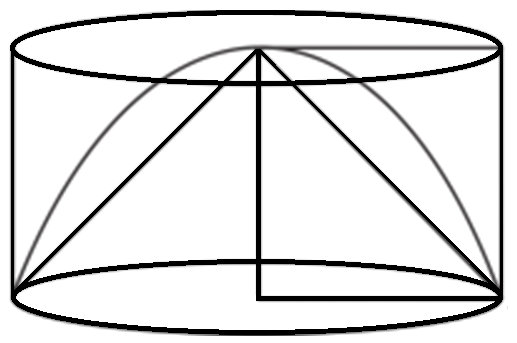
Now,
The ratio of their volumes will be
Volume of cone: volume of hemisphere: volume of a cylinder
$\frac{1}{3}\pi\text{r}^2\text{h}:\frac{2}{3}\pi\text{r}^3:\pi\text{r}^2\text{h}$
$\text{V}_1:\text{V}_2:\text{V}_3=\frac{1}{3}\pi\text{r}^3:\frac{2}{3}\pi\text{r}^3:\pi\text{r}^3$
Hence, $V_1: V_2: V_3 = 1: 2: 3$ View full question & answer→Question 633 Marks
A metallic sphere 1dm in diameter is beaten into a circular sheet of uniform thickness equal to 1mm. Find the radius of the sheet.
AnswerDiameter of a sphere = 1dm = 10cm
$\therefore$ Radius (r) $=\Big(\frac{10}{2}\Big)=5\text{cm}$
Volume of metal used in the sphere $=\Big(\frac{4}{3}\Big)\pi\text{r}^3$
$=\frac{4}{3}\times\pi(5)^3\text{cm}^3$
$=\frac{4}{3}\pi\times1256=\frac{500}{3}\pi\ \text{cm}^3$
Thickness of the sheet (h) $=1\text{mm}=\frac{1}{10}\text{cm}$
Let r be the radius of the circular sheet, then
$\pi\text{r}_1^2\text{h}=\frac{500}{3}\pi\Rightarrow\text{r}_1^2\text{h}=\frac{500}{3}$
$\Rightarrow\text{r}_1^2\times\frac{1}{10}=\frac{500}{3}$
$\Rightarrow\text{r}_1^2=\frac{500\times10}{3}=\frac{5000}{3}$
$\Rightarrow\text{r}=\sqrt{\frac{5000}{3}}\text{cm}^2\sqrt{16.67}=4.08\text{cm}$
$\therefore$ radius 4.08cm
View full question & answer→Question 643 Marks
A milk container of height $16\ cm$ is made of metal sheet in the form of a frustum of a cone with radii of its lower and upper ends as $8\ cm$ and $20\ cm$ respectively. Find the cost of milk at the rate of $₹ 44\ per$ litre which the container can hold.
AnswerGiven that, height of milk container $(h) = 16\ cm$
Radius of lower end of milk container $(r) = 8\ cm$
and radius of upper end of milk container $(R) = 20\ cm$
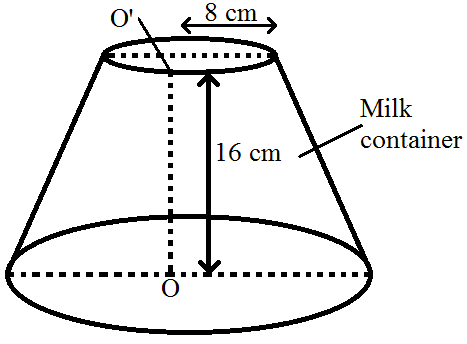
$\therefore$ Volume of the milk container made of metal sheet in the form of a frustum of a cone
$=\frac{22\times16}{21}(400+64+160)$
$=\frac{22\times16\times624}{21}=\frac{219648}{21}$
$= 10459.42\text{cm}^3=10.45942\ \text{L}$
So, volume of the maik container is $10459.42cm^3$
$\because$ Cost of $1L$ milk $= ₹ 44$
$\therefore$ Cost of $10.45942L$ milk =$ 44 \times 10.45942 = 460.24$
Hence, the required cost of milk is $₹ 460.24$ View full question & answer→Question 653 Marks
Lead spheres of diameter 6cm are dropped into a cylindrical beaker containing some water and are fully submerged. If the diameter of the beaker is 18cm and water rises by 40cm. find the number of lead spheres dropped in the water.
AnswerDiameter of cylindrical diameter = 18cm $\therefore$ Radius (R) $=\frac{18}{2}=9\text{cm}$ Height of water level (h) = 40cm $\therefore$ Volume of water $=\pi\text{R}^2\text{h}=\pi\times(9)^2\times40\text{cm}^3$ $=\pi\times28\times40=3240\pi\ \text{cm}^3$ Diameter of lead sphere = 6cm $\therefore$ Radius (r) $=\frac{6}{2}=3\text{cm}$ and volume $=\frac{4}{3}\pi\text{r}^3=\frac{4}{3}\pi(3)^3\text{cm}^3$ $=\frac{4}{3}\times27\pi=4\times9\pi\ \text{cm}^3$ $=36\pi\ \text{cm}^3$$\therefore$ Number of lead sphere $=\frac{3240\pi}{36\pi}=90$
View full question & answer→Question 663 Marks
A cone of maximum size is carved out from a cube of edge 14cm. Find the surface area of the cone and of the remaining solid left out after the cone carved out.
AnswerThe cone of maximum size that is carved out from a cube of edge 14cm will be of base radius 7cm and the height 14cm.
Surface area of the cone $=\pi\text{rl}+\pi\text{r}^2$
$=\frac{22}{7}\times7\times\sqrt{7^2+14^2}+\frac{22}{7}\times(7)^2$
$=\frac{22}{7}\times7\times\sqrt{245}+154$
$=(154\sqrt{5}+154)\text{cm}^2=154\sqrt{5}+1)\text{cm}^2$
Surface area of the cube $=6\times(14)^2$
$=6\times196=1176\text{cm}^2$
So, surface area of the rremaining solid left out after the cone is carved out
$=(1176-154+154\sqrt{5})\text{cm}^2$
$=(1022+154\sqrt{5})\text{cm}^2$
View full question & answer→Question 673 Marks
A 16m deep well with diameter 3.5m is dug up and the earth from it is spread evenly to form a platform 27.5m by 7m. Find the height of the platform.
AnswerAssume the well as a solid right circular cylinder. Then, the radius of the solid right circular cylinder is$\text{r}=\frac{3.5}{2}=1.75\text{m}$
The well is 16m deep. Thus, the height of the solid right circular cylinder is 16m. Therefore, the volume of the solid right circular cylinder is $\text{V}_1=\pi\text{r}^2\text{h}$
$=\frac{22}{7}\times(1.75)^2\times16\ \text{cubic meter}$ Let the height of the platform formed be x m. The length and the breadth of the platform are l = 27.5m and b = 7m respectively. Therefore, the volume of the platform is $V_2 = lbx = 27.5 \times 7 \times x = 192.5x$ cubic meters Since, the well is spread to form the platform; the volume of the well is equal to the volume of the platform. Hence, we have $V_1 = V_2$_
$\Rightarrow\frac{22}{7}\times(1.75)^2\times16=192.5\text{x}$
$\Rightarrow\ \text{x}=\frac{22}{7\times192.5}\times(1.75)^2\times16$
$\Rightarrow\frac{22\times3.0625\times16}{7\times192.5}$
$\Rightarrow0.8$ Hence, the height of the platform is 0.8m = 80cm.
View full question & answer→Question 683 Marks
A circus tent is cylindrical to a height of $3$ metres and conical above it.
If its diameter is $105\ m$ and the slant height of the conical portion is $53\ m$, calculate the length of the canvas $5\ m$ wide to make the required tent.
AnswerDiameter of the tent $= 105\ m$
$\therefore$ Radius (r) $=\Big(\frac{105}{2}\Big)\text{m}$
Height of cylindrical part $(h_1) = 3\ m$
Slant height of conical part $(h_2) = 53\ m$
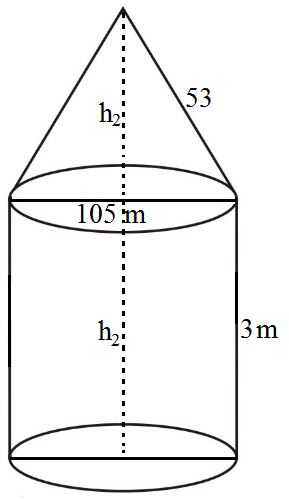
$\therefore$ Total surface area of the tent = curved surface area of the conical part + curved surface area of the cylindrical area
$=\pi\text{rl}+2\pi\text{rh}_1$
$=\pi\text{r}(\text{l}+2\text{h}_1)=\frac{22}{7}\times\frac{105}{2}\ [53+2\times3]^2\text{m}^3$
$= 165 \times 599735m^2$
Width of canvas $= 5\ m$
$\therefore$ Length of canvas $= 9735 ÷ 5 = 1947\ m$ View full question & answer→Question 693 Marks
A tent is in the form of a right circular cylinder surmounted by a cone. The diameter of the base of the cylinder or the cone is $24\ m$. The height of the cylinder is $11\ m$. If the vertex of the cone is 16m above the ground, find the area of the canvas required for making the tent. $(\text{Use}\ \pi=\frac{22}{7})$
AnswerSurface area of cylindrical part
$=2\pi\text{rh}$
$=2\times\frac{22}{7}\times\frac{24}{2}\times11$
$=829.71\text{m}^2$
Height of cone
$= 16 - 11$
$= 5\ m$
Surface area of conical part
$=\pi\text{rl}$
$\text{l}=\sqrt{\text{r}^2+\text{h}^2}$
$=\sqrt{(5)^2+(12)^2}$
$=13\text{m}$
S.A. of conical part
$=\frac{22}{7}\times12\times13$
$=490.29\text{m}^2$
Total area
$= 490.29 + 829.71$
$= 1319.99$
$= 1320m^2$
So canvas required will be $1320m^2$
View full question & answer→Question 703 Marks
A bucket is in the form of a frustum of a cone and holds $28.490$ litres of water. The radii of the top and bottom are $28\ cm$ and $21\ cm$ respectively. Find the height of the bucket.
AnswerGiven, volume of the frustum
$= 28.49 l = 28.49 \times 1000cm^3$ [$\because$ $1 L = 1000cm^3$]
$= 28490cm^3$
and radius of the top $(r_1) = 28\ cm$
Radius of the bottom $(r_2) = 21\ cm$
Let height of the bucket = $h\ cm$
Now, Volume of the buket
$=\frac{1}{3}\pi\text{h}(\text{r}_1^2+\text{r}_2^2+\text{r}_1\text{r}_2)=28490$ [given]
$=\frac{1}{3}\times\frac{22}{7}\times\text{h}(28^2+21^2+28\times21)=28490$
$\Rightarrow\text{h}(784+441+588)=\frac{28490\times3\times7}{22}$
$\Rightarrow1813\text{h}=1295\times21$
$\therefore\text{h}=\frac{1295\times21}{1813}=\frac{27195}{1813}=15\text{cm}$
View full question & answer→Question 713 Marks
A hemispherical bowl of internal radius 9cm is full of liquid. The liquid is to be filled into cylindrical shaped bottles each of radius 1.5cm and height 4cm. How many bottles are needed to empty the bowl?
AnswerGiven, radius of hemispherical bowl, r = 9cm
and radius of cylindrical bottles, R = 1.5cm
and height, h = 4cm
$\therefore$ Number of required cylindrical bottles
$\frac{\text{Volume of hemisphere bowl}}{\text{Volume of one cylindrical bottle} }$
$=\frac{\frac{2}{3}\pi\text{r}^3}{\pi\text{R}^2\text{h}}=\frac{\frac{2}{3}\pi\times9\times9\times9}{\pi\times1.5\times1.5\times4}=54$
View full question & answer→Question 723 Marks
The height of a solid cylinder is 15cm and the diameter of its base is 7cm. Two equal conical holes each of radius 3cm and height 4cm are cut off. Find the volume of the remaining solid.
Answer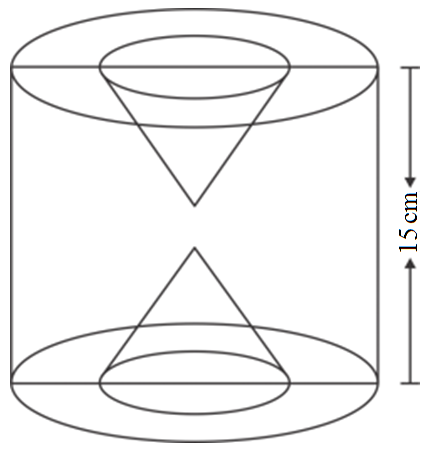
The height of cylinder h = 15cm
Radius of cylinder r $=\frac72$
The volume of cylinder
$=\pi\text{r}^2\text{h}$
$=\pi\times\Big(\frac{7}{2}\Big)^2\times15\text{cm}^2$
$=183.75\pi$
The radius of conical holes = 3cm
Height of conical holes = 4cm.
The volume of conical holes
$=\frac{1}{3}\pi\text{r}^2\text{h}$
$=\frac{1}{3}\pi\times9^3\times4$
$=12\pi\ \text{cm}^3$
Clearly,
The volume of remaining solid
= vol. of cylinder − 2 × vol. of cone
$=183.75\pi-24\pi$
$=501.6\text{cm}^3$ View full question & answer→Question 733 Marks
Find the volume of a solid in the form of a right circular cylinder with hemi-spherical ends whose total length is 2.7m and the diameter of each hemi-spherical end is 0.7m.
AnswerTotal height of solid = 2.7m
diameter of hemisphere = 0.7m
redius of hemisphere $=\frac{0.7}{2}\text{m}=0.35$
height of cylindrical = 2m.
So, that volume of the solid = 2 × volume of hemispherical part + volume of cylindrical part
$=2\times\frac{2}{3}\pi\text{r}^3+\pi\text{r}^2\text{h}$
$=\frac{4}{3}\times\frac{22}{7}\times0.35^3+\frac{22}{7}\times0.35^2\times2$
$=2\times\frac{22}{7}\times0.35\times0.35\times\Big[\frac{2\times0.35}{3}+1\Big]$
$=2\times22\times\frac{0.05}{100}\times\frac{0.35}{100}\Big[\frac{0.70+3}{3}\Big]$
$=2\times\frac{110\times35}{100\times100}\Big[\frac{3.70}{3}\Big]$
$2\times\frac{1.10\times35\times3.70}{300}$
$=0.9496$
$=0.955\text{m}^2$
View full question & answer→Question 743 Marks
A solid is in the form of a cylinder with hemispherical ends. Total height of the solid is $19\ cm$ and the diameter of the cylinder is $7\ cm$. Find the volume and total surface area of the solid.
AnswerVolume of cylinder $=\pi\text{r}^2\text{h}$
$=\frac{22}{7}\times\frac{7}{2}\times\frac{7}{2}\times12$
$=462\text{cm}^3$
Volume of 2 hemisphere $=4\pi\text{r}^3$
$=\frac{4}{3}\times\frac{22}{2}\times\frac{7}{2}\times\frac{7}{2}\times\frac{7}{2}$
$=179.6\text{cm}^3$
Therefore,
Volume of solid $= 462 + 179.6$
$= 641.6\ cm^3$
Total surface area of the solid
$=2\pi\text{rh}+4\pi\text{r}^2$
$=2\pi\text{r}(\text{h}+2\text{r})$
$=2\times\frac{22}{7}\times\frac{7}{2}\Big(12+2\times\frac{7}{2}\Big)$
$=418\text{cm}^2$
View full question & answer→Question 753 Marks
Metal spheres, each of the radius $2\ cm$, are packed into a rectangular box of internal dimension $16\ cm \times 8\ cm \times 8\ cm$ when $16$ spheres are packed the box is filled with preservative liquid. Find the volume of this liquid.
AnswerThe radius of each of the metallic sphere is $2\ cm$. Therefore, the volume of each metallic sphere is $\text{V}=\frac{4}{3}\pi\times (2)^3\text{cm}^3$
The total volume of the $16$ spheres is
$\text{V}_1=16\times\frac{4}{3}\pi\times(2)^3\text{cm}^3$
The internal dimension of the rectangular box is 16cm × 8cm × 8cm. Therefore, the volume of the rectangular box is $V_2 = 16 \times 8 \times 8cm^3$
Therefore, the volume of the liquid is $V2 - V1$ $=16\times8\times8-16\times\frac{4}{3}\pi\times(2)^3$
$= 1024 - 536.03$
$= 488$
Hence volume of liquid is $488cm^3$
View full question & answer→Question 763 Marks
An iron pole consisting of a cylindrical portion $110\ cm$ high and of base diameter $12\ cm$ is surmounted by a cone $9\ cm$ high. Find the mass of the pole, given that $1\ cm^3$ of iron has $8$ gram mass approximately. $\Big(\text{Use}:\ \pi=\frac{355}{115}\Big)$
AnswerDiameter of the base of the cylindrical pole $= 12\ cm$
$\therefore$ Radius (r) $=\Big(\frac{22}{2}\Big)=6\text{cm}$
Height of cylindrical portion $(h_1) = 110\ cm$
and height of conical portion $(h_2) = 9\ cm$
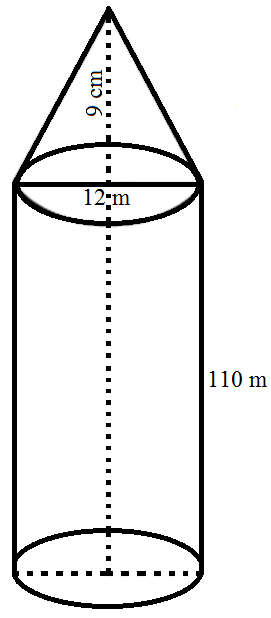
$\therefore$ Volume of the pole = Volume of cylindrical portion + volume of conical portion
$=\pi\text{r}^2\text{h}_1+\frac{1}{3}\pi\text{r}^2\text{h}_2$
$=\pi\text{r}^2\Big(\text{h}_1+\frac{1}{3}\text{h}_2\Big)=\frac{355}{115}(6)^2\Big(110+\frac{1}{3}\times9\Big)\text{cm}^3$
$=\frac{355}{115}\times36\times113\text{cm}^3$
$=\frac{71}{23}\times36\times113\text{cm}^3=\frac{288828}{23}\text{cm}^3$
Weight of $1cm^2 = 8gm$
$=\frac{288828\times8}{23\times1000}\text{kg}=100.46\text{kg}$
Note: If height of cone is $15\ cm$ instead of $9\ cm$ then the weight will be $102.24\ kg$ View full question & answer→Question 773 Marks
A solid is composed of a cylinder with hemispherical ends. If the length of the whole solid is 108cm and the diameter of the cylinder is $36\ cm$, find the cost of polishing the surface at the rate of $7$ paise per $cm^2$. $ (\text{Use}\ \pi=3.1416)$
AnswerHeight of the cylinder $= 108 - 36 = 72\ cm r = 18\ cm$
C.S.A. of cylinder $=2\pi\text{rh}$ $=2\pi\times18\times72$ $=2\times3.14\times18\times72$$=8138.88\text{cm}^2$
C.S.A. of $2$ hemisphere = surface of a sphere$=4\pi\text{r}^2$
Total surface $=2\pi\text{rh}+4\pi\text{r}^2$ $=2\pi\text{r}(\text{h}+2\text{r})$ $=2\times3.14\times18(72+2\times18)$$=12214.54\text{cm}^2$
Total cost $= 7 \times 12214.54 = 85502\ paise = 855.02\ Rs$.
View full question & answer→Question 783 Marks
A farmer runs a pipe of internal diameter 20cm from the canal into a cylindrical tank in his field which is 10m in diameter and 2m deep. If water flows through the pipe at the rate of 3km/h, in how much time will the tank be filled?
AnswerDiameter of pipe = 20cm
$\therefore$ Radius (r) $=\frac{20}{2}=10\text{cm}=\frac{10}{100}=\frac{1}{10}\text{m}$
Diameter of cylinderical tank = 10m
$\therefore$ Radius of tank (R) $=\frac{10}{2}=5\text{m}$
and depth {h} = 2m
$\therefore$ Volume of water filled in it $=\pi\text{r}^2\text{h}$
$=\frac{22}{7}\times\frac{1}{10}\times\frac{1}{10}\times\text{H}=\frac{1100}{7}$
$\text{H}=\frac{1100}{7}\times\frac{700}{22}=5000\text{m}=5\text{km}$
Speed of water = 3km/hr
$\therefore$ Time taken $=\frac{5}{3}\text{hr}=1\frac{2}{3}\text{hours}$
= 1 hr 40 minutes.
View full question & answer→Question 793 Marks
A conical vessel whose internal radius is $10\ cm$ and height $48\ cm$ is full of water. Find the volume of water. If this water is poured into a cylindrical vessel with internal radius $20\ cm$, find the height to which the water level rises in it.
AnswerInternal radius of the conical vessel $(r_1) = 10\ cm$
Height $(h_1) = 48\ cm$
$\therefore$ Volume of water in it $=\frac{1}{3}\pi\text{r}_1^2\text{h}_1=\frac{1}{3}\pi\times(10)^2\times48\text{cm}^3$
$=1600\pi\text{cm}^3=1600\times3.14=5024\text{cm}^2$
Now volume of water in the cylindrical vessel
$=1600\pi\ \text{cm}^3$
Internal radius $(r_2) = 20cm$
Let $h_1$ be the height of water level, then
$\pi\text{r}_2^2\text{h}_2=1600\pi\Rightarrow\pi\times(20)^2\text{h}_2=1600\pi$
$\Rightarrow400\pi\ \text{h}_2=1600\pi\Rightarrow\text{h}_2=\frac{1600\pi}{400\pi}=4$
Hence height $= 4cm$
View full question & answer→Question 803 Marks
If $r_1$ and $r_2$ be the radii of two solid metallic spheres and if they are melted into one solid sphere, prove that the radius of the new sphere is $(\text{r}_1^3+\text{r}_2^3).\frac{1}{3}$
AnswerLet $r_1$ and $r_2$ be the radii of two solid sphere.
$\therefore$ Volume of both the sphere
$=\frac{4}{3}\pi\text{r}_1^3+\frac{4}{3}\pi\text{r}_2^3=\frac{4}{3}\pi(\text{r}_1^3+\text{r}_2^3)$
Now volume of the new sphere so formed whose volume is
$=\frac{4}{3}\pi(\text{r}_1^3+\text{r}_2^3)$
$\therefore$ Radius of new sphere
$=\frac{\frac{4}{3}\pi\sqrt[3]{(\text{r}_1^3+\text{r}_2^3)}}{\frac{4}{3}\pi}=\sqrt[3]{\text{r}_1^3+\text{r}_1^3}$
$=(\text{r}_1^3+\text{r}_2^3)^\frac{1}{3}$
View full question & answer→Question 813 Marks
A factory manufactures $120,000$ pencils daily. The pencils are cylindrical in shape each of length $25\ cm$ and circumference of base as $1.5\ cm.$ Determine the cost of colouring the curved surfaces of the pencils manufactured in one day at $ ₹\ 0.05\ per\ dm^2$.
AnswerLength of the pencil, $h = 25\ cm$
circumference of the base $= 1.5\ cm$
Curved surface area of the pencil which needs to be painted will be
CSA = circumference × height
$= 1.5 \times 25cm^2$
$= 37.5cm^2$
$= 0.375dm^2$
Pencils manufactured in one day $= 120000$
So, the total area to be painted will be
$120000 \times 0.375dm^2 = 45000dm^2$
View full question & answer→Question 823 Marks
16 glass spheres each of radius $2\ cm$ are packed into a cuboidal box of internal dimensions $16\ cm \times 8\ cm \times 8\ cm$ and then the box is filled with water. Find the volume of water fdled in the box.
AnswerGiven, dimensions of the cuboidal
$= 16cm \times 8cm \times 8cm$
$\therefore$ Volume of the cuboidal $= 16 \times 8 \times 8$
$= 1024\ cm^3$
Also, given radius of one glass sphere = 2cm
$\therefore$ Volume of one glass sphere $=\Big(\frac{4}{3}\Big)\pi\text{r}^3$
$=\Big(\frac{4}{3}\times\frac{22}{7}\times(2)^3\Big)$
$=\Big(\frac{704}{21}\Big)=33.523\text{cm}^3$
Now, volume of 16 glass spheres $= 16 \times 33.523 = 536.37\ cm$
$\therefore$ Required volume of water = Volume of cuboidal – Volume of $16$ glass spheres
$= 1024 - 536.37 = 487.6\ cm^3$
View full question & answer→Question 833 Marks
A solid is composed of a cylinder with hemispherical ends. If the whole length of the solid is $104\ cm$ and the radius of each of the hemispherical ends is $7\ cm$, find the cost of polishing its surface at the rate of $Rs\ 10\ per\ dm^2.$
AnswerWe have a solid composed of cylinder with hemispherical ends.
Radius of the two curved surfaces $(r) = 7\ cm$
Height of cylinder is h.
Total height of the body $(h + 2r) = 104\ cm$
So, total surface area is given by,
Total surface area = curved surface area of cylinder + $2$ (curves surface area of hemisphere)
$=2\pi\text{rh}+2(2\pi\text{r}^2)$
$=2\pi\text{r}(\text{h}+2\text{r})$
$=2(3.14)(7)(104)\text{cm}^2$
$=4571.84\text{cm}^2$
Change the units of curved surface area as,
Total surface area $=\frac{4571.84}{100}\text{dm}^2$
$= 45.7184\ dm^2$
Cost of polishing the surface is $Rs\ 10\ per\ dm^2$.
So total cost,
$= Rs\ (45.7184)(10)$
$= Rs\ 457.18$
View full question & answer→Question 843 Marks
Volume and surface area of a solid hemisphere are numerically equal. What is the diameter of hemisphere?
AnswerLet the radius of the hemisphere be r units.
Volume of a hemisphere = Surface area of the hemisphere
$\Rightarrow\frac{2}{3}\pi\text{r}^3=3\pi\text{r}^2$
$\Rightarrow\frac{2}{3}\text{r}=3$
$\Rightarrow\text{r}=\frac{9}{2}$
$\Rightarrow\text{d}=9\text{units}$
Hence, diameter of the hemisphere is equal to 9 units.
View full question & answer→Question 853 Marks
Find the mass of a $3.5\ m$ long lead pipe, if the external diameter of the pipe is $2.4\ cm$, thickness of the metal is 2mm and the mass of $1\ cm^3$ of lead is $11.4\ g$.
AnswerExternal diameter of a cylindrical pipe $= 2.4\ cm$
Radius (R) $=\Big(\frac{2.4}{2}\Big)=1.2\text{cm}$
Thickness of the pipe $=2\text{mm}=\Big(\frac{2}{10}\Big)=0.2\text{cm}$
Inner radius $(r) = 1.2 – 0.2 = 1.0\ cm$
Height (length) of the pipe $(h) = 3.5\ m$
$= 350\ cm$
Volume of the mass of the pipe $=\pi\text{h}(\text{R}^2-\text{r}^2)$
$=\frac{22}{7}\times350(1.2^2-1^2)\text{cm}^3$
$=1100(1.44-1)\text{cm}^3$
$=1100\times0.44=484\text{cm}^3$
weight of $1\ cm^3$ of lead $= 11.4\ gm$
total wweight of thew pipe $= 484 \times 11.4\ gm$
$=5517.6\text{gm}$
$=\frac{5517.6}{1000}=5.5176\text{kg}$
$=5.518\text{kg}$
View full question & answer→Question 863 Marks
Marbles of diameter 1.4cm are dropped into a cylindrical beaker of diameter 7cm containing some water. Find the number of marbles that should be dropped into the beaker so that the water level rises by 5.6cm.
AnswerDiameter of the marbles = 1.4cm
Radius of the marbles, $\text{r}=\frac{1.4}{2}=0.7\text{cm}$
Diameter of the cylindrical beaker = 7cm
Radius of the beaker $=\frac{7}{2}=3.5\text{cm}$
Rise in the level of water = 5.6cm = Height of cylindar
let the volume of marbles be n.
n × volume of the marbles = volume of the water raise
$\Rightarrow\text{n}=\frac{\text{volume of the water risen}}{\text{volume of the marble}}$
$\Rightarrow\text{n}=\frac{\pi\Big(\frac{7}{2}\Big)^2(5.6)}{\frac{4}{3}\pi(0.7)^3}=150$
Hence, the number marbbles will be 150.
View full question & answer→Question 873 Marks
A right circular cylinder having diameter $12\ cm$ and height $15\ cm$ is full ice-cream. The ice-cream is to be filled in cones of height $12\ cm$ and diameter $6\ cm$ having a hemispherical shape on the top. Find the number of such cones which can be filled with ice-cream.
AnswerWe have to find the number of cones which can be filled using the ice cream in the cylindrical vessel.
Radius of the cylinder $\left(r_1\right)=6 cm$
Height of cylinder $(h)=15 cm$
Radius of cone and the hemisphere on it $\left(r_2\right)=3 cm$
Height of cone $( l )=12 cm$
Let ' $n$ ' number of cones filled. So we can write it as,
n (Volume of each cone) = Volume of cylinder
So,
(n) $\left(\frac{1}{3} \pi r _2^2 l +\frac{2}{3} \pi r _2^3\right)=\pi r _1^2 h$
(n) $\left(\frac{ r _2^2\left(1+2 r _2\right)}{3}\right)= r _1^2 h$
Now put the values to get,
(n) $\left(\frac{9(12+6)}{3}\right)=36(15)$
$54 n =540$
Therefore, $n =10$
View full question & answer→Question 883 Marks
If the radii of the circular ends of a conical bucket which is $45\ cm$ high be $28\ cm$ and $7\ cm$, find the capacity of the bucket. $(\text{use}\ \pi=\frac{22}{7}).$
AnswerThe height of the conical bucket is $h$ $= 45cm.$
The radii of the bottom and top circles are $r_1 = 28cm$ and $r_2 = 7cm$ respectively.
The volume/ capacity of the conical bucket is,
$\text{V}=\frac{1}{3}\pi\big(\text{r}^2_1+\text{r}_1\text{r}_2+\text{r}^2_2\big)\times \text{h}$
$=\frac{1}{3}\pi\big(28^2+28\times7+7^2\big)\times45$
$=\frac{1}{3}\times\frac{22}{7}\times1029\times45$
$=22\times147\times15$
$= 48510\text{cm}^3$
Hence, volume $= 48510\ cm^3$
View full question & answer→Question 893 Marks
In a cylindrical vessel of diameter $24\ cm$, filled up with sufficient quantity of water, a solid spherical ball of radius $6\ cm$ is completely immersed. Find the increase in height of water level.
AnswerRadius of spherical ball $r = 6\ cm$, radius of cylindrical vessel $r_1 = 12\ cm$
Since, the ball completely immersed into the vessel, the water level is increased.
Let the height of increased level.
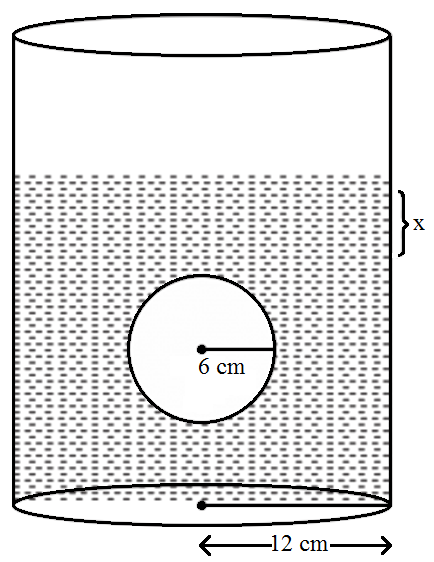
Therefore,
The volume of increase water level = volume of ball
$\pi\times(12)^2\times\text{x}=\frac{4}{3}\pi\times(6)^3$
$144\text{x}=\frac{4}{3}\times216$
$144\text{x}=4\times72$
$\text{x}=\frac{4\times72}{144}$
$\text{x}=2\text{cm}$
Hence, the level of water increased by $2\ cm$. View full question & answer→Question 903 Marks
A hemispherical depression is cut out from one face of a cubical wooden block of edge $21\ cm$, such that the diameter of the hemisphere is equal to the edge of the cube. Determine the volume and total surface area of the remaining block.
AnswerGiven edge of wooden block $(a) = 21\ cm$
Given diameter of hemisphere = edge of cube
Radius $=\frac{21}{2}=10.5\text{cm}$
Volume of remaining block = Volume of box - Volume of hemisphere
$=\text{a}^3-\frac{2}{3}\pi\text{r}^3$
$=(21)^3-\frac{2}{3}\pi(10.5)^3$
$=6835.5\text{cm}^3$
Surface area of box $= 6a^2$
Curved surface area of hemisphere $=\pi\text{r}^2$
So remaining surface area of box $= (1) - (2) + (3)$
$=6\text{a}^2-\pi\text{r}^2+2\pi\text{r}^2$
$=6(21)^2-\pi(10.5)+2\pi(10.5)^2$
$=2992.5\text{cm}^2$
$\therefore$ Remaining surface area of box $= 2992.5\ cm^2$
Volume of remaining block $= 6835.5\ cm^3$
View full question & answer→Question 913 Marks
Rain water, which falls on a flat rectangular surface of length $6\ m$ and breadth 4m is transferred into a cylindrical vessel of internal radius $20\ cm$. What will be the height of water in the cylindrical vessel if a rainfall of $1\ cm$ has fallen?
AnswerThe fallen rains are in the form of a cuboid of height $1\ cm$, length $6m = 600\ cm$ and breadth $4m = 400\ cm$. Therefore, the volume of the fallen rains is
$V = 600 \times 400 \times 1 = 240000\ cm^3$
The fallen rains are transferred into a cylindrical vessel of internal radius $r_1 = 20cm.$ Let, the height of the water in the cylindrical vessel is $h_1cm$.
Then, the volume of the water in the cylinder is
$\text{V}_1=\pi\text{r}^2_1\text{h}_1=\frac{22}{7}\times(20)^2\times\text{h}_1$
Since, the volume of the water in the cylinder is same as the volume of the rainfalls, we have
$V_{1 =}V$
$\Rightarrow\frac{22}{7}\times(20)^2\times\text{h}_1=240000$
$\Rightarrow\text{h}_1=\frac{240000\times7}{(20)^2\times22}$
$\Rightarrow190.9$
Therefore, the height of the water in the cylinder is $190.9\ cm.$
View full question & answer→Question 923 Marks
A petrol tank is a cylinder of base diameter $21\ cm$ and length $18\ cm$ fitted with conical ends each of axis length $9\ cm$. Determine the capacity of the tank.
AnswerDiameter of cylindrical part $= 21\ cm$
Radius $(r)$ $=\Big(\frac{21}{2}\Big)\text{cm}$
Height of cylindrical part $(h_1) = 18\ cm$
and height of each conical part $(h_2) = 9\ cm$
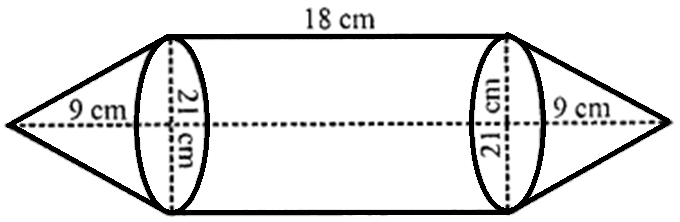
Total volume of the tank $=2\times\frac{1}{3}\pi\text{r}^2\text{h}_2+\pi\text{r}^2\text{h}_1$
$=\pi\text{r}^2\Big(\frac{2}{3}\text{h}_2+\text{h}_1\Big)$
$=\frac{22}{7}\Big(\frac{21}{2}\Big)^2\Big(\frac{2}{3}\times9+18\Big)\text{cm}^3$
$=\frac{22}{7}\times\frac{441}{4}(6+18)\text{cm}^3$
$=\frac{11\times63}{2}\times24\text{cm}^3=8316\text{cm}^3$ View full question & answer→Question 933 Marks
How many spherical bullets each of $5\ cm$ in diameter can be cast from a rectangular block of metal $11dm \times 1m \times 5dm$?
AnswerWe are given a metallic block of dimension $= 11dm \times 1m \times 5dm.$
We know that, $1dm = 10^{-1}m$
So, the volume of the given metallic block is $= 11 \times 10^{-1}\times 1 \times 5 \times 10^{-1} = 55 \times 10^{-2}m^3$
We want to know how many spherical bullets can be formed from this volume of the metallic block. It is given that the diameter of each bullet should be $5 cm$.
We know,
$\text{Volume of a sphere}=\frac{4}{3}\pi(\text{r})^3$
Here, $r = 25 \times 10^{-3}m$
Let the no. of bullets formed be n.
We know that the sum of the volumes of the bullets formed should be equal to the volume of the metallic block.
$\Rightarrow55\times10^{-2}=\text{n}\times\frac{4}{3}\times\frac{22}{7}\times(25\times10^{-3})^3$
$\text{n}=\frac{55\times3\times7\times10^{-2}}{4\times22\times25\times25\times25\times10^{-9}}$
$=\frac{21\times10^7}{(2\times5)^3\times25}$
$=8400$
Hence the no. of bullets that can be formed is $8400$.
View full question & answer→Question 943 Marks
A well of diameter 3m is dug 14m deep. The earth taken out of it is spread evenly all around it to a width of 4m to form an embankment. Find the height of the embankment.
AnswerWe have,
Radius of well $\text{r}=\frac{3}{2}\text{m}$
Depth of well = 14m
The volume of well
$=\pi\times\Big(\frac{3}{2}\Big)^2\times14$
$=\pi\times\frac{9}{4}\times14$
$=\frac{63}{2}\pi\ \text{cm}^3$
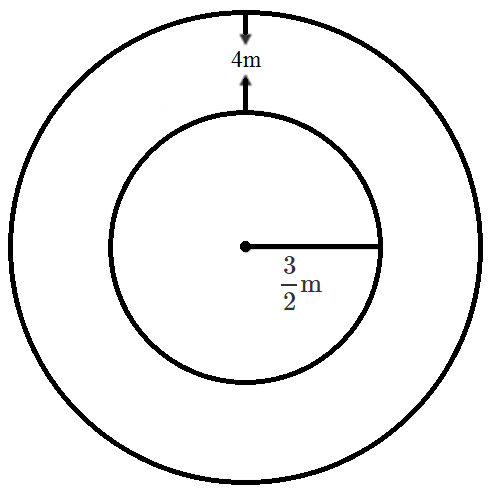
Therefore,
Volume of earth dugout = volume of well $=\frac{63}{2}\pi\ \text{m}^3$
Let h be the height of embankment.
Clearly, embankment form a cylindrical shell whose inner and outer radius are
$\frac{3}{2}\text{m}\ \text{and}\ \Big(\frac{3}{2}+4\Big)=\frac{11}{2}\text{m}$
Volume of embankment View full question & answer→Question 953 Marks
Prove that the surface area of a sphere is equal to the curved surface area of the circumscribed cylinder.
AnswerLet radius of a sphere be $r$
Curved surface area of sphere $=4\pi\text{r}^2$
$\text{S}_1=4\pi\text{r}^2$
let radius of cylinder be $'r'\ cm$
Height of cylinder be $'2r'\ cm$
Curved surface area of cylinder $=2\pi\text{r}\text{h}$
$\text{S}_2=2\pi\text{r}(2\text{r})=4\pi\text{r}$
$S_1$ and $S_2$ are equal. Hence proved.
So curved surface area of sphere = surface area of cylinder.
View full question & answer→Question 963 Marks
The sum of the radius of base and height of a solid right circular cylinder is $37\ cm$. If the total surface area of the solid cylinder is $1628\ cm^2$, find the volume of cylinder.$\Big(\text{use}\ \pi=\frac{22}{7}\Big)$
AnswerLet the radius of the base of the cylinder be $r\ cm$
Let the height be $h\ cm$
Now given that $r + h = 37\ cm$
Total surface area $= 1628\ cm^2 ...(1)$
Total surface area of the cylinder $=2\pi\text{r}^2+2\pi\text{rh}$
$=2\pi\text{r}(\text{r}+\text{h})$
$=2\pi\text{r}\times37$
$=74\pi\text{r}\ ...(2)$
From equating (1) and (2) we get
$74\pi\text{r}=1628$
$\Rightarrow\text{r}=\frac{1628}{74\pi}=7\text{cm}^3$
Thus, the height will be 37 - 7 = 30cm
Thus, the volume of the cylinder $=\pi\text{r}^2\text{h}=\pi(7)^2\times30=4620\text{cm}^3$
Hence the volume is $4620\ cm^3$
View full question & answer→Question 973 Marks
If $r_1$ and $r_2$ denote the radii of the circular bases of the frustum of a cone such that $r_1 > r_2$, then write the ratio of the height of the cone of which the frustum is a part to the height fo the frustum.
Answer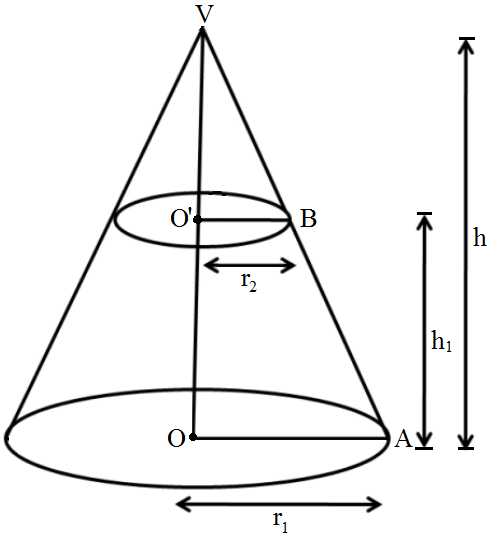
Since, $\triangle\text{VO'B}\sim\triangle\text{VOA}$
Therefore,
In $\triangle\text{VO'B}\sim\triangle\text{VOA}$
$\frac{\text{O'B}}{\text{OA}}=\frac{\text{O'V}}{\text{OV}}$
$\frac{\text{r}_2}{\text{r}_1}=\frac{\text{h}-\text{h}_1}{\text{h}}$
$\frac{\text{r}_2}{\text{r}_1}=1-\frac{\text{h}_1}{\text{h}}$
$\frac{\text{h}_1}{\text{h}}=1-\frac{\text{r}_2}{\text{r}_1}$
$\frac{\text{r}_1-\text{r}_2}{\text{r}_1}$
Hence,
The ratio of the height of cone of which the frustum is a part to the height fo the frustum.
$\frac{\text{OV}}{OO'}=\frac{\text{h}}{\text{h}_1}=\frac{\text{r}_1}{\text{r}_1-\text{r}_2}$
Hence, $h : h_1 = r_1 : (r_1 - r_2)$ View full question & answer→Question 983 Marks
A wall $24m, 0.4m$ thick and $6m$ high is constructed with the bricks each of dimensions $25cm \times 16cm \times 10cm$. If the mortar occupies $\Big(\frac{1}{10}\Big)$ of the volume of the wall, then find the number of bricks used in constructing the wall.
AnswerDimensions of the wall are $24m \times 0.4m \times 6m$
Volume of the wall $= 24m \times 0.4m \times 6m = 57.6m^3$
Dimensions of the bricks are $25m \times 16m \times 10m$
Volume of each brick $= 4000cm^3 = 0.004m^3$
Volume of mortor $=\frac{1}{10}\times$ Volume of the wall $=\frac{1}{10}\times57.6=5.76\text{m}^3$
Volume of all the bricks = Volume of the wall - volume of motor
$= 57.6 - 5.76m^3$
Let the number of bricks used in making the wall be n.
$\frac{\text{volume of all the bricks}}{\text{volume of each bricks}}=\text{n}$
$\Rightarrow\frac{51.84}{0.004}=\text{n}$
$\Rightarrow\text{n}=12960$
Hence, $12960$ bricks are used to make the wall.
View full question & answer→Question 993 Marks
A solid metallic sphere of radius 10.5cm is melted and recast into a number of smaller cones, each of radius 3.5cm and height 3cm. Find the number of cones so formed.
AnswerThe volume of the solid metallic sphere $=\frac{4}{3}\pi(10.5)^3\text{cm}^3$
Volume of a cone of radius 3.5cm and height 3cm $=\frac{1}{3}\pi(3.5)^2\times3\text{cm}^3$
Number of cones so formed.
The volume of the solid metallic sphere $=\frac{4}{3}\pi(10.5)^3\text{cm}^3$
Volume of a cone of radius 3.5cm and hieght.
$3\text{cm}=\frac{1}{3}\pi(3.5)^2\times3\text{cm}^3$
Number of cones so formed
$\frac{\frac{4}{3}\pi\times10.5\times10.5\times10.5}{\frac{1}{3}\pi\times3.5\times3.5\times3}=126$
View full question & answer→Question 1003 Marks
The largest sphere is carved out of a cube of side 10.5cm. Find the volume of the sphere.
Answer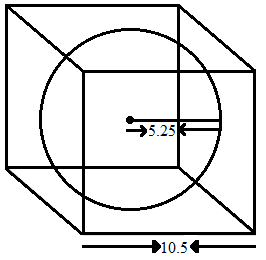
The side of cube a = 0.5cm.
Since, a largest sphere is curved out of that cube i.e., radius of sphere,
$\text{r}=\frac{\text{a}}{2}$
$\text{r}=\frac{10.5}{2}\text{cm}$
$\text{r}=5.25\text{cm}$
The volume of sphere
$=\frac{4}{3}\pi(5.25)^3$
$=\frac{4}{3}\times\frac{22}{7}\times5.25\times5.25\times5.25$
$=22\times0.75\times1.75\times21$
$=606.375\text{cm}^3$ View full question & answer→Question 1013 Marks
A cylindrical tub of radius $12\ cm$ contains water to a depth of 20cm. A spherical from ball of radius $9\ cm$ is dropped into the tub and thus the level of water is raised by h cm. What is the value of h?
AnswerGiven that radius of cylindrical tube $(r_1) = 12cm$
Let height of cylinder tube $(h)$
Volume of a cylinder $=\pi\text{r}^2_1\text{h}$
$\text{v}_1=\pi(12)^2\times\text{h}\ ...(1)$
Given spherical ball radius $(r_2) = 9cm$
volume of sphere $=\frac{4}{3}\pi\text{r}^3_2$
$\text{v}_2=\frac{4}{3}\times\pi\times9^3$
$\text{h}=\frac{\frac{4}{3}\times\pi\times9^3}{\pi(12)^2}$
$\text{h}=6.75\text{cm}$
Level of water raised in tube $(h) = 6.75\ cm$
View full question & answer→Question 1023 Marks
A cylindrical vessel having diameter equal to its height is full of water which is poured into two identical cylindrical vessels with diameter 42cm and height 21cm which are filled completely. Find the diameter of the cylindrical vessel.
AnswerDiameter of each small cylindrical vessels = 42cm
$\therefore$ Radius of each vessel (r) $=\frac{42}{2}=21\text{cm}$
Height (h) = 21cm
$\therefore$ Volume of each cylindrical vessal $=\pi\text{r}^2\text{h}=\pi(21)^2(21)=9261\pi\text{cm}^3$
and volume of both vessels $=2\times9261\pi=18522\pi\text{cm}^3$
Now volume of larger cylindrical vessel $=18522\pi\text{cm}^3$
Let R be the radius of the vessel, then Height (H) = diameter = 2R,
$\therefore\text{volume}\pi\text{R}^2\times2\text{R}=2\pi\text{R}^2$
$\therefore\text{volume}\pi\text{R}^2\times2\text{R}=2\pi\text{R}^2$
$\therefore2\pi\text{R}^3=18522\pi$
$\Rightarrow\text{R}^3=\frac{18522}{2}=9261$
$\Rightarrow\text{R}^3=9261=(21)^3$
$\therefore\text{R}=21$
$\therefore$ Diameter = 2R = 2 × 21 = 42cm
View full question & answer→Question 1033 Marks
The radii of two cones are in the ratio $2 : 1$ and their volumes are equal. What is the ratio of their heights?
AnswerLet the radius of the first cone $= 2x$
And height of the first cone $= h_1$
Then,
Volume of the first cone $=\frac{1}{3}\pi\text{r}^2\text{h}$
$=\frac{1}{3}\pi(2\text{x})^2\text{h}_1$
The radius of the second cone $= x$
Height of the second cone $= h_2$
Then,Volume of the secound cone $=\frac{1}{3}\pi\text{r}^2\text{h}$
$=\frac{1}{3}\pi(\text{x})^2\text{h}_2$
Since,
The volumes of the two cones are equal.
$h_1 : h_2 = 1 : 4$
View full question & answer→Question 1043 Marks
What is the ratio of the volume of a cube to that of a sphere which will fit inside it?
AnswerRatio of sphere
$=\frac{1}{2}\times\text{side of cube}$
$\text{r}=\frac{\text{a}}{2}$
Now,
Volume of cube $V_1 = A^3$
Volume of sphere
$\text{v}_2=\frac{4}{3}\pi\text{r}^3$
$=\frac{4}{3}\pi\Big(\frac{\text{a}}{2}\Big)^3$
$=\frac{4}{3}\pi\frac{\text{a}^3}{8}$
$\text{v}_2=\frac{1}{6}\pi\text{a}^3$
The ratio of their volumes
$\text{v}_1:\text{v}_2=\text{a}^3:\frac{1}{6}\pi\text{a}^3$
$\frac{\text{v}_1}{\text{v}_2}=\frac{\text{a}^3}{\frac{1}{6}\pi\text{a}^3}$
$=\frac{6}{\pi}$
Hence, $\text{v}_1:\text{v}_2=6:\pi$
View full question & answer→Question 1053 Marks
A hollow sphere of internal and external diameters $4$ and $8\ cm$ respectively is melted into a cone of base diameter $8\ cm$. Find the height of the cone.
AnswerOuter diameter of a hollow sphere $= 8cm$
$\therefore$ Outer radius (R) $=\Big(\frac{8}{2}\Big)=4\text{cm}$
and inner diameter
$\therefore$ Inner radius (r) $=\Big(\frac{4}{2}\Big)=2\text{cm}$
Now volume of metal used $=\frac{4}{3}\pi(\text{R}^3-\text{r}^3)$
$=\frac{4}{3}\pi[4^3-2^3]=\frac{4}{3}\pi(64-8)\text{cm}^3$
$=\frac{4}{3}\pi\times56=\frac{224}{3}\pi\ \text{cm}^3$
Now volume of cone $=\frac{224}{3}\pi\ \text{cm}^3$
Diameter of cone $= 8cm$
$\therefore$ Radius $(r_1)$ $=\frac{8}{2}=4\text{cm}$
$\therefore$ Volume $=\frac{1}{3}\pi\text{r}_1^2\text{h}$
$\therefore$ $=\frac{1}{3}\pi\text{r}_1^2\text{h}=\frac{224}{3}\pi$
$\Rightarrow\frac{1}{3}\pi(4)^2\text{h}=\frac{224}{3}\pi\Rightarrow\frac{1}{3}\pi\times16\text{h}=\frac{224}{3}\pi$
$\Rightarrow\text{h}=\frac{224\pi\times3}{3\times\pi\times16}=14$
Hence height of the cone $= 14cm$
View full question & answer→Question 1063 Marks
The largest sphere is to be curved out of a right circular cylinder of radius $7\ cm$ and height $14\ cm$. Find the volume of the sphere.
AnswerGiven radius of cylinder $(r) = 7\ cm$
Height of cylinder $(h) = 14\ cm$
Largest sphere is curved out from cylinder
Thus diameter of sphere = diameter of cylinder
Diameter of sphere $(d) = 2 \times 7 = 14\ cm$
Volume of a sphere $=\frac{4}{3}\pi\text{r}^3$
$=\frac{4}{3}\times\pi(7)^3$
$=\frac{1372\pi}{3}$
$= 1436.75\ cm^3$
$\therefore$ Volume of sphere $= 1436.75cm^3$
View full question & answer→Question 1073 Marks
A golf ball has diameter equal to 4.2cm. Its surface has 200 dimples each of radius 2mm. Calculate the total surface area which is exposed to the surroundings assuming that the dimples are hemispherical.
AnswerDiameter of the golf ball = 4.2cm
$\therefore$ Redius (R) $=\frac{4.2}{2}=2.1\text{cm}$
Radius of each hemispherical dimples (r) = 2mm $=\frac{2}{10}=\frac{1}{5}\text{cm}$
Curved surface area of one dimple $=2\pi\text{r}^2$
$=2\pi\times\Big(\frac{1}{5}\Big)^2\text{cm}^2$
$=2\pi\times\frac{1}{25}=\frac{2}{25}\pi\text{cm}^2$
$\therefore$ Surface area of 200 dimples
$=200\times\frac{2}{25}\pi\text{ cm}^2$
$=16\pi\text{ cm}^2=\frac{16\times22}{7}=\frac{352}{7}\text{cm}^2$
$=50.28\text{cm}^2$
Surface Area of the spherical ball $=4\pi\text{r}^2$
$=4\times\frac{22}{7}\times(2.1)^2\text{cm}^2$
$\therefore$ Total surface area of the golf ball (exposed) = surface area of the ball + surface area of 200 dimples - area of 200 circles
$=55.44+50.28-200\pi\text{r}^2$
$=105.72-200\times\frac{22}{7}\times\Big(\frac{1}{5}\Big)^2$
$105.72-\frac{4400}{7}\times\frac{1}{25}$
$105.72-\frac{176}{7}=\frac{105.72\times7-176}{7}$
$=80.57\text{cm}^2$
View full question & answer→Question 1083 Marks
Water flows at the rate of $15km/hr$ through a pipe of diameter $14\ cm$ into a cuboidal pond which is $50\ m$ long and $44\ m$ wide. In what time will the level of water in the pond rise by $21\ cm$?
AnswerGiven, length of the pond $= 50m$ and width of the pond $= 44m$
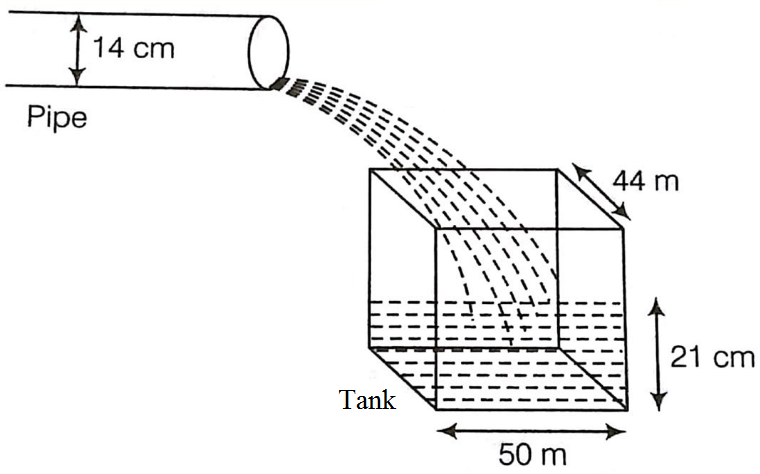
Depth required of water $21 cm=\frac{21}{100} m$
Volume of water in the pond
$=\left(50 \times 44 \times \frac{21}{100}\right)^3=462 m^3$
Also, given radius of the pipe $=7 cm=\frac{7}{100} m$
and speed of water flowing through the pipe $=(15 \times 1000)=15000 mh ^{-1}$
Now, volume of water flows in $1 h=\pi r ^2 h$
$=\left(\frac{22}{7} \times \frac{7}{100} \times \frac{7}{100} \times 15000\right)=231 m^3$
Since, $231 m^3$ of water fals in the pond in 1 h .
So, $1 m^3$ waterfalls in the pond in $\frac{1}{231} h$.
Also, $462 m^3$ of water falls in the pond in $\left(\frac{1}{231} \times 462\right) h =2 h$
Hence, the required times is 2 h . View full question & answer→Question 1093 Marks
Find the weight of a hollow sphere of metal having internal and external diameters as $20\ cm$ and $22\ cm$, respectively if $1\ m^3$ of metal weighs $21\ g$.
AnswerInternal diameter of a hollow sphere $= 20\ cm$
and external diameter $= 22\ cm$
$\therefore$ Outer radius (R) $=\Big(\frac{22}{2}\Big)=11\text{cm}$
and inner radius $=\Big(\frac{20}{2}\Big)=10\text{cm}$

$\therefore$ volume $=\frac{4}{3}\pi\text{R}^3=\frac{4}{3}\pi\text{r}^3$
$=\frac{4}{3}\times\pi(\text{R}^3-\text{r}^3)\text{cm}^3$
$=\frac{4}{3}\times\frac{22}{7}[11^3-10^3]\text{cm}^3$
$=\frac{88}{21}[1331=1000]\text{cm}^3$
$=\frac{88}{21}\times331\text{cm}^3$
$=\frac{29128}{21}\text{cm}^3$
Weight of $10cm^3 = 21g$
$\therefore$ Total weight $=\frac{29128}{21}\times21\text{g}$
$= 29128g$
$= 29.128kg$
$= 29.13kg$ View full question & answer→Question 1103 Marks
The interior of a building is in the form of a cylinder of base radius 12m and height 3.5m, surmounted by a cone of equal base and slant height 12.5m. Find the internal curved surface area and the capacity of the building.
AnswerHeight of the cone $=\sqrt{(12.5)^2-(12)^2}$ $=\sqrt{12.25}$ $=3.5\text{m}$ 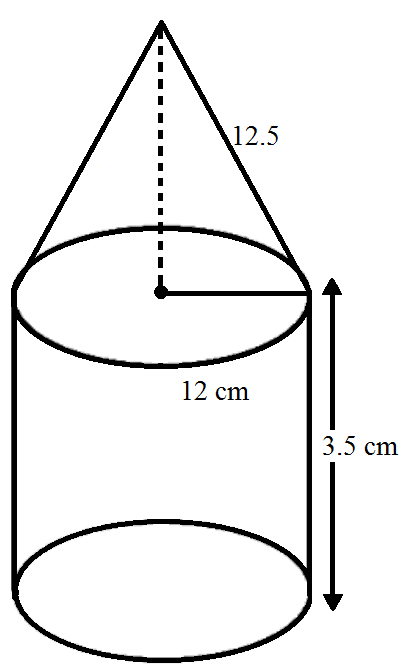 Capacity (volume) of cone $=\frac{1}{3}\pi\text{r}^2\text{h}$ $=\frac{1}{3}\times\frac{22}{7}\times12\times3.5$ $=528\text{m}^3$ Capacity (volume) of cylinder $=\pi\text{r}^2\text{h}$ $=\frac{1}{3}\times12\times12\times3.5$ $=1584\text{m}^3$ Therefore, Total capacity of building$= 1584+528$
$= 2112\text{m}^3$ Internal curved surface area of the building $=2\pi\text{rh}+\pi\text{rl}$ $=\pi\text{r}(2\text{h}+\text{l})$ $=\frac{22}{7}\times12(2\times3.5+12.5)$ $=\frac{22}{7}\times12\times19.5$ $=735.43\text{m}^3$ View full question & answer→Question 1113 Marks
A tent of height $8.25m$ is in the form of a right circular cylinder with diameter of base $30m$ and height $5.5m$, surmounted by a right circular cone of the same base. Find the cost of the canvas of the tent at the rate of $₹\ 45\ per\ m^2.$
Answer$\text{l}=\sqrt{(2.75)^2}+(15)^2$ $\text{l}=\sqrt{232.5625}$ $\text{l}=15.25$
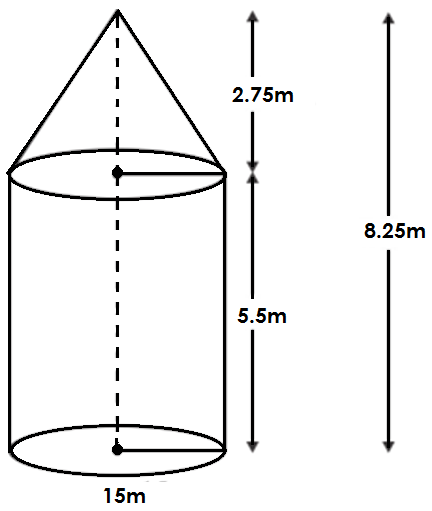
Total surface area of the tent $=2\pi\text{rh}+\pi\text{rl}$ $=\pi\text{r}(2\text{h}+\text{l})$
$=\frac{22}{7}\times15\big[2\times5.5+15.25\big]$
$=\frac{330\times26.25}{7}$ $=1237.5$
Therefore, Cost of the canvas of the tent $=1237.5\times45$ $=\text{Rs}.55687.50$ View full question & answer→Question 1123 Marks
A cylindrical jar of radius $6\ cm$ contains oil. Iron spheres each of radius $1.5\ cm$ are immersed in the oil. How many spheres are necessary to raise the level of the oil by two centimetres?
AnswerRadius of cylinderical jar $(r) = 6cm$
Height or raise of the level of oil $= 2cm$
$\therefore$ Volume of oil in the jar $=\pi\text{r}^2\text{h}$
$=\frac{22}{7}\times(6)^2\times2\text{cm}^2$
$=\frac{36\times44}{7}\ \text{cm}^3$
Radius of iron sphere $(r_1) = 1.5\ cm$
$\therefore$ Volume of one sphere $=\frac{4}{3}\pi\text{r}^3_1$
$=\frac{4}{3}\times\frac{22}{7}\times(1.5)^3\text{cm}^3$
$=\frac{88}{21}\times\Big(\frac{3}{2}\Big)^3\text{cm}^3$
$=\frac{88}{21}\times\frac{27}{8}=\frac{99}{7}\text{cm}^3$
Number of spheres $\frac{36\times44}{7}\div\frac{99}{7}=\frac{36\times44}{7}\times\frac{7}{99}=16$
View full question & answer→Question 1133 Marks
How many balls, each of radius $1\ cm$, can be made from a solid sphere of lead of radius $8\ cm$?
AnswerGiven that a solid sphere f radius $(r_1) = 8\ cm$ With this sphere we have to make spherical balls of radius $(r_2) = 1\ cm.$
Since, we don’t know no of balls let us assume that no of balls formed be $‘n’$
We know that,
$\text{volume of sphere}=\frac{4}{3}\pi\text{r}^2$
Volume of solid sphere should be equal to sum of volumes of n spherical balls.
$\text{n}\times\frac{4}{3}\pi(1)^3=\frac{4}{3}\pi\text{r}^2$
$\text{n}=\frac{\frac{4}{3}\pi(8)^3}{\frac{4}{3}\pi(1)^3}$
$\text{n}=8^3$
$n = 512$
$\therefore$ Hence $512$ no of balls can be made of $1\ cm$ from a solid sphere of radius $8\ cm$.
View full question & answer→Question 1143 Marks
A solid is in the shape of a cone surmounted on a hemisphere, the radius of each of them is being 3.5cm and the total height of solid is 9.5cm. Find the volume of the solid.$\Big(\text{use}\ \pi=\frac{22}{7}\Big)$
Answer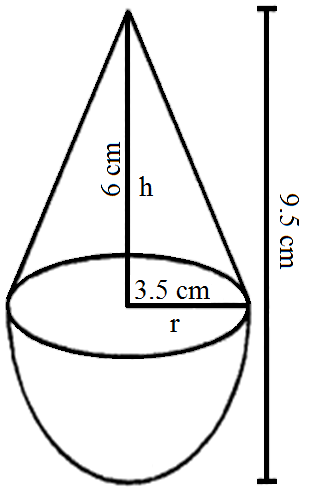
Radius of the base of conical part = 3.5cm
and total height = 9.5cm
$\therefore$ Height of conical part = 9.5 - 3.5 = 6cm
$\therefore$ Volume of conical part + Volume of hemispherical part
$=\frac{1}{3}\pi\text{r}^2\text{h}+\frac{2}{3}\pi\text{r}^3$
$=\frac{1}{3}\pi\text{r}^2(\text{h}+2\text{r})$
$=\frac{1}{3}\times\frac{22}{7}\times(3.5)^2[6+2\times3.5]$
$=\frac{22}{21}\times3.5\times3.5\times13\text{cm}^3$
$=166.83\text{cm}^3$ View full question & answer→Question 1153 Marks
A solid sphere of radius $'r'$ is melted and recast into a hollow cylinder of uniform thickness. If the external radius of the base of the cylinder is $4cm$, its height $24cm$ and thickness $2cm$, find the value of $'r'.$
AnswerVolume of sphere $=\frac{4}{3}\pi\text{R}^3...(1)$
Since,
The sphere is recast in to a hollow cylinder of uniform thickness $2cm$.
The external radius of hollow cylinder $r_1 = 4cm$
The internal radius of hollow cylinder $r_2^= 4 − 2 = 2cm$
and height, $h = 24cm$
Clearly,
The volume of hollow cylinder = volume of sphere
$\pi(\text{r}_1^2-\text{r}_2^2)\times\text{h}=\frac{4}{3}\pi\text{r}^3$
$(4^2-2^2)\times24=\frac{4}{3}\text{r}^3$
$12\times24=\frac{4}{3}\text{r}^3$
$\text{r}^3=\frac{12\times24\times3}{4}$
$\text{r}^3=\sqrt{12\times6\times3}$
$\sqrt[3]{3\times2\times2\times2\times3\times3}$
$\text{r}=6\text{cm}$
View full question & answer→Question 1163 Marks
A hollow sphere of internal and external diameters 4cm and 8cm respectively is melted into a cone of base diameter 8cm. Calculate the height of the cone.
AnswerGiven internal diamerter of hollow sphere (r) = 4cm
External diameter (R) = 8cm
$\text{Volume of hollow sphere}=\frac{4}{3}\pi(\text{R}^3-\text{r}^3)$
$\frac{4}{3}\pi(\text{4}^3-2^3)$
$\frac{4}{3}\pi(64-8)$
$\frac{4}{3}\pi\times56$
Given diameter of cone = 8cm
Radius of cone = 4cm
Let hieght of cone be h.
$\text{Volume of cone}=\frac{1}{3}\pi\text{r}^2\text{h}$
$=\frac{1}{3}\pi({4})^2\text{h}$
Since hollow sphere is melted into a cone so there volume are equal (1) = (2)
$\Rightarrow\frac{4}{3}\pi\times56=\frac{1}{3}\pi(4)^2\text{h}$
$\Rightarrow4\times56=4^2\times\text{h}$
$\Rightarrow\text{h}=\frac{56}{4}$
$\Rightarrow\text{h}=14\text{cm}$
$\therefore\text{Hieght of a cone}=14\text{cm}$
View full question & answer→Question 1173 Marks
A vessel in the shape of a cuboid contains some water. If three identical spheres immersed in the water, the level of water is increased by $2\ cm$.
If the area of the base of the cuboid is $160\ cm^2$ and its height $12\ cm$, determine the radius of any of the spheres.
AnswerArea of the base of a cuboide $= 160\ cm^2$
Height $(h) = 12\ cm$
Level of water increased by outting $3$ sphere into $it = 2\ cm$
$\therefore$ Volume of water = area of base $\times $ height $= 160 \times 2 = 320\ cm^2$
$\therefore$ Volume of $3$ sphere $= 320\ cm^2$
Volume of one sphere $=\frac{320}{3}\text{cm}^3$
Let r be the radius of the sphere, then
$\frac{4}{3}\pi\text{r}^3=\frac{320}{3}\Rightarrow\frac{4}{3}\times\frac{22}{7}\times\text{r}^3=\frac{320}{3}$
$\Rightarrow\text{r}^3=\frac{320\times3\times7}{3\times4\times22}=\frac{280}{11}=25.45$
$\therefore\text{r}=3\sqrt{25.45}=2.94\text{cm}$
$\therefore$ Radius of each sphere $= 2.94\ cm$
View full question & answer→Question 1183 Marks
The inner and outer radii of a hollow cylinder are $15\ cm$ and $20\cm$, respectively. The cylinder is melted and recast into a solid cylinder of the same height.
Find the radius of the base of new cylinder.
AnswerInner radius of hollow cylinder $r_1 = 15\ cm$
Outer radius of hollow cylinder $r_2 = 20\ cm$
The volume of hollow cylinder $=\pi(\text{r}_2^2-\text{r}_1^2)\text{h}$
Since,
The hollow cylinder is melted and recast into a solid cylinder of same height.
Let r be the radius of solid cylinder.
Therefore,
The volume of solid cylinder = volume of hollow cylinder.
$\pi\text{r}^2\text{h}=\pi(\text{r}_2^2-\text{r}_1^2)\text{h}$
$r^2 = (20^2 - 15^2)$
$r^2 = 35 \times 5$
$r = 13.2cm$
Hence, the radius of solid cylinder is $13.2\ cm$.
View full question & answer→Question 1193 Marks
Water is flowing at the rate of 2.52km/h through a cylindrical pipe into a cylindrical tank, the radius of the base is 40cm. If the increase in the level of water in the tank, in half an hour is 3.15m, find the internal diameter of the pipe.
AnswerIncrease in the level of water in half an hour, h = 3.15m = 315cm
Radius of the water tank, r = 40cm
Volume of water that falls in the tank in half an hour $=\pi\text{r}^2\text{h}$
$\pi\times(40)^2\times315$
$=5,04,000\pi\text{cm}^3$
Rate of flow of water = 2.52km/h
Length of water column in half an hour = 2.52 ÷ 2 = 1.26km = 1,26,000cm
Let the internal diameter of the cylindrical pipe be d.
Volume of the water that flows through the pipe in half an hour$=\pi\Big(\frac{\text{d}}{2}\Big)^2\times126000$
We know
Volume of the water that flows through the pipe in half an hour = Volume of water that falls in the tank in half an hour
$\Rightarrow\pi\Big(\frac{\text{d}}{2}\Big)^2\times126000=504000\pi$
$\Rightarrow\Big(\frac{\text{d}}{2}\Big)^2=4$
$\Rightarrow\text{d}=4\text{cm}$
Thus, the internal diameter of the pipe is 4cm.
View full question & answer→Question 1203 Marks
A copper rod of diameter $1\ cm$ and length 8cm is drawn into a wire of length 18m of uniform thickness. Find the thickness of the wire.
AnswerThe radius of the copper rod is $0.5\ cm$ and length is $8\ cm$. Therefore, the volume of the copper rod is $\text{V}_1=\pi\times(0.5)^2\times8\text{cm}^3$
Let the radius of the wire is $r\ cm$. The length of the wire is 18m=1800cm. Therefore, the volume of the wire is $\text{V}_1=\pi\times(\text{r}^2)\times1800\text{cm}^3$
Since, the volume of the copper rod is equal to the volume of the wire; we have
$V_1 = V$
$\Rightarrow\pi\text{r}^2\times1800=\pi\times(0.5)^2\times8$
$\Rightarrow\text{r}^2=\frac{0.25\times8}{1800}=\frac{1}{900}$
$\Rightarrow\text{r}=\frac{1}{30}=0.033\text{cm}$
Hence, the radius of the wire is 0.033cm = 0.33mm. so, thickness $= 0.33 \times 2 = 0.66mm$
View full question & answer→Question 1213 Marks
A bucket open at the top, and made up of a metal sheet is in the form of a frustum of a cone. The depth of the bucket is $24\ cm$ and the diameters of its upper and lower circular ends are $30\ cm$ and $10\ cm$ respectively. Find the cost of metal sheet used in it at the rate of $Rs. 10\ per\ 100cm^2$. $(\text{use}\ \pi=3.14)$
AnswerThe slant height of the bucket is given by
$\text{l}=\sqrt{\text{h}^2+(\text{R}-\text{r})^2}$
$=\sqrt{(24)^2+(15-5)^2}$
$=\sqrt{576+100}$
$=\sqrt{676}$
$=26\text{cm}$
Surface area of bucket
= curved surface area of bucket + Area of the smaller circular base
$=\pi\text{l}(\text{R}+\text{r})+\pi\text{r}^2$
$= 3.14 \times 26 \times (15 + 5) + 3.14 \times 5 \times 5$
$= 1632.8 + 78.5$
$= 1711.3cm^2$
Cost of metal sheet used $=\frac{10}{100}\times1711.3=\text{Rs}.\ 171.13$
View full question & answer→Question 1223 Marks
The largest sphere is to be curved out of a right circular cylinder of radius $7\ cm$ and height $14\ cm$. Find the volume of the sphere.
AnswerGiven radius of cylinder $(r) = 7\ cm$
Height of cylinder$ (h) = 14\ cm$
Largest sphere is curved out from cylinder
Thus diameter of sphere = diameter of cylinder
Diameter of sphere $(d) = 2 \times 7 = 14\ cm$
Volume of a sphere $=\frac{4}{3}\pi\text{r}^3$
$=\frac{4}{3}\times\pi(7)^3$
$=\frac{1372\pi}{3}$
$= 1436.75\ cm^3$
$\therefore$ Volume of sphere $= 1436.75\ cm^3$
View full question & answer→Question 1233 Marks
A cubic cm of gold is drawn into a wire 0.1mm in diameter, find the length of the wire.
AnswerVolume of solid gold = 1cm³
Diameter of cylinderical wire = 0.1mm
$=\frac{1}{10}\text{mm}=\frac{1}{100}\text{cm}$
$\therefore$ Radius (r) $=\frac{1}{100\times2}=\frac{1}{200}\text{cm}$
Let length of wire = h
$\therefore\pi\text{r}^2\text{h}=1\Rightarrow\frac{22}{7}\times\Big(\frac{1}{200}\Big)^2\times\text{h}=1$
$\text{h}=\frac{7\times200\times200}{22}=\frac{140000}{11}\text{cm}$
$=\frac{140000}{11\times100}=\frac{1400}{11}\text{m}=127.3\text{m}$
View full question & answer→Question 1243 Marks
A conical flask is full of water. The flask has base-radius r and height h. The water is poured into a cylindrical flask of base-radius mr. Find the height of water in the cylindrical flask.
AnswerGiven base radius of conical flask be r.
Hieght of conical flask is h.
$\text{Volume of cone}=\frac{1}{3}\pi\text{r}^2\text{h}$
So its volume $=\frac{1}{3}\pi\text{r}^2\text{h}\ ...(1)$
Given base radius of cylindrical flask is ms.
Let height of flask be $h_1$
$\text{volume of cylinder}=\pi\text{r}^2\text{h}_1$
So its Volume $=\frac{22}{7}(\text{mr})^2\text{h}_1\ ...(2)$
Since water in contical flask is poured in cylinderical flask their volumes are same.
Equation (1) and (2) are Equal
$\Rightarrow\frac{1}{3}\pi\text{r}^2\text{h}=\pi(\text{mr})^2\times\text{h}_1$
$\Rightarrow\text{h}_1=\frac{\text{h}}{3\text{m}^2}$
View full question & answer→Question 1253 Marks
A sphere and a cube have equal surface areas. What is the ratio of the volume of the sphere to that of the cube?
AnswerLet r and x be the side of square and cube respectively.
It is given that,
Surface area of sphere = Surface area of cube.
$4\pi\text{r}^2=6\text{x}^2$
$\Rightarrow\frac{\text{r}^2}{\text{x}^2}=\frac{6}{4\pi}=\frac{3}{2\pi}$
$\Rightarrow\frac{\text{r}}{\text{x}}=\Big(\frac{6}{4\pi}\Big)^\frac{1}{2}$
$\frac{\text{volume of sphere}}{\text{volume of cube}}=\frac{\frac{4}{3}\pi\text{r}^3}{\text{x}^3}$
$\Rightarrow\frac{\text{V}_1}{\text{V}_2}=\frac{4\pi\text{r}^3}{3\text{x}^3}$
$\Rightarrow\frac{\text{V}_1}{\text{V}_2}=\frac{4\pi}{3}\times\Big(\frac{\text{r}}{\text{x}}\Big)\times\Big(\frac{\text{r}}{\text{x}}\Big)^2$
$\Rightarrow\frac{\text{V}_1}{\text{V}_2}=\frac{4}{3}\pi\times\Big(\frac{3}{2\pi}\Big)^\frac{1}{2}\times\frac{3}{2\pi}$
$\Rightarrow\frac{\text{V}_1}{\text{V}_2}=\sqrt{\frac{6}{\pi}}$
Hence, the required ratio are $\sqrt{6}:\sqrt{\pi}$
View full question & answer→Question 1263 Marks
A metallic sphere of radius 10.5cm is melted and thus recast into small cones, each of radius 3.5cm and height 3cm. Find how many cones are obtained.
AnswerRadius of sphere (R) = 10.5cm
$\therefore$ Volume of sphere $=\Big(\frac{4}{3}\Big)\pi\text{R}^3$
$=\frac{4}{3}\pi\times(10.5)^3\text{cm}^3=\frac{4}{3}\pi\times\Big(\frac{21}{2}\Big)^3\text{cm}^3$
$=\frac{4}{3}\pi\times\frac{21}{2}\times\frac{21}{2}\times\frac{21}{2}=\frac{3087}{2}\pi\ \text{cm}^3$
Now radius of small cone (r) $=3.5\text{cm}=\frac{7}{2}\text{cm}$
and height (h) = 3cm
Volume of one cone $=\frac{1}{3}\pi\times\frac{7}{2}\times\frac{7}{2}\times3\text{cm}^3$
$=\frac{49\pi}{4}\text{cm}^3$
$\therefore$ No. of cones formed $=\frac{3087\pi}{2}\times\frac{4}{49\pi}$
$=63\times2=126$
View full question & answer→Question 1273 Marks
A solid consisting of a right circular cone of height 120cm and radius 60cm standing on a hemisphere of radius 60cm is placed upright in a right circular cylinder full of water such that it touches the bottoms. Find the volume of water left in the cylinder, if the radius of the cylinder is 60cm and its height is 180cm.
AnswerWe have to find the remaining volume of water left in the cylinder when the solid is inserted into it. The solid is a hemisphere surmounted by a cone.
Radius of cone, cylinder and hemisphere (r) = 60cm
Height of cone (l) = 120cm
Height of the cylinder (h) = 180cm
So the remaining volume of water left in the cylinder when the solid is inserted into it,
$=\pi\text{r}^2\text{h}-\Big(\frac{1}{3}\pi\text{r}^2\text{l}+\frac{2}{3}\pi\text{r}^3\Big)$
$=\pi\text{r}^2\Big(\text{h}-\frac{1}{3}\text{l}-\frac{2}{3}\text{r}\Big)$
Put the values to get,
$=\Big(\frac{22}{7}\Big)(3600)(180-40-40)\text{m}^3$
$=1.131\text{m}^3$
View full question & answer→Question 1283 Marks
The surface area of a sphere is the same as the curved surface area of a cone having the radius of the base as 120cm and height 160cm. Find the radius of the sphere.
AnswerLateral height of cone
$\text{l}=\sqrt{(120)^2+(160)^2}$
$=\sqrt{14400+25600}$
$=\sqrt{40000}$
$=200$
Surface area of sphere = surface area of cone
$4\pi\text{r}_1^2=\pi\text{rl}$
$\text{r}_1^2=\frac{\text{rl}}{4}$
$\text{r}_1^2=\frac{120\times200}{4}$
$\text{r}_1^2=6000$
Radius of sphere
$\text{r}_1=\sqrt{6000}$
$=77.46\text{cm}$
View full question & answer→Question 1293 Marks
A hemispherical tank full of water is emptied by a pipe at the rate of $\frac{25}{7}$ litres per second. How much time will it take to half-empty the tank, if the tank is 3 metres in diameter?
AnswerDiameter of the hemispherical tank = 3m
$\therefore$ Radius (r) $=\frac{3}{2}\text{m}$
and volume of water in it $=\frac{2}{3}\pi\text{r}^3$
$=\frac{2}{3}\times\frac{22}{7}\times\Big(\frac{3}{2}\Big)^3\text{cm}^3$
$=\frac{2}{3}\times\frac{22}{7}\times\frac{27}{8}=\frac{99}{14}\text{m}^3$
$\therefore$ Volume of half full tank $=\frac{99}{14\times2}=\frac{99}{28}\text{m}^3$
$\therefore$ capacity of water $=\frac{99}{8}\times1000\text{l}$
$=\frac{99000}{28}\ \text{liters}$
Rate of water flow out $=\frac{25}{7}\ \text{l per secound}$
$\therefore$ Time taken $=\frac{99000}{28}\times\frac{7}{25}=990\ \text{secounds}$
$=\frac{990}{60}=16.5\ \text{minutes}$
View full question & answer→Question 1303 Marks
Two cubes have their volumes in the ratio $1 : 27$. What is the ratio of their surface areas?
AnswerLet $x_1$ and $x_2$ be the side of two cubes
It is given that ratio of their volumes are $1 : 27$.
The ratio of their volumes
$\Rightarrow\frac{\text{V}_1}{\text{V}_2}=\frac{1}{27}$
$\Rightarrow\frac{\text{x}_1^3}{\text{x}_2^3}=\frac{1}{27}$
$\Rightarrow\frac{\text{x}_1}{\text{x}_2}=\frac{1}{3}$
The ratio of their surface area
$\text{S}_1:\text{S}_2=6\text{x}_1^2:6\text{x}_2^2$
$\Rightarrow\frac{\text{S}_1}{\text{S}_2}=\frac{6\text{x}_1^2}{6\text{x}_2^2}$
$\Rightarrow\frac{\text{S}_1}{\text{S}_2}=\Big(\frac{1}{3}\Big)^2$
$\Rightarrow\frac{\text{S}_1}{\text{S}_2}=\frac{1}{9}$
Hence, the required ratio are $1 : 9$
View full question & answer→Question 1313 Marks
A cone, a hemisphere and a cylinder stand on equal bases and have the same height. Show that their volumes are in the ratio 1 : 2 : 3.
AnswerLet r be the radius of the base.
and h be the height.
Here, h = r.
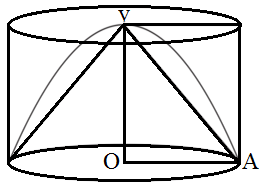
Now,
The ratio of their volumes will be
Volume of cone : volume of hemisphere : volume of a cylinder
$\frac{1}{3}\pi\text{r}^2\text{h}:\frac{2}{3}\pi\text{r}^3:\pi\text{r}^2\text{h}$
$\text{V}_1:\text{V}_2:\text{V}_3=\frac{1}{3}\pi\text{r}^3:\frac{2}{3}\pi\text{r}^3:\pi\text{r}^3$
Hence, $\text{V}_1:\text{V}_2:\text{V}_3=1:2:3$ View full question & answer→Question 1323 Marks
A solid cylinder of diameter 12cm and height 15cm is melted and recast into toys with the shape of a right circular cone mounted on a hemisphere of radius 3cm.If the height of the toy is 12cm, find the number of toys so formed.
AnswerDiameter of cylinder = 12cm
Therefore
r = 6cm
Height = 15cm
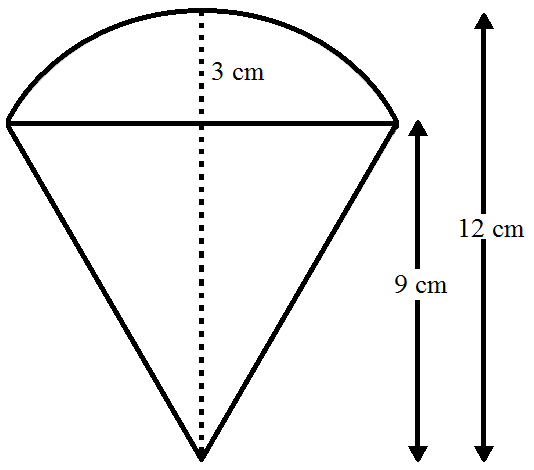
Therefore,
Volume of cylinder
$=\pi\text{r}^2\text{h}$
$=36\times15\times\pi\ \text{cm}^3$
Therefore,
Volume of toy = Volume of cone + Volume of hemisphere
$=\frac{1}{3}\pi\text{r}^2\text{h}+\frac{2}{3}\pi\text{r}^3$
$=\frac{1}{3}\pi\text{r}^2(\text{h}+2\text{r})$
$=\frac{1}{3}\pi\times3\times3(9+2\times3)$
$=45\pi\ \text{cm}^3$
Therefore,
No. of toys
$=\frac{\text{Volume of cylinder}}{\text{Volume of toy}}$
$=\frac{36\times15\pi}{45\times\pi}$
$=12$ View full question & answer→Question 1333 Marks
The diameter of a metallic sphere is equal to $9\ cm$. It is melted and drawn into a long wire of diameter $2\ mm$ having uniform cross-section. Find the length of the wire.
AnswerThe radius of the metallic sphere is $\frac{9}{2}=4.5\text{cm}=45\text{mm}.$Therefore, the volume of the metallic sphere is $\text{v}=\frac{4}{3}\pi\times(45)^3\text{cubic}\ \text{mm}$
The metallic sphere is melted to produce a long wire of uniform cross section of radius $\frac{2}{2}=1\text{mm}.$ Let the length of the wire be mm. Then, the volume of the wire is
$\text{V}_1=\pi\times(1)^2\times=\pi\text{l}\ \text{cubic mm}$
Since, the volume of the metallic sphere is equal to the volume of the wire, we have
$V = V_1$
$\Rightarrow\frac{4}{3}\pi\times(45)^3=\pi\text{l}$
$\Rightarrow\text{l}=\frac{4}{3}\times(45)^3$
$\Rightarrow\ =4\times(45)^2\times15$
$\Rightarrow\ =12150$
Hence, the length of the wire is $121500\ mm = 12150\ cm$.
Hence Length $= 12150\ cm.$
View full question & answer→Question 1343 Marks
A solid metallic sphere of diameter 28cm is melted and recast into a number of smaller cones, each of diameter 4cm and height 3cm. Find the number of cones so formed.
AnswerThe radius of solid metallic sphere, $\text{R}=\frac{28}{2}=14\text{cm}$
The volume of sphere
$=\frac{4}{3}\pi\text{R}^3$
$=\frac{4}{3}\times\pi\times(14)^3$
$=\frac{4}{3}\times\pi\times14\times14\times14$
$=\frac{10976}{3}\text{cm}^3$
Given, the sphere is recast into smaller cones.
The radius of cone,
$\text{r}=\frac{14}{3\times2}$
$=\frac{7}{3}\text{cm}$
The height of cone h = 3cm
Let n be the no. of smaller cones.
Clearly, the volume of solid sphere = n × volume of one smaller cone
$\frac{10976}{3}\pi=\text{n}\times\frac{1}{3}\pi\times\Big(\frac{7}{3}\Big)^2\times3$
$\text{n}\times\frac{49}{3}=10976$
$\text{n}=\frac{10976\times3}{49}$
$\text{n}=672$
Thus, the no. of smaller cones = 672
View full question & answer→Question 1353 Marks
An oil funnel of tin sheet consists of a cylindrical portion $10\ cm$ long attached to a frustum of a cone. If the total height be $22\ cm$, the diameter of the cylindrical portion $8\ cm$ and the diameter of the top of the funnel $18\ cm,$ find the area of the tin required.
AnswerUpper diameter of the frustum $= 18\ cm$
and lower diameter $= 8m$
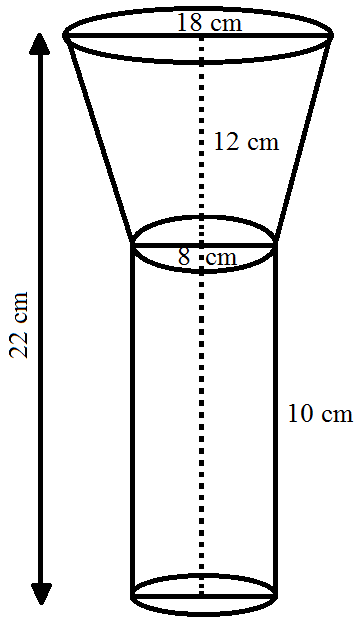
$\therefore$ upper radius $(r_1)$ $=\frac{18}{2}=9\text{cm}$
and lower radius $(r_2)$ $=\frac{8}{2}=4\text{cm}$
Radius of cylindrical portion $(r_2) = 4cm$
Height of cylindrical portion $(h_1) = 22 - 10 = 12cm$
and height of cylindrical portion $h_2= 10cm$
Now lateral height of frustum (l)
$=\sqrt{\text{h}_1^2+(\text{r}_1-\text{r}_2)^2}$
$=\sqrt{(12)^2+(9-4)^2}=\sqrt{(12)^2+(5)^2}$
$=\sqrt{144+25}=\sqrt{169}=13\text{cm}$
Now surface area of the tin used in the funnel
$=\pi(\text{r}_1+\text{r}_2)\text{l}+2\pi\text{r}_2\text{h}_1$
$\pi[9+4]\times13+2\pi\times4\times10\text{cm}^2$
$=\pi\times13\times13+2\times\pi\times40$
$=\pi[13\times13+2\times40]$
$=\pi[169+80]$
$=\pi\times249\text{cm}^2$
$=249\pi\ \text{cm}^2$ View full question & answer→Question 1363 Marks
The slant height of the frustum of a cone is $4\ cm$ and the perimeters of its circular ends are $18\ cm$ and $6\ cm$. Find the curved surface of the frustum.
AnswerPerimeter of the top of frustum = 18cm
$\therefore $ Radius $(r_1)$ $=\frac{\text{C}}{2\pi}=\frac{18\times7}{2\times22}$
$=\frac{63}{22}\text{cm}$ and perimeter of the bottom = 6cm
$\therefore$ Radius $(r_2)$ .
$ =\frac{\text{C}}{2\pi}=\frac{18\times7}{2\times22}=\frac{21}{22}\text{cm}$ and
slant height $(l) = 4\ cm$
curved surface area $=\pi (\text{r}_1+\text{r}_2) \text{l} $
$=\frac{22}{7}\Big(\frac{63}{22}+\frac{21}{22}\Big)\times4$
$= \frac{22}{7}\times\frac{84}{22}\times4=48\text{cm}^2$
View full question & answer→Question 1373 Marks
A boiler is in the form of a cylinder 2m long with hemispherical ends each of 2 metre diameter. Find the volume of the boiler.
AnswerDiameter of the cylinder = 2m
$\therefore$ Radius (r) $=\Big(\frac{2}{2}\Big)=1\text{m}$
Height (length) of cylindrical part (h) = 2m
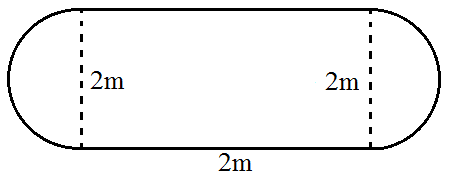
$\therefore$ Volume of the boiler $=2\times\frac{2}{3}\pi\text{r}^3+\pi\text{r}^2\text{h}$
$=\frac{4}{3}\pi\text{r}^3+\pi\text{r}^2\text{h}$
$=\pi\text{r}^2\Big(\frac{4}{3}\text{r}+\text{h}\Big)$
$=\frac{22}{7}(1)^2\Big(\frac{4}{3}\times1+2\Big)=\frac{22}{7}\Big(\frac{4}{3}+2\Big)\text{m}^3$
$=\frac{22}{7}\times\frac{4+6}{3}=\frac{22}{7}\times\frac{10}{3}\text{m}^3$
$=\frac{220}{21}\text{m}^3$ View full question & answer→Question 1383 Marks
A metallic hemisphere is melted and recast in the shape of a cone with the same base radius R as that of the hemisphere. If H is the height of the cone, then write the values of HR.
AnswerGiven,
Radius of the hemisphere = Radius of the cone.
Now,
Volume of the hemisphere $\frac{2}{3}\pi\text{R}^3$
and
Volume of the cone $\frac{1}{3}\pi\text{R}^2\text{H}$
Volume of the hemisphere = volume of the cone
$\frac{2}{3}\pi\text{R}^3=\frac{1}{3}\pi\text{R}^2\text{H}$
$2\text{R}=\text{H}$
$\frac{\text{H}}{\text{R}}=2$
View full question & answer→Question 1393 Marks
A cylinder, a cone and a hemisphere are of equal base and have the same height. What is the ratio of their volumes?
AnswerLet r be the radius of all three of all threee solid and h be the height
For hemisphere
Radius = r
Height = h = r
For cylinder
Radius = r
Height = h = r
For cone Radius = r
Height = h = r
Then, the ratio of their volume
Volume of cylinder : Volume of cone : Volume of hemisphere
$\pi\text{r}^2\text{h}:\frac{1}{3}\pi\text{r}^2\text{h}:\frac{2}{3}\pi\text{r}^3$
$\Rightarrow\pi\text{r}^3:\frac{1}{3}\pi\text{r}^3:\frac{2}{3}\pi\text{r}^3$
$\Rightarrow1:\frac{1}{3}:\frac{2}{3}$
$\Rightarrow3:1:2$
Hence, the required ratio are 3 : 1 : 2
View full question & answer→Question 1403 Marks
A spherical shell of lead, whose external diameter is $18\ cm$, is melted and recast into a right circular cylinder, whose height is $8\ cm$ and diameter $12\ cm$. Determine the internal diameter of the shell.
AnswerDiameter of the cylinder $= 12\ cm$
$\therefore$ Radius $(r_1)$ $=\Big(\frac{12}{2}\Big)=6\text{cm}$
Height $(h) = 8\ cm$
$\therefore$ Volume $=\pi\text{r}_1^2\text{h}=\pi(6)^2\times8\text{cm}^3$
$=\pi\times36\times8=288\pi\ \text{cm}^3$
Now volume of metal used in spherical shell $=288\pi\ \text{cm}$
External diameter $= 18\ cm$
$\therefore$ External radius (R) $=\Big(\frac{18}{2}\Big)=9\text{cm}$
Let r be the internal radius, then
Volume of the metal $=\Big(\frac{4}{3}\Big)\pi(\text{R}^3-\text{r}^3)$
$\Rightarrow\frac{4}{3}\pi\ (\text{R}^3-\text{r}^3)=288\pi$
$(\text{R}^3-\text{r}^3)=288\pi\times\frac{3}{4\pi}=72\times3=216$
$\Rightarrow(9)^3-\text{r}^3=276\Rightarrow729-\text{r}^3=216$
$\text{r}^3=729-216=513$
$\therefore\text{r}=\sqrt[3]{513}=\sqrt[3]{27\times19}=\sqrt[3]{3^3\times19}$
$=3\sqrt[3]{19}=3(19)^\frac{1}{3}\text{cm}$
$\therefore$ Internal diameter $=2\text{r}=2\times3(19)^\frac{1}{3}\text{cm}$
$=6(19)^\frac{1}{3}\text{cm}$
View full question & answer→Question 1413 Marks
The diameter of a copper sphere is 18cm. The sphere is melted and is drawn into a long wire of uniform circular cross-section. If the length of the wire is 108m, find its diameter.
AnswerDiameter of copper sphere = 18cm
Radius (R) $=\Big(\frac{18}{2}\Big)=9\text{cm}$
Volume $=\Big(\frac{4}{3}\Big)\pi(\text{R}^3)$
$=\frac{4}{3}\pi(9)^3\text{cm}^3=\frac{4}{3}\pi\times9\times9\times9\text{cm}^3$
$=972\pi\ \text{cm}^3$
Now volume of cross section wire
$=972\pi\ \text{cm}^3$
length of wire (h) = 108m = 10800cm
Let r be the radius of circular wire, then
$\pi\text{r}^2\text{h}=972\pi$
$\pi\text{r}^2(108)=972\pi\Rightarrow\text{r}^2=\frac{972\pi}{10800\pi{}}=\frac{9}{100}$
$\therefore$ Radius $=\sqrt{\frac{9}{100}}=\frac{3}{10}\text{cm}=0.3\text{cm}$
$\therefore$ Diameter $=2\text{r}=0.3\times2=0.6\text{cm}$
View full question & answer→Question 1423 Marks
Height of a solid cylinder is 10cm and diameter 8cm. Two equal conical hole have been made from its both ends. If the diameter oaf the holes is 6cm and height 4cm, find
- volume of the cylinder
- volume of one conical hole,
- volume of the remaining solid.
AnswerHeight = 10cm.
Radius
$=\frac{8}{2}$
$=4\text{cm}$
- Volume of cylinder
$=\pi\text{r}^2\text{h}$
$=\pi\times(4)^2\times10$
$=160\pi\ \text{cm}^3$
- Volume of conical hole diameter of cone = 6cm.
radius $=\frac{6}{2}$
$=3\text{cm}$
height = 4cm
Volume $=\frac{1}{3}\pi(7)^2\text{h}$
$=\frac{1}{3}\pi.9.4$
$=12\pi\ \text{cm}^3$
- Volume of remaining solid
$=160\pi-2\times(12\pi)$
$=160\pi-24\pi$
$=136\pi\ \text{cm}^3$ View full question & answer→Question 1433 Marks
If the slant height of the frustum of a cone is 6cm and the perimeters of its circular bases are 24cm and 12cm respectively. What is the curved surface area of the frustum?
AnswerGiven that:
The perimeter of upper base $2\pi\text{r}_1=6$
$\Rightarrow\text{r}_1=\frac{6}{\pi}\text{cm}$
The perimeter of lower base $2\pi\text{r}_2=24\text{cm}$
$\Rightarrow\text{r}_2=\frac{12}{\pi}\text{cm}$
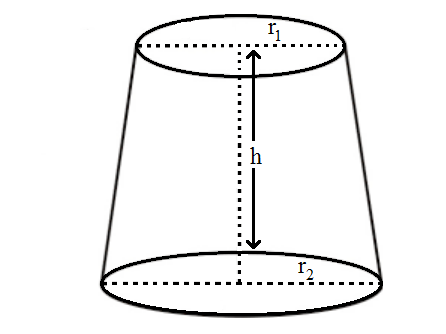
the slant height of the frustum cone l = 6cm
The surface area of frustum
$\pi(\text{r}_1+\text{r}_2)\text{l}=\pi\Big(\frac{6}{\pi}+\frac{12}{\pi}\Big)$
$=\pi\times\frac{18}{\pi}\times6$
$108\text{cm}^2$
Hence the curved surface area of frustum is $108\text{cm}^2$ View full question & answer→Question 1443 Marks
A solid cuboid of iron with dimensions 53cm × 40cm × 15cm is melted and recast into a cylindrical pipe. The outer and inner diameters of pipe are 8cm and 7cm respectively. Find the length of pipe.
AnswerVolume of solid cuboid of iron = Volume of cylindrical pipe
$\Rightarrow\text{lbh}=\pi\text{h}(\text{R}^2-\text{r}^2)$
$\Rightarrow53\times40\times15=\frac{22}{7}\times\text{h}\Big[\Big(\frac{8}{2}\Big)^2-\Big(\frac{7}{2}\Big)^2\Big]$
$\Rightarrow53\times40\times15=\frac{22}{7}\times\text{h}\Big[4^2-(3.5)^2\Big]$
$\Rightarrow53\times40\times15=\frac{22}{7}\times\text{h}\times3.75$
$\Rightarrow\text{h}=2698.18\text{cm}$
View full question & answer→