MCQ
A constant torque acting on a uniform circular wheel changes its angular momentum from $A_0$ to $4 A_0$ in $4$ seconds. The magnitude of this torque is ...........
  • $\frac{3 A_0}{4}$
  • B
    $A_0$
  • C
    $4 A_0$
  • D
    $12 A_0$

Answer

Correct option: A.
$\frac{3 A_0}{4}$
a
(a)

$\tau=\frac{\Delta L}{\Delta t}$

$\tau=\frac{4 A_0-A_0}{4}=\frac{3 A_0}{4}$

Need a full question paper?

Generate a complete, print-ready paper with questions like this in minutes — across 16+ boards, with answer keys.
Start Generating Free

Similar questions

Pressure exerted by a gas is:
Two particles are projected simultaneously in the same vertical plane, from the same point on ground, but with same speeds but at different angles $( < 90^o )$ to the horizontal. The path followed by one, as seen by the other, is
A car is standing $200\, m$ behind a bus, which is also at rest. The two start moving at the same instant but with different forward accelerations. The bus has acceleration $2\,m/s^2$ and the car has acceleration $4\, m/s^2$ . The car will catch up with the bus after a time of
A composition string is made up by joining two strings of different masses per unit length $\rightarrow \mu$ and $4\mu$ . The composite string is under the same tension. A transverse wave pulse $: Y = (6 mm) \,\,sin\,\,(5t + 40x),$ where $‘t’$ is in seconds and $‘x’$ in meters, is sent along the lighter string towards the joint, the percentage of power transmitted to the heavier string through the joint is approximately ..... $\%$
Which is the point at which all three states of matter exist are in equilibrium are called :
A monatornic gas at a pressure $P,$ having a volume $V$ expands isothermally to a volume $2\, V$ and then adiabatically to a volume $16\, V.$ The final pressure of the gas is $(\,Take \,\gamma = 5/3)$
Two discs of moment of inertia $I_1$ and $I_2$ and angular speeds ${\omega _1}\,{\rm{and }}{\omega _2}$ are rotating along collinear axes passing through their centre of mass and perpendicular to their plane. If the two are made to rotate together along the same axis the rotational $KE$ of system will be 
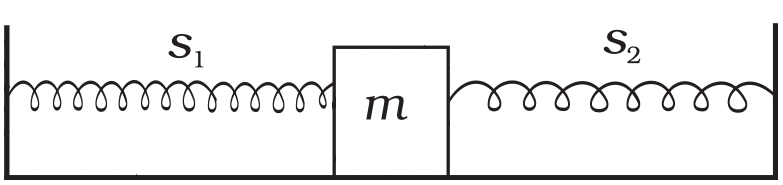
When a mass in is connected individually to two springs S1 and S2, the oscillation frequencies are Vand V2. If the same mass is attached to the two springs as shown in figure, the oscillation frequency would be:

  1. $\text{v}_1+\text{v}_2$

  2. $\sqrt{\text{v}_1^2+\text{v}_2^2}$

  3. $\Big(\frac{1}{\text{v}_1}+\frac{1}{\text{v}_2}\Big)^{-1}$

  4. $\sqrt{\text{v}_1^2-\text{v}_2^2}$

$Assertion :$ The base of Laplace correction was that exchange of heat between the region of compression and rarefaction in air is negligible.
$Reason :$ Air is bad conductor of heat and velocity of sound in air is quite large.

      Column $-I$

    Angle of projection

    Column $-II$
  $A.$ $\theta \, = \,{45^o}$   $1.$ $\frac{{{K_h}}}{{{K_i}}} = \frac{1}{4}$
  $B.$ $\theta \, = \,{60^o}$   $2.$ $\frac{{g{T^2}}}{R} = 8$
  $C.$ $\theta \, = \,{30^o}$   $3.$ $\frac{R}{H} = 4\sqrt 3 $
  $D.$ $\theta \, = \,{\tan ^{ - 1}}\,4$   $4.$ $\frac{R}{H} = 4$

$K_i :$ initial kinetic energy

$K_h :$ kinetic energy at the highest point