MCQ
Pressure exerted by a gas is:
  • A
    Directly proportional to the density of the gas.
  • B
    Directly proportional to the square of the density of the gas.
  • C
    Inversely proportional to the density of the gas.
  • D
    Independent of density of the gas.

Answer

  1. Directly proportional to the density of the gas.

Need a full question paper?

Generate a complete, print-ready paper with questions like this in minutes — across 16+ boards, with answer keys.
Start Generating Free

Similar questions

A horizontal platform is rotating with uniform angular velocity around the vertical axis passing through its centre. At some instant of time a viscous fluid of mass $m$ is dropped at the centre and is allowed to spread out and finally fall. The angular velocity during this period
The ratio of intensities between two coherent sound sources is $4: 1$. The difference of loudness in dB between maximum and minimum intensities when they interfere in the space is ..........
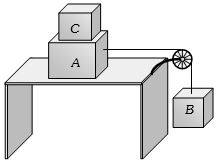
Two masses $A$ and $B$ of $10\, kg$ and $5 \,kg$ respectively are connected with a string passing over a frictionless pulley fixed at the corner of a table as shown. The coefficient of static friction of $A$ with table is $0.2$. The minimum mass of $C$ that may be placed on $A$ to prevent it from moving is ........ $kg$
The moment of inertia of a disc of radius $0.5\,\,m$  about its geometric axis is $2\,kg-m^2.$ If a string is tied to its circumference and a force of $10$  $newton$ is applied, the value of torque with respect to this axis will be ........ $N-m.$
The vector projection of a vector $3\hat i + 4\hat k$ on $Y-$axis is
The quantity that is not conserved in an inelastic collision is
Which of the following is a necessary and sufficient condition for S.H.M.
Consider the following

$I.$ Waves created on the surfaces of a water pond by a vibrating sources.

$II.$ Wave created by an oscillating electric field in air.

$III.$ Sound waves travelling under water.

Which of these can be polarized
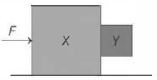
Consider the system shown below. A horizontal force $F$ is applied to a block $X$ of mass $8 \,kg$, such that the block $Y$ of mass $2 \,kg$ adjacent to it does not slip downwards under gravity. There is no friction between the horizontal plane and the base of the block $X$. The coefficient of friction between the surfaces of blocks $X$ and $Y$ is $0.5$. The minimum value of $F$ is ............ $N$ (take, acceleration due to gravity to be $10 \,ms ^{-2}$ )
Which of the diagrams shown in figure represents variation of total mechanical energy of a pendulum oscillating in water as function of time?