MCQ
A constraint in an LP model becomes redundant because:
  • A
    Two iso - profit line may be parallel to each other
  • B
    The solution is unbounded
  • C
    This constraint is not satisfied by the solution values
  • D
    None of the above

Answer

  1. None of the above

Solution:

A constraint in an LP model becomes redundant when the feasible region doesnt change by the removing the constraint.

For example, $\text{x}+2\text{y}\leq20$ and $2\text{x}+4\text{y}\leq40$ are the constraints.

$2\text{x}+4\text{y}\leq40$

$\Rightarrow2\times(\text{x}+2\text{y})\leq2\times20$

$\Rightarrow\text{x}+2\text{y}\leq20$

 which is same as the first constraint.

Therefore, $2\text{x}+4\text{y}\leq40$ can be removed.

By removing this constraint feasible region doesnt change.

Need a full question paper?

Generate a complete, print-ready paper with questions like this in minutes — across 16+ boards, with answer keys.
Start Generating Free

Similar questions

The point(s), at which the function $f$ given by $f(x)=\left\{\begin{array}{l}\frac{x}{|x|}, x<0 \\ -1, x \geq 0\end{array}\right.$ is continuous, is/are
$\int_0^{\pi / 4} \tan ^2 x d x$ is equal to :
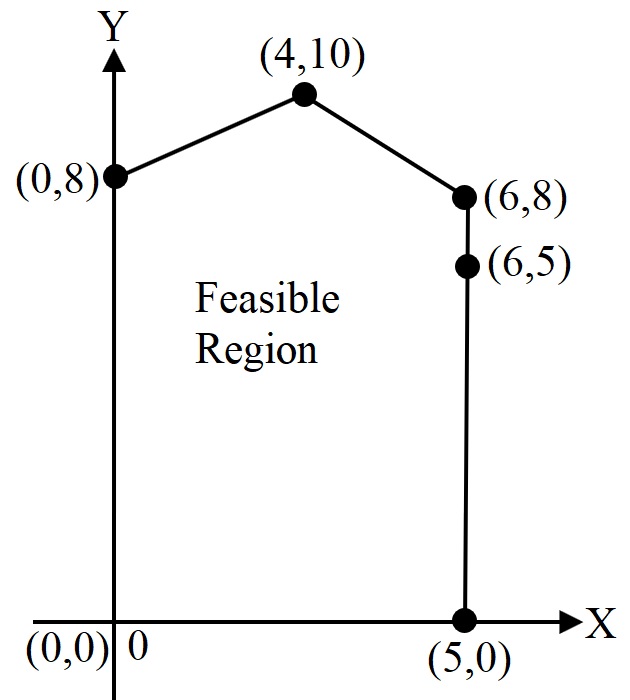
The feasible region for a LPP is shown shaded in the figure. Let Z = 3x - 4y be the objective function. Minimum of Z occurs at.

The solution of the differential equation $\frac{{dy}}{{dx}} = \left( {x - {y}} \right)^2$ when $y(1) = 1$, is
The existance of the unique solution of the system of equations$2x + y + z = \beta $ , $10x - y + \alpha z = 10$ and $4x+ 3y-z =6$ depends on
If the value of the integral $\int_{-1}^1 \frac{\cos \alpha x}{1+3^x} d x$ is $\frac{2}{\pi}$. Then, a value of $\alpha$ is
Minimise $\text{Z}=\sum\limits^{\text{n}}_{\text{j}=1}\sum\limits^{\text{m}}_{\text{i}=1}\text{c}_{\text{ij}}\cdot\text{x}_{\text{ij}}$ Subject to $\sum\limits^{\text{m}}_{\text{i}=1}\text{x}_{\text{ji}}=\text{b}_{\text{j}},\text{j}=1,2,....\text{n}$ $\sum\limits^{\text{n}}_{\text{j}=1}\text{x}_{\text{ji}}=\text{b}_{\text{j}},\text{j}=1,2,.....,\text{m}$  is a LPP with number of constraints.
  1. $\text{m}-\text{n}$
  2. $\text{m}\text{n}$
  3. $\text{m}+\text{n}$
  4. $\frac{\text{m}}{\text{n}}$
If $A = \left[ {\begin{array}{*{20}{c}}{\cos \alpha }&{ - \sin \alpha }\\{\sin \alpha }&{\cos \alpha }\end{array}} \right]$and $B = \left[ {\begin{array}{*{20}{c}}{\cos \beta }&{ - \sin \beta }\\{\sin \beta }&{\cos \beta }\end{array}} \right]$, then the correct relation is
The value of $\frac{d}{{d(\ln x)}}({e^x}{\ln ^2}x)$ at $x=e$, is
The set of values of $'a'$ for which the inequality ${x^2} - (a + 2)x - (a + 3) < 0$ is satisfied by atleast one positive real $x$ , is