MCQ
A container with rigid walls is covered with perfectly insulating material. The container is divided into two parts by a partition. One part contains a gas while the other is fully evacuated (vacuum). The partition is suddenly removed. The gas rushes to fill the entire volume and comes to equilibrium after a little time. If the gas is not ideal, then
  • the initial internal energy of the gas equals its final internal energy
  • B
    the initial temperature of the gas equals its final temperature
  • C
    the initial pressure of the gas equals its final pressure
  • D
    the initial entropy of the gas equals its final entropy
Answer

Correct option: A.
the initial internal energy of the gas equals its final internal energy
a
(a)

Expansion is in vacuum, so work done by expanding gas is $\Delta W=0$.

Container is insulated, so heat exchanged with surroundings is $\Delta Q=0$.

Now, from first law of thermodynamics, we have

$\Rightarrow \Delta Q=\Delta U+\Delta W$

$\Rightarrow \Delta U=0$

$\Rightarrow U_i=U_f$

Hence, initial and final internal energies of gas are equal.

As, the gas is not ideal expansion results in reduction of pressure, so intermolecular potential energy increases. This results in reduction of kinetic energy, so temperature reduces.

Need a full question paper?

Generate a complete, print-ready paper with questions like this in minutes — across 16+ boards, with answer keys.

Start Generating Free

Similar questions

Two waves having equations

${x_1} = a\sin (\omega \,t + {\phi _1})$, ${x_2} = a\sin \,(\omega \,t + {\phi _2})$

If in the resultant wave the frequency and amplitude remain equal to those of superimposing waves. Then phase difference between them is

A simple pendulum is executing simple harmonic motion with a time period $T$. If the length of the pendulum is increased by $21\%$, the percentage increase in the time period of the pendulum of increased length is ..... $\%$
$Assertion :$ The velocity of flow of a liquid is smaller when pressure is larger and vice-versa.
$Reason :$ According to Bernoulli’s theorem, for the stream line flow of an ideal liquid, the total energy per unit mass remains constant.
First law of thermodynamics:
A wave represented by the equation $y = A cos (kx - \omega t)$ is superimposed with another wave to form a statioary wave such that the point $x =0$ is a node. The equation of the other wave is:
A ball suspended by a thread swings in a vertical plane so that its magnitude of acceleration in the extreme position and lowest position are equal. The angle $(\theta)$ of thread deflection in the extreme position will be :
The potential energy of a simple harmonic oscillator when the particle is half way to its end point is (where $E$ is the total energy)
An engine pump is used to pump a liquid of density $\rho $ continuously through a pipe of cross-sectional area $A$. If the speed of flow of the liquid in the pipe is v, then the rate at which kinetic energy is being imparted to the liquid is
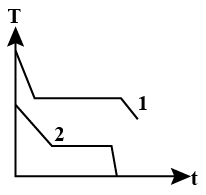
Two different liquids of same mass are kept in two identical vessels, which are placed in a freezer that extracts heat from them at the same rate causing each liquid to transform into a solid. The schematic figure below shows the temperature $T$ versus time $t$ plot for the two materials. We denote the specific heat in the liquid states to be $C_{L 1}$ and $C_{L 2}$ for materials 1 and 2, respectively and latent heats of fusion $U_1$ and $U_2$, respectively. Choose the correct option.