MCQ
A simple pendulum is executing simple harmonic motion with a time period $T$. If the length of the pendulum is increased by $21\%$, the percentage increase in the time period of the pendulum of increased length is ..... $\%$
  • $10$
  • B
    $21$
  • C
    $30$
  • D
    $50$

Answer

Correct option: A.
$10$
a
(a) If initial length ${l_1} = 100$ then ${l_2} = 121$

By using $T = 2\pi \sqrt {\frac{l}{g}} $

$\Rightarrow \frac{{{T_1}}}{{{T_2}}} = \sqrt {\frac{{{l_1}}}{{{l_2}}}} $

Hence, $\frac{{{T_1}}}{{{T_2}}} = \sqrt {\frac{{100}}{{121}}} $

$\Rightarrow {T_2} = 1.1\,{T_1}$

$\%$ increase = $\frac{{{T_2} - {T_1}}}{{{T_1}}} \times 100 = 10\,\% $

Need a full question paper?

Generate a complete, print-ready paper with questions like this in minutes — across 16+ boards, with answer keys.

Start Generating Free

Similar questions

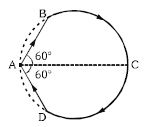
Consider a circle of radius $42\  cm$. An insect crawls with uniform speed of $1.3\  cm/s$ along the chord $AB$ then along the circular arc $BCD$ to reach point $D$ and then following cord $DA$ to reach finally $A$. Time spend by the insect to crawl from $A$ to $A$ is closest to    ......... $\sec$
A wheel is rotating at $900\ r.p.m.$  about its axis. When the power is cut-off, it comes to rest in $1 \,minute.$ The angular retardation in $radian$/$s^2$ is
Two discs $A$ and $\mathrm{B}$ are mounted coaxially on a vertical axle. The discs have moments of inertia $I$ and $2 I$ respectively about the common axis. Disc $\mathrm{A}$ is imparted an initial angular velocity $2 \omega$ using the entire potential energy of a spring compressed by a distance $x_1$. Disc $B$ is imparted an angular velocity $\omega$ by a spring having the same spring constant and compressed by a distance $x_2$. Both the discs rotate in the clockwise direction.

$1.$  The ratio of $x_1 / x_2$ is

$(A)$ $2$  $(B)$ $\frac{1}{2}$  $(C)$ $\sqrt{2}$  $(D)$ $\frac{1}{\sqrt{2}}$

$2.$  When disc $\mathrm{B}$ is brought in contact with disc $\mathrm{A}$, they acquire a common angular velocity in time $\mathrm{t}$. The average frictional torque on one disc by the other during this period is

$(A)$ $\frac{2 \mathrm{I} \omega}{3 \mathrm{t}}$  $(B)$ $\frac{9 \mathrm{I} \omega}{2 \mathrm{t}}$  $(C)$ $\frac{9 \mathrm{I} \omega}{4 \mathrm{t}}$  $(D)$ $\frac{3 \mathrm{I} \omega}{2 \mathrm{t}}$

$3.$  The loss of kinetic energy during the above process is

$(A)$ $\frac{\mathrm{I} \omega^2}{2}$  $(B)$ $\frac{\mathrm{I} \omega^2}{3}$  $(C)$ $\frac{\mathrm{I} \omega^2}{4}$  $(D)$ $\frac{\mathrm{I} \omega^2}{6}$

Give the answer question $1,2$ and $3.$
The variation of density of a cylindrical thick and long rod, is $\rho  = {\rho _0}\frac{{{x^2}}}{{{L^2}}}$ , then position of its centre of mass from $x = 0$ end is
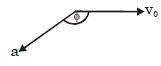
The figure shows the velocity and the acceleration of a point like body at the initial moment of its motion. The direction and the absolute value of the acceleration remain constant. Find the time when the speed becomes minimum.........$s$ (Given : $a = 4\, m/s^2, v_0 = 40\, m/s, \phi =143^o$)
Two thermometers $A$ and $B$ are exposed in sun light. The valve of $A$ is painted black, But that of $B$ is not painted. The correct statement regarding this case is
If flux of the electric field through a closed surface is zero:
  1. The electric field must be zero everywhere on the surface.
  2. The electric field may be zero everywhere in the surface.
  3. The charge inside the surface must be zero.
  4. The charge in the vicinity of the surface must be zero.
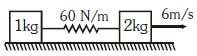
Two blocks of mass $1\  kg$ and $2\  kg$ are connected with each other with a spring of spring constant $60\  N/m$. If the velocity given to the block of mass $ 2\  kg$ at the natural length is $6\  m/s$. Find the maximum veloicty of $1\  kg$ block in subsequent motion (in $m/s$).
Two boys are standing at the ends $A$ and $B$ of a ground where $AB = a$. The boy at $B$ starts running in a direction perpendicular to $AB$ with velocity ${v_1}.$ The boy at $A$ starts running simultaneously with velocity $v$ and catches the other boy in a time $t$, where $t$ is
Two paper screens $A$ and $B$ are separated by a distance of $100\,m$. A bullet pierces $A$ and then $B$. The hole in $B$ is $10\,cm$ below the hole in $A$. If the bullet is travelling horizontally at the time of hitting $A$, then the velocity of the bullet at $A$ is $.......\,m / s$