Question
A converging mirror $M_1$, a point source $S$ and a diverging mirror $M_2$ are arranged as shown in figure. The source is placed at a distance of $30$ cm from $\mathrm{M}_1$. The focal length of each of the mirrors is $20$ cm . Consider only the images formed by a maximum of two reflections. It is found that one image is formed on the source itself.
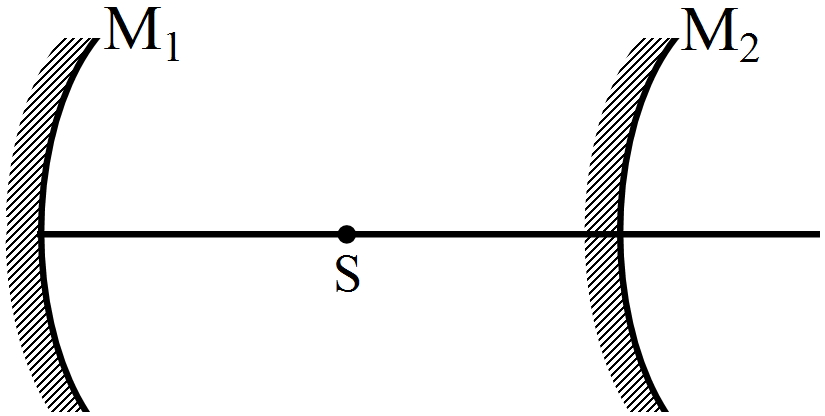
  1. Find the distance between the two mirrors.
  2. Find the location of the image formed by the single reflection from $M_2$.
Answer


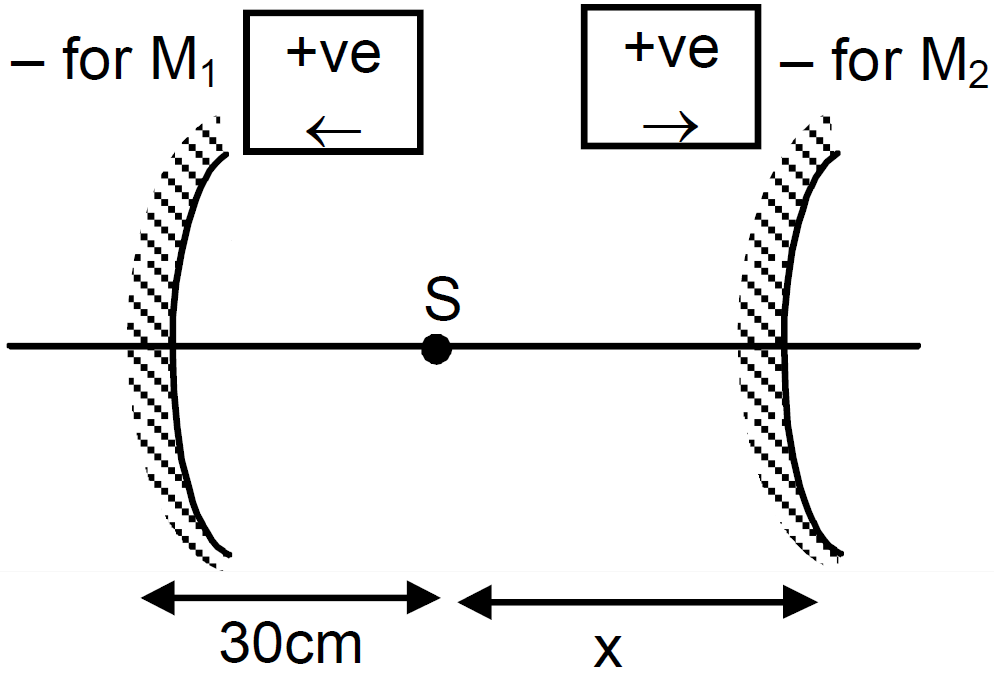
  1. As shown in figure, for $1^{st}$ reflection in $M_1, u = -30cm, f = -20cm$
$\Rightarrow\frac{1}{\text{v}}+\frac{1}{-30}=-\frac{1}{20}\Rightarrow\text{v}=-60\text{cm}.$
So, for $2^{nd}$ reflection in $M_2$
$u = 60 - (30 + x) = 30 - x$
$v = -x; f = 20cm$
$\Rightarrow\frac{1}{30-\text{x}}-\frac{1}{\text{x}}=\frac{1}{20}$
$\Rightarrow \frac{\text{x}-30+\text{x}}{\text{x}(30-\text{x})}=\frac{1}{20}$
$\Rightarrow40\text{x}-600=30\text{x}-\text{x}^2$
$\Rightarrow\text{x}^2+10\text{x}-600=0$
$\Rightarrow\text{x}=\frac{10\pm50}{2}=\frac{40}{2}=20\text{cm}$ or $-30\text{cm}$
$\therefore$ Total distance between the two lines is 20 + 30 = 50cm.

Need a full question paper?

Generate a complete, print-ready paper with questions like this in minutes — across 16+ boards, with answer keys.

Start Generating Free

Similar questions

A metal bar of length L and area of cross-section A, is rigidly clamped between two walls. The Young's modulus of its material is Y and the coefficient of linear expansion is $\alpha.$ The bar is heated so that its temperature is increased from 0 to $\theta^\circ\text{C}.$ Find the force exerted at the ends of the bar.
A lady uses +1.5D glasses to have normal vision from 25cm onwards. She uses a 20D lens as a simple microscope to see an object. Find the maximum magnifying power if she uses then microscope
  1. Together with her glass
  2. Without the glass. Do the answers suggest that an object can be more clearly seen through a microscope without using the correcting glasses?
Suppose all the electrons of 100g water are lumped together to form a negatively charged particle and all the nuclei are lumped together to form a positively charged particle. If these two particles are placed 10.0cm away from each other, find the force of attraction between them. Compare it with your weight.
Explain in detail the Kepler's three laws related to planetary motion.
A rod, when suspended in a magnetic field, stays in the east-west direction. Can we be sure that the field is in the east-west direction? Can it be in the north-south direction?
  1. Find the radius of the circular orbit of a satellite moving with an angular speed equal to the angular speed of earth's rotation.
  2. If the satellite is directly above the north pole at some instant, find the time it takes to come over the equatorial plane. Mass of the earth = $6 \times 10^{24}kg$.
If an object of mass $M$ moving with velocity $\mu$ has a direct elastic collision with an other stable object of mass $m$ then prove that the energy loss of the object of mass $M$ and the result of its intial energy will be $\frac{4 m M }{( M +m)^2}$
A pendulum clock gives correct time. What is the error in time per day if the length increases by 0.05%?
There are four forces acting at a point P produced by strings as shown in which is at rest. Find the forces $F_1$ and $F_2$.
Explain the total energy in simple harmonic motion and show the graphical representation of energy in SHM.