Question
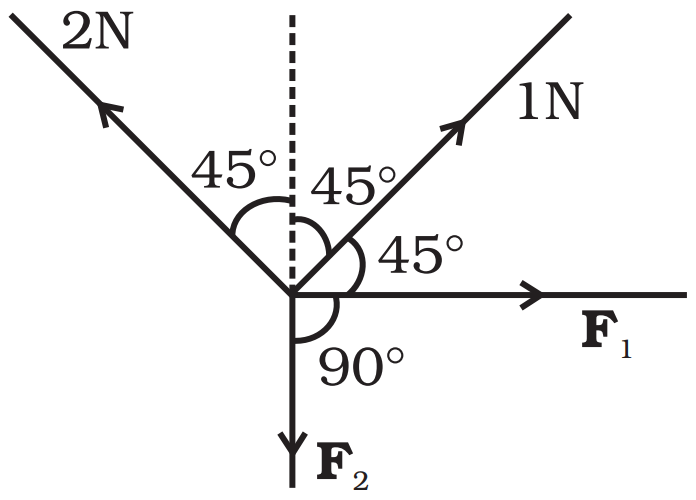
There are four forces acting at a point P produced by strings as shown in which is at rest. Find the forces $F_1$ and $F_2$.

Answer

As the particle is rest or a = 0. So resultant force due to all forces will be zero. $\therefore$ Net components along X and Y-axis will be zero. Resolving all forces along X-axis $\text{F}_\text{x}=0$ $\text{F}_1+1\cos45^\circ-2\cos45^\circ=0$ or $\text{F}_1-1\cos45^\circ=0$ $\text{F}_1=\cos45^\circ=\frac{1}{\sqrt{2}}\frac{\sqrt{2}}{\sqrt{2}}=\frac{\sqrt{2}}{2}=\frac{1.414}{2}=0.707\text{N}$ Resolving all forces along Y-axis $\text{F}_\text{y}=0$ $-\text{F}_2+1\cos45^\circ+2\cos45%\circ=0$ $-\text{F}_2=-3\cos45^\circ$ $\text{F}_2=3.\frac{1}{\sqrt{2}}=\frac{3\sqrt{2}}{2}=\frac{3\times1.414}{2}=3\times0.707=2.121\text{N.}$

Need a full question paper?

Generate a complete, print-ready paper with questions like this in minutes — across 16+ boards, with answer keys.
Start Generating Free

Similar questions

A man runs across the roof-top of a tall building and jumps horizontally with the hope of landing on the roof of the next building which is of a lower height than the first. If his speed is $9m/s$, the (horizontal) distance between the two buildings is 10m and the height difference is $9m$, will he be able to land on the next building? (take $g = 10m/s^2$).
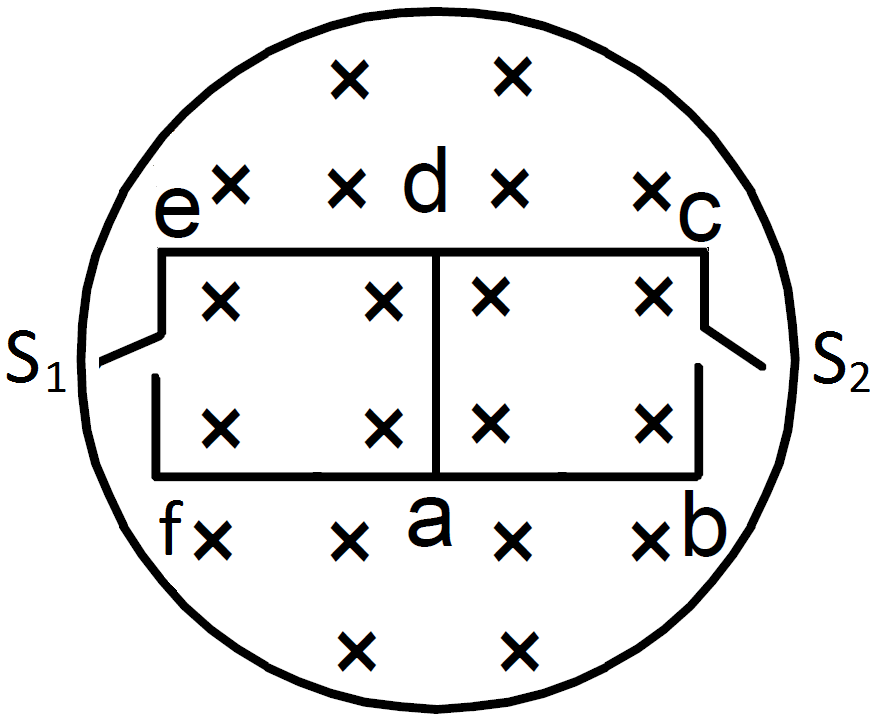
The magnetic field in the cylindrical region shown in figure increases at a constant rate of $20.0mT/s$. Each side of the square loop abcd and defa has a length of $1.00cm$ and a resistance of $4.00\Omega.$ Find the current (magnitude and sense) in the wire ad if:
  1. The switch $S_1$ is closed but $S_2$ is open.
  2. $S_1$ is open but $S_2$ ia closed.
  3. Both $S_1$ and $S_2$ are open.
  4. Both $S_1$ and $S_2$ are closed.
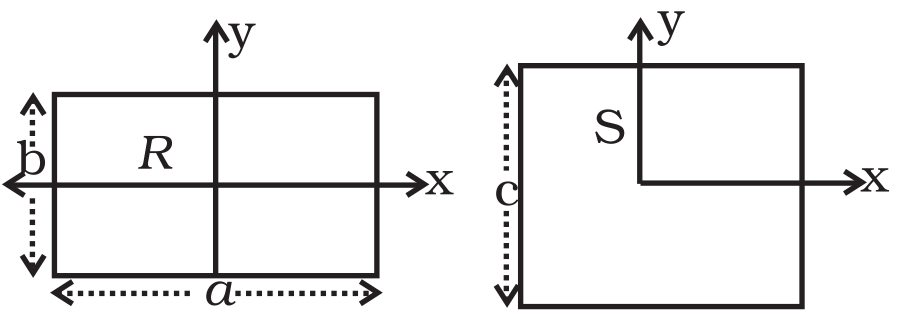
A uniform square plate S(side c) and a uniform rectangular plate R(sides b, a) have identical areas and masses:
Show that:
  1. $\frac{\text{I}_\text{xR}}{\text{I}_\text{xS}}<1$
  2. $\frac{\text{I}_\text{ys}}{\text{I}_\text{ys}}>1$
  3. $\frac{\text{I}_{2\text{R}}}{\text{I}_{2\text{s}}}>1$
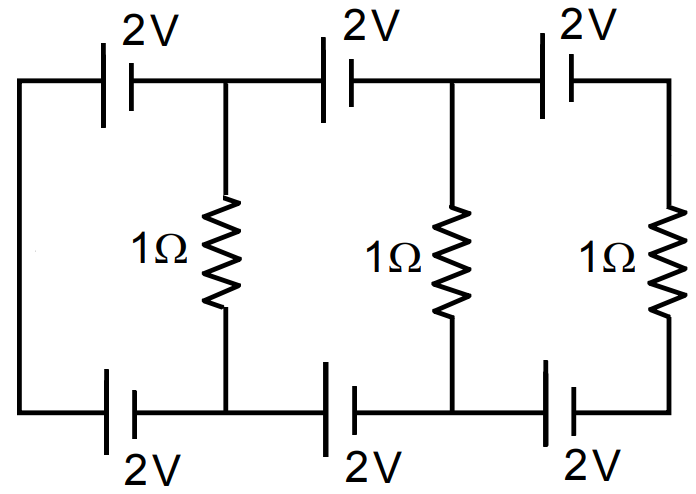
Find the circuit in the three resistors shown in the figure.
From a certain apparatus, the diffusion rate of hydrogen has an average value of $28.7cm^3 s^{-1}$. The diffusion of another gas under the same conditions is measured to have an average rate of $7.2cm^3 s^{-1}$. Identify the gas. [Hint: Use Graham’s law of diffusion $\frac{\text{R}_1}{\text{R}_2}=\Big(\frac{\text{M}_2}{\text{M}_1}\Big)^{\frac{1}{2}},$ where $R_1 , R_2$ are diffusion rates of gases 1 and 2, and $M_1$ and $M_2$ their respective molecular masses. The law is a simple consequence of kinetic theory]
What is meant by thermal radiation? What is the nature of thermal radiation? Explain.
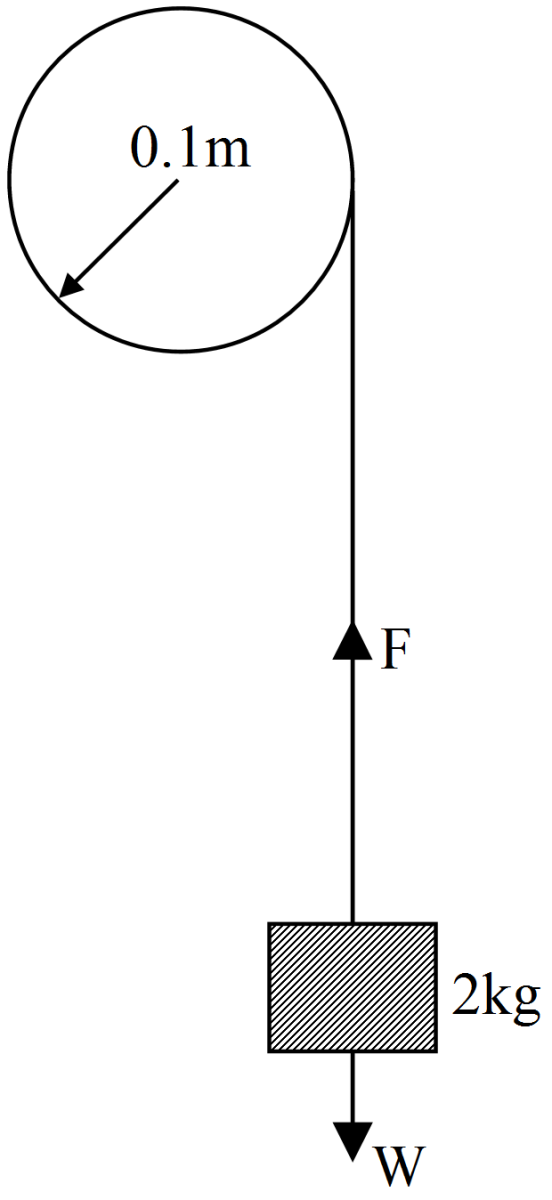
The moment of inertia of a solid flywheel about its axis is $0.1kg-m^2$. A tangential force of $2kg/ wt$ is applied round the circumference of the flywheel with the help of a string and mass arrangement as shown in Fig. If the radius of the wheel is $0.1m$, find the acceleration of the mass.
​​​​​​​
Two identical pith balls, each carrying a charge q, are suspended from a common point by two strings of equal length l. Find the mass of each ball if the angle between the strings is $2\theta$ in equilibrium.
Consider an excited hydrogen atom in state n moving with a velocity u(ν << c). It emits a photon in the direction of its motion and changes its state to a lower state m. Apply momentum and energy conservation principles to calculate the frequency ν of the emitted radiation. Compare this with the frequency $ν_0$ emitted if the atom were at rest.
What is meant by elastic potential energy? Derive an expression for the elastic potential energy of a stretched wire. Prove that its elastic energy density is equal to $\frac{1}{2}\text{stress}\times\text{strain}.$