Question
A converging mirror M1, a point source S and a diverging mirror M2 are arranged as shown in figure. The source is placed at a distance of 30cm from M1. The focal length of each of the mirrors is 20cm. Consider only the images formed by a maximum of two reflections. It is found that one image is formed on the source itself.
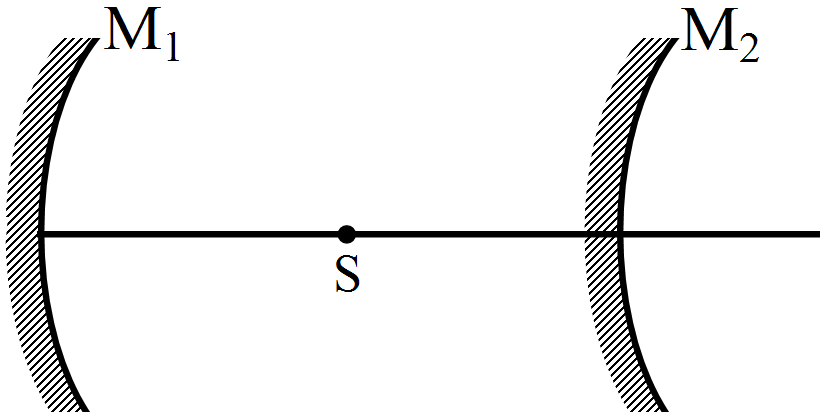
  1. Find the distance between the two mirrors.
  2. Find the location of the image formed by the single reflection from M2.
Answer


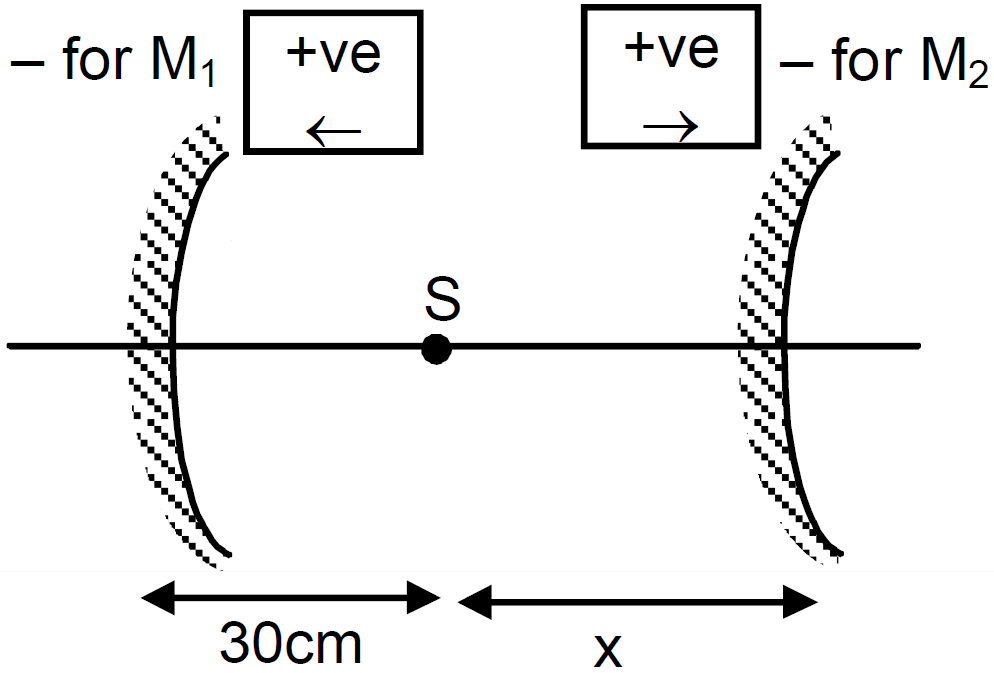
  1. As shown in figure, for 1st reflection in M1, u = -30cm, f = -20cm

$\Rightarrow\frac{1}{\text{v}}+\frac{1}{-30}=-\frac{1}{20}\Rightarrow\text{v}=-60\text{cm}.$

So, for 2nd reflection in M2

u = 60 - (30 + x) = 30 - x

v = -x; f = 20cm

$\Rightarrow\frac{1}{30-\text{x}}-\frac{1}{\text{x}}=\frac{1}{20}$

$\Rightarrow \frac{\text{x}-30+\text{x}}{\text{x}(30-\text{x})}=\frac{1}{20}$

$\Rightarrow40\text{x}-600=30\text{x}-\text{x}^2$

$\Rightarrow\text{x}^2+10\text{x}-600=0$

$\Rightarrow\text{x}=\frac{10\pm50}{2}=\frac{40}{2}=20\text{cm}$ or $-30\text{cm}$

$\therefore$ Total distance between the two lines is 20 + 30 = 50cm.

Need a full question paper?

Generate a complete, print-ready paper with questions like this in minutes — across 16+ boards, with answer keys.

Start Generating Free

Similar questions

Explain with the help of a diagram the formation of depletion region and barrier potential in a $p-n$ junction diode.
i. Draw a ray diagram showing the image formation by a compound microscope. Obtain the expression for total magnification when the image is formed at infinity.
ii. How does the resolving power of a compound microscope get affected, when
1. focal length of the objective is decreased.
2. the wavelength of light is increased ? Give reasons to justify your answer.
An ideal gas at pressure 2.5 × 10⁵Pa and temperature 300K occupies 100cc. It is adiabatically compressed to half its original volume. Calculate,
  1. The final pressure.
  2. The final temperature.
  3. The work done by the gas in the process. Take $\gamma=1.5.$
A heavy but uniform rope of length L is suspended from a ceiling.
  1. Write the velocity of a transverse wave travelling on the string as a function of the distance from the lower.
  2. If the rope is given a sudden sideways jerk at the bottom, how long will it take for the pulse to reach the ceiling?
  3. A particle is dropped from the ceiling at the instant the bottom end is given the jerk. Where will the particle meet the pulse ?
Figure shows a charge array known as an electric quadrupole. For a point on the axis of the quadrupole, obtain the dependence of potential on r for r/a >> 1, and contrast your results with thatdue to an electric dipole, and an electric monopole (i.e., a single charge).

(a) For circuits used for transporting electric power, a low power factor implies large power loss in transmission. Explain.
(b) Power factor can often be improved by the use of a capacitor of appropriate capacitance in the circuit. Explain.
A capacitor of capacitance C is connected to a battery of emf $\in$ at t = 0 through a resistance R. Find the maximum rate at which energy is stored in the capacitor. When does the rate have this maximum value?
The electric field associated with a light wave is given by $\text{E}=\text{E}_0\sin[(1.57\times10^7\text{m}^{-1})(\text{x}-{\text{ct}})].$ Find the stopping potential when this light is used in an experiment on photoelectric effect with the emitter having work function 1.9eV.
What is called a capacitor? Explain its principle. Find the formula for combination of capacitors in parallel and series.###Define capacitor. Establish the formula of resultant capacitance in its series and parallel combination. Also draw the necessary circuit diagram.###Define capacitor. How can we increase its capacity? Establish the formula for combining capacitors in parallel and series.
Find the circuit in the three resistors shown in the figure.