Question
A convex lens whose refractive index is $n_2$, immersed in a liquid whose refractive index is $n_1,\left(n_2>n_1\right)$. What will be the difference in the working style?

Answer

This lens will work like a concave lens.

Need a full question paper?

Generate a complete, print-ready paper with questions like this in minutes — across 16+ boards, with answer keys.
Start Generating Free

Similar questions

At Deoprayag (Garhwal, UP) river Alaknanda mixes with the river Bhagirathi and becomes river Ganga. Suppose Alaknanda has a width of 12m, Bhagirathi has a width of 8m and Ganga has a width of 16m. Assume that the depth of water is same in the three rivers. Let the average speed of water in Alaknanda be 20km/h and in Bhagirathi be 16km/h. Find the average speed of water in the river Ganga.
Draw a graph between potential difference (V) and current (I) according Ohm's law.
Answer the following questions:
Would the maximum possible magnetisation of a paramagnetic sample be of the same order of magnitude as the magnetisation of a ferromagnet?
A current $\text{i}_1=\text{i}_0\sin\omega\text{t}$ passes through a resistor of resistance $R.$ How much thermal energy is produced in one time period? A current $\text{i}_2=-\text{i}_0\sin\omega\text{t}$ passes through the resistor. How much thermal energy is produced in one time period? If $i_1,$ and $i_2$ both pass through the resistor simultaneously, how much thermal energy is produced? Is the principle of superposition obeyed in this case?
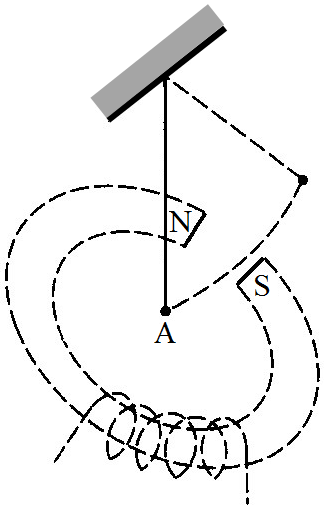
A metallic bob A oscillates through the space between the poles of an electromagnet. The oscillations are more quickly damped when the circuit is on, as compared to the case when the circuit is off. Explain.
Would you prefer a voltmeter or a potentiometer to measure the emf of a battery?
An electric bulb is hanging over a table at a height of 1m above it. The illuminance on the table directly below the bulb is 40 lux. The illuminance at a point on the table 1m away from the first point will be about:
  1. 10 lux
  2. 14 lux
  3. 20 lux
  4. 28 lux
Ultraviolet radiations of different frequencies and are incident on two photosensitive materials having work functions $\ce{W_1}$ and $\ce{W_2(W_1>W_2)}$ respectively. The kinetic energy of the emitt3ed electrons is same in both the cases. Which one of the two radiations will be of higher frequency?
What is the luminous flux of a source emitting radio waves?
An electron, an alpha particle and a proton have the same kinetic energy. Which one of these particles has the largest de-Broglie wavelength?