If the magnification of optical instrument is negative, then the image will always be formed :
Question types
Ray Optics and Optical Instruments question types
160 questions across 7 question groups — pick any mix to generate a Physics paper with step-by-step answer keys.
160
Questions
7
Question groups
5
Question types
01
M.C.Q (1 Marks)
39 Q→021 Marks Question
42 Q→032 Marks Questions
27 Q→043 Marks Question
13 Q→054 Marks Questions
8 Q→065 Marks Questions
19 Q→07Fill in the blanks.
12 Q→Sample Questions
Ray Optics and Optical Instruments questions
One sample from each question group in this chapter. Select any group above to see the full set with answer keys.
View full solution →
If the magnification of objective and eyepiece in a compound microscope is ' $m_o$ ' and ' $m_e$ ' respectively, then the total magnifying power $( m )$ of the microscope will be :
View full solution →What will be the focal length of a convex lens whose power is +2.5 D ?
If the refractive index of denser medium 1 relative to rare medium 2 is $n_{12}$ and the critical angle for the pair of these mediums is $i_{ c }$, then the relationship between $n _{12}$ and $i_c$ is :
View full solution →A virtual and enlarged image of the object forms:
The radius of curvature of a concave mirror is 28 cm . Its focal length will be :
A convex lens with a refractive index is placed in that medium whose refractive index is equal to the refractive index of the lens. What will be the focal length of the lens in this medium?
What is meant by reflection of light?
What is the focal length of a plane mirror?
The magnifying power of a simple microscope will be maximum for which colour of light and minimum for which colour of light?
Draw the graph between the angle of incidence $(i)$ and the angle of deviation $(\delta)$ for a triangular prism.
View full solution →Define the phenomenon of total internal reflection.
Write the definition of concave mirror and convex mirror.
When light travels from an optically denser medium to a rarer medium, why does the critical angle of incidence depend on the color of the light?
Define lens and write its formula.
(a) When a telescope is turned upside down and looked at the objective, it appears very small, why?
(b) Why does this not happen in a microscope?
(b) Why does this not happen in a microscope?
What is meant by pure and impure spectrum?
A mobile phone is placed on the principal axis of a concave mirror. Show the formation of the image with a suitable ray diagram. Explain why the magnification is not uniform. Does the distortion of the image depend on the position of the phone relative to the mirror?
Prove that $n_{12}=\frac{1}{\sin i_C}$ where $I_c$ is the critical angle.
View full solution →Write the definition of wavefront. Using Huygens' principle, draw the shape of a plane wave incident on a convex lens and the refracted wave body.
###
(a) When a wave propagates from a rarer medium to a denser medium, then which characteristic of that wave does not change and why?
(b) The refractive indices of two mediums are $\mu_1$ and $\mu_2$, what will be the ratio of velocities in the wave in them?
View full solution →###
(a) When a wave propagates from a rarer medium to a denser medium, then which characteristic of that wave does not change and why?
(b) The refractive indices of two mediums are $\mu_1$ and $\mu_2$, what will be the ratio of velocities in the wave in them?
An object of size 3.0 cm is placed 14 cm in front of a concave lens of focal length 21 cm. Describe the image produced by the lens. What happens if the object is moved further away from the lens?
A prism is made of glass of unknown refractive index. A parallel beam of light is incident on a face of the prism. The angle of minimum deviation is measured to be 40″ deg What is the refractive index of the material of the prism? The refracting angle of the prism is 60 deg If the prism is placed in water (refractive index 1.33), predict the new angle of minimum deviation of a parallel beam of light.
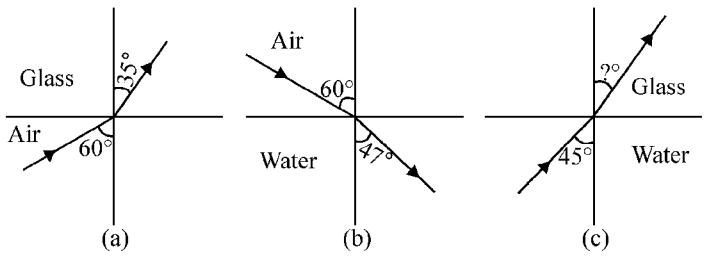
Figure (a) and (b) show refraction of a ray in air incident at 60 deg with the normal to a glass-air and water-air interface, respectively. Predict the angle of refraction in glass when the angle of incidence in water is 45 deg with the normal to a water-glass interface [Fig. (c)].
At what angle should a ray of light be incident on the face of a prism of refracting angle 60° so that it just suffers total internal reflection at the other face? The refractive index of the material of the prism is 1.524.
A 4.5 cm needle is placed 12 cm away from a convex mirror of focal length 15 cm. Give the location of the image and the magnification. Describe what happens as the needle is moved farther from the mirror.
Define total internal reflection. Establish the relation between $u, v$ and $f$ for a spherical mirror. Draw the necessary ray diagram. ### Define lateral displacement. Derive the lens maker formula.
$
\frac{1}{f}=\left(n_{21}-1\right)\left(\frac{1}{R_1}-\frac{1}{R_2}\right)
$
Draw the necessary ray diagram. (Where the signs have their usual meanings.)
View full solution →$
\frac{1}{f}=\left(n_{21}-1\right)\left(\frac{1}{R_1}-\frac{1}{R_2}\right)
$
Draw the necessary ray diagram. (Where the signs have their usual meanings.)
$(a)$ What is meant by compound microscope? Draw a ray diagram of image formation by a compound microscope. Briefly describe its working and derive the formula for its total magnification.
$(b)$ How does the resolving power of a microscope change when :
$(i)$ The diameter of the objective lens decreases,
$(ii)$ The wavelength of incident light increases? Justify your answer in each case.
View full solution →$(b)$ How does the resolving power of a microscope change when :
$(i)$ The diameter of the objective lens decreases,
$(ii)$ The wavelength of incident light increases? Justify your answer in each case.
Draw a labelled diagram of a refracting telescope. Obtain an expression for its magnifying power. Write two main disadvantages of refracting telescope as compared to reflecting telescope. What is meant by telescope? Draw the ray diagram of image formation by a refracting telescope. Briefly describe its working and derive the formula for its magnifying power.
What is meant by power of lens? Explain this.
Define the following :
(a) Total internal reflection
(b) Diffraction of light
(c) Refraction of light.
(a) Total internal reflection
(b) Diffraction of light
(c) Refraction of light.
The radius of curvature of a concave mirror is 24 cm. The value of its focal length will be __________ cm .
If the critical angle of the medium is $60^{\circ}$ then the refractive index of the medium will be ___________ .
View full solution →When light entering from air to glass, for __________ colour of light critical angle will be minimum.
If the angle of incidence in an equilateral prism is $45^{\circ}$, then minimum deviation will be __________.
View full solution →Spherical aberrations in a lens is __________ if the total deviation over the both surfaces are uniformly distributed.
Generate a Ray Optics and Optical Instruments paper free
Pick question groups from the list above, set marks and difficulty, and export a branded PDF with step-by-step answer keys. First 3 chapters free — no signup.